About This Image
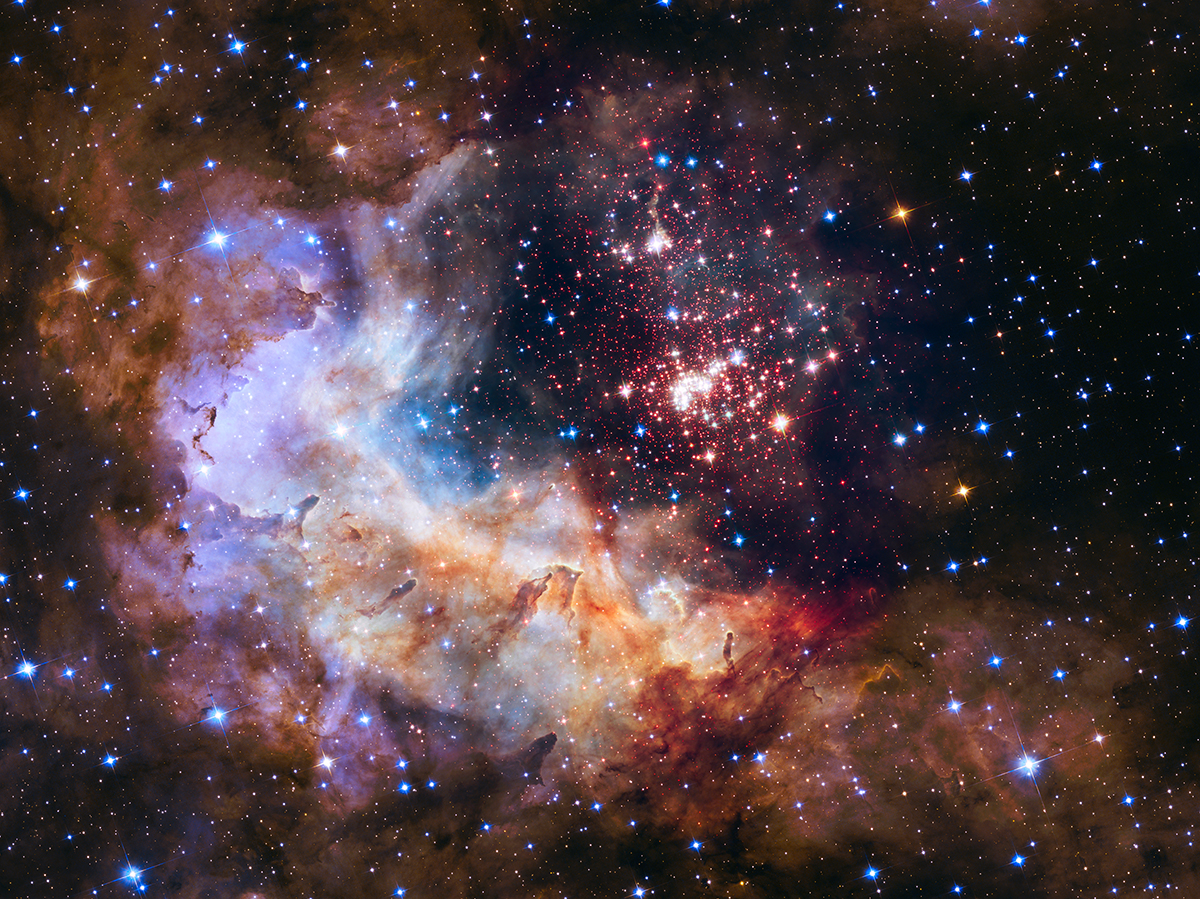
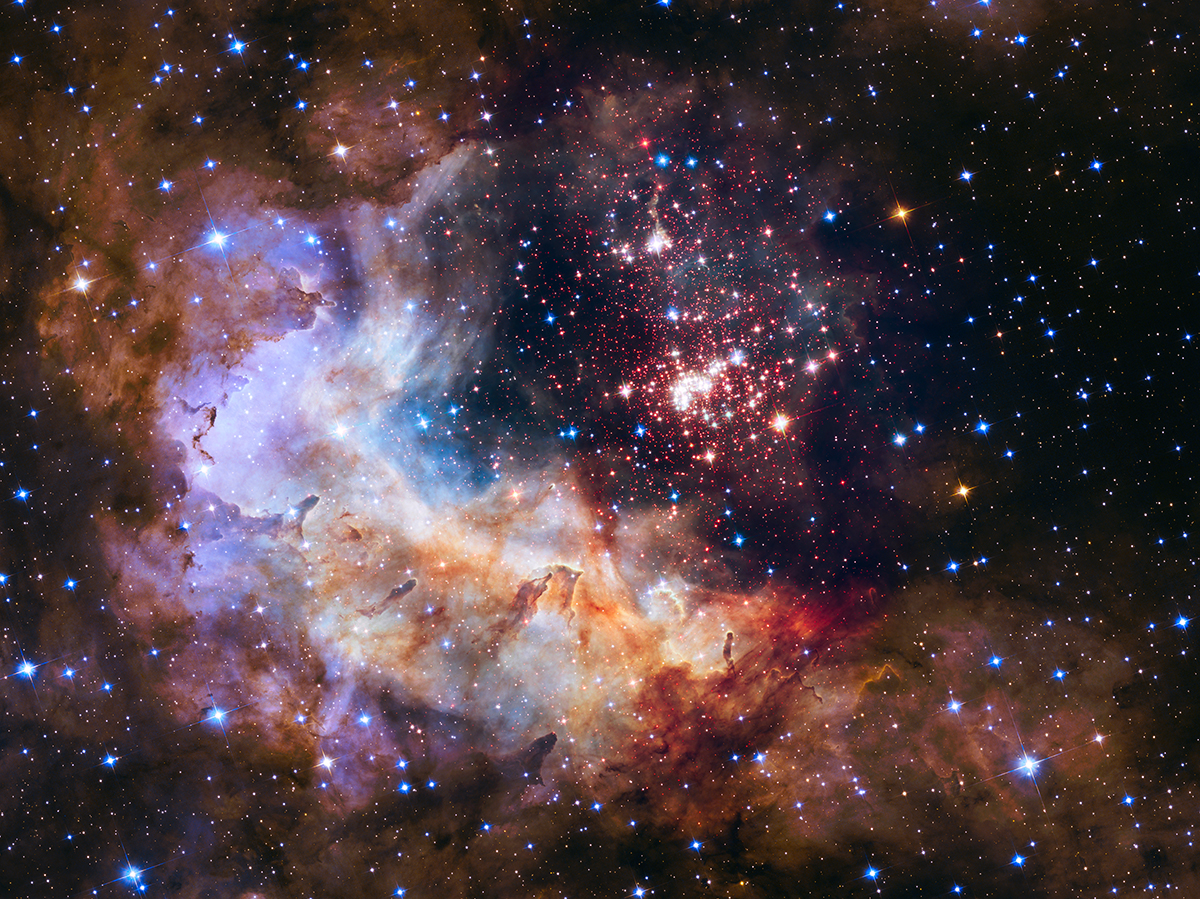
This alternative view of the magnificent star cluster Westerlund 2 reveals different aspects of this cosmic nursery's spectacular structure. Home to approximately 3,000 young stars, Westerlund 2 sits at the heart of the Gum 29 nebula, a vast stellar breeding ground located 20,000 light-years distant in the southern constellation Carina. The cluster's massive young stars — some exceeding 50 times the Sun's mass — blast their surroundings with fierce ultraviolet radiation and powerful stellar winds that sculpt the nebular gas into towering pillars and jagged ridges. These pillars, reminiscent of the famous 'Pillars of Creation' in the Eagle Nebula, are dense fingers of gas and dust that have temporarily resisted the onslaught of stellar radiation, protecting pockets of material that may still be forming new stars. At only 2 million years old, Westerlund 2 is a cosmic infant, offering astronomers a glimpse into the violent early stages of stellar cluster evolution.
Scientific Significance
This complementary observation of Westerlund 2 emphasizes the interaction between the cluster's massive stars and their natal environment. The dramatic pillars and ridges visible in the nebula mark the boundary between the ionized gas carved out by stellar radiation and the denser molecular material that has yet to be destroyed. These structures are laboratories for studying triggered star formation — the process by which compression from expanding ionization fronts or shock waves induces gravitational collapse in adjacent dense gas. Some of the pillars in Westerlund 2 show evidence of embedded young stellar objects, suggesting that the cluster may still be actively growing even as the first generation of massive stars begins to disperse the parent cloud. The cluster's extreme youth and massive stellar content make it an important analog for understanding the 'super star clusters' observed in starburst galaxies, which are thought to be modern-day counterparts of the globular clusters that formed in the early universe.
Observation Details
This observation utilized Hubble's Wide Field Camera 3 (WFC3) in both visible and near-infrared filters, providing a complementary view to other Westerlund 2 observations. The near-infrared imaging penetrated the dusty nebula to reveal embedded stellar sources, while visible-light filters captured the ionized gas emission and revealed the sharp boundaries of the eroding pillars. Different processing and color mapping of the multi-filter data emphasized different structural features compared to the 25th anniversary image, highlighting the scientific information encoded in the raw observations. The combined data enabled studies of the cluster's stellar content, star formation history, and interaction with the surrounding interstellar medium.
Location in the Universe
Constellation
Carina
Distance from Earth
20,000 light-years
Fun Facts
- 1
The most massive stars in Westerlund 2 are so luminous that each one outshines the Sun by a factor of several million.
- 2
Westerlund 2 was discovered in 1961 by Swedish astronomer Bengt Westerlund while studying the southern Milky Way from Mount Stromlo Observatory in Australia.
- 3
The pillars and ridges in the surrounding nebula will eventually be completely eroded away, leaving the stellar cluster exposed to the galaxy.
Image credit: NASA, ESA, Hubble Space Telescope