About This Image
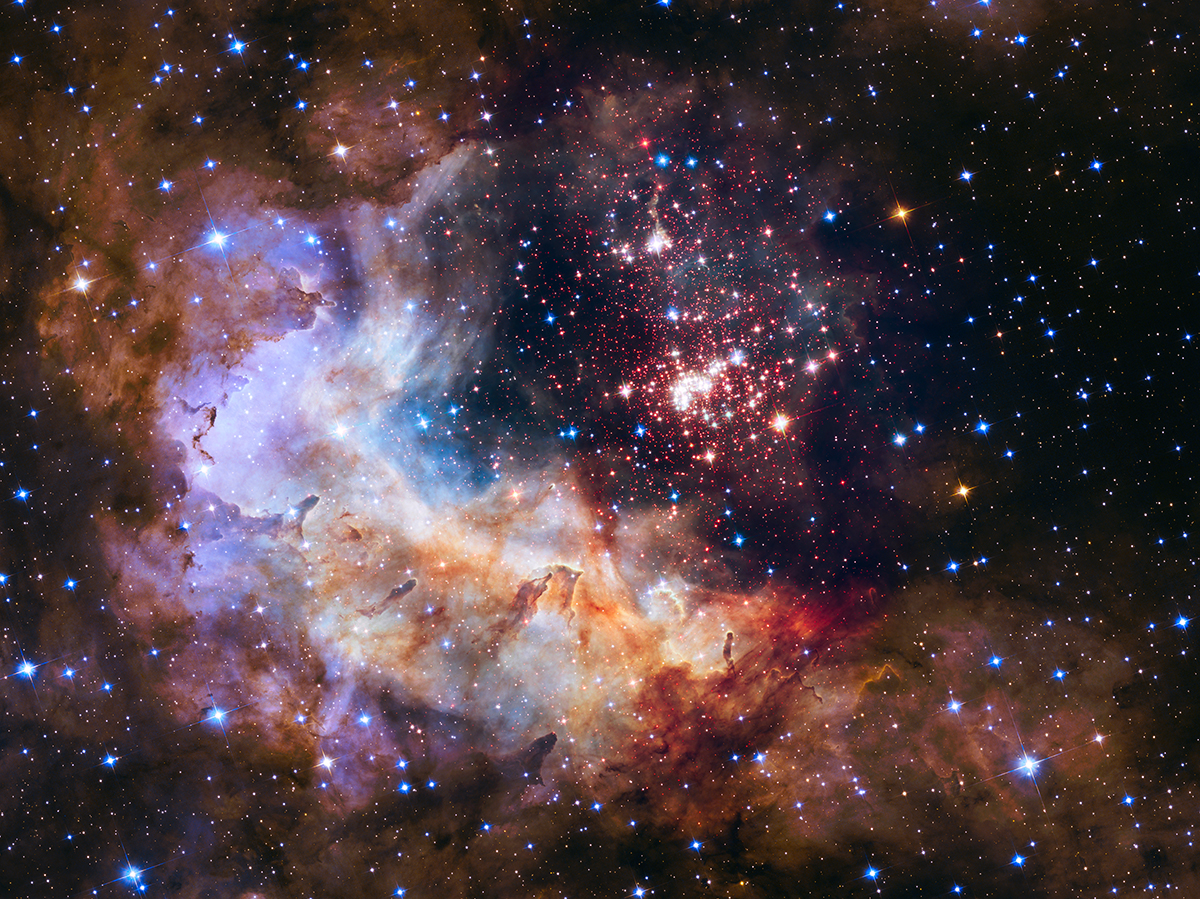
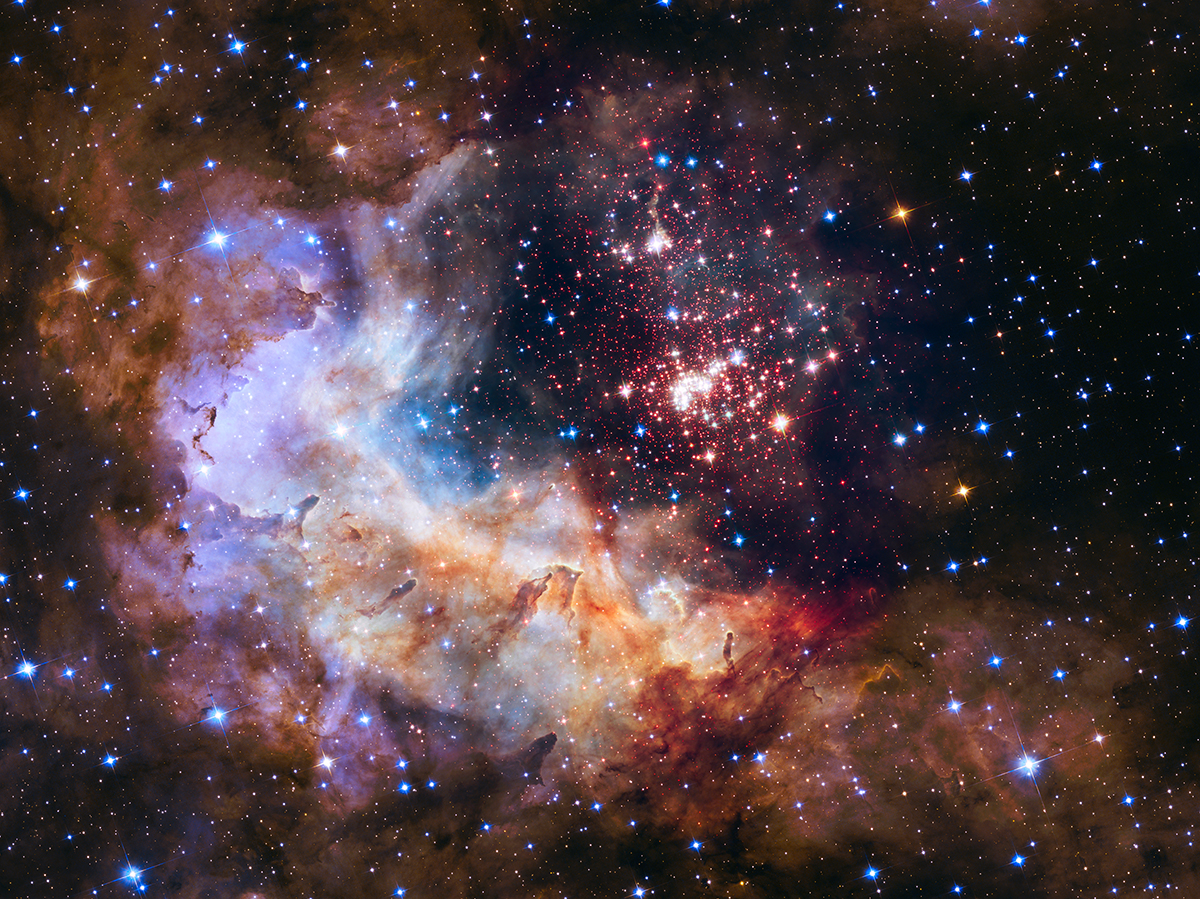
This breathtaking image captures Westerlund 2, a spectacular stellar nursery containing approximately 3,000 stars in the vibrant star-forming region Gum 29. Released to celebrate Hubble's 25th anniversary in space, this image showcases the cosmic interplay between newborn stars and the gas and dust from which they formed. The cluster's most massive stars — giants 10 to 50 times the mass of our Sun — blaze with intense ultraviolet radiation that sculpts the surrounding nebula into dramatic pillars, ridges, and valleys. These stellar winds and radiation are actively eroding the molecular cloud, revealing newly formed stars that were previously hidden within the dusty cocoon. Located approximately 20,000 light-years away in the constellation Carina, Westerlund 2 is one of the youngest and most massive star clusters in our galaxy, providing astronomers with a pristine laboratory for studying how stars form in dense, violent environments.
Scientific Significance
Westerlund 2 is one of the most important clusters for understanding massive star formation and early stellar evolution. Its extreme youth — only about 2 million years — means we are observing stars at a very early evolutionary stage, before significant stellar evolution has occurred. The cluster contains some of the most massive stars known in our galaxy, including Wolf-Rayet stars with masses exceeding 80 solar masses. These stellar behemoths produce powerful winds and intense radiation that profoundly affect their surroundings, driving the evolution of the parent molecular cloud and potentially triggering or suppressing star formation in adjacent regions. The cluster's environment provides insights into the conditions that prevailed in starburst galaxies and in the early universe when massive star formation was more prevalent. Studies of the stellar initial mass function in Westerlund 2 — the distribution of stellar masses at birth — help constrain theories of how gas fragments and collapses to form stars of different sizes.
Observation Details
Hubble captured this image using the Wide Field Camera 3 (WFC3) in visible and near-infrared light. The near-infrared observations were critical for penetrating the obscuring dust and revealing stars still embedded within the nebula, while visible-light imaging captured the ionized gas structures sculpted by stellar radiation. The image combines data from multiple filters to create a natural-color rendering that highlights the contrast between the red hydrogen emission from the nebula and the blue light from the hottest young stars. The observation covered a field spanning about 60 light-years across, encompassing the full extent of the central cluster and surrounding nebular structures.
Location in the Universe
Constellation
Carina
Distance from Earth
20,000 light-years
Fun Facts
- 1
Westerlund 2 is only about 2 million years old — just a cosmic instant compared to our 4.6-billion-year-old Sun — making it one of the youngest massive star clusters known.
- 2
This image was released on April 24, 2015, to celebrate Hubble's 25th anniversary in orbit around Earth.
- 3
The massive stars in Westerlund 2 will burn through their nuclear fuel in just a few million years, ending their lives in spectacular supernova explosions.
Image credit: NASA, ESA, Hubble Space Telescope