About This Image
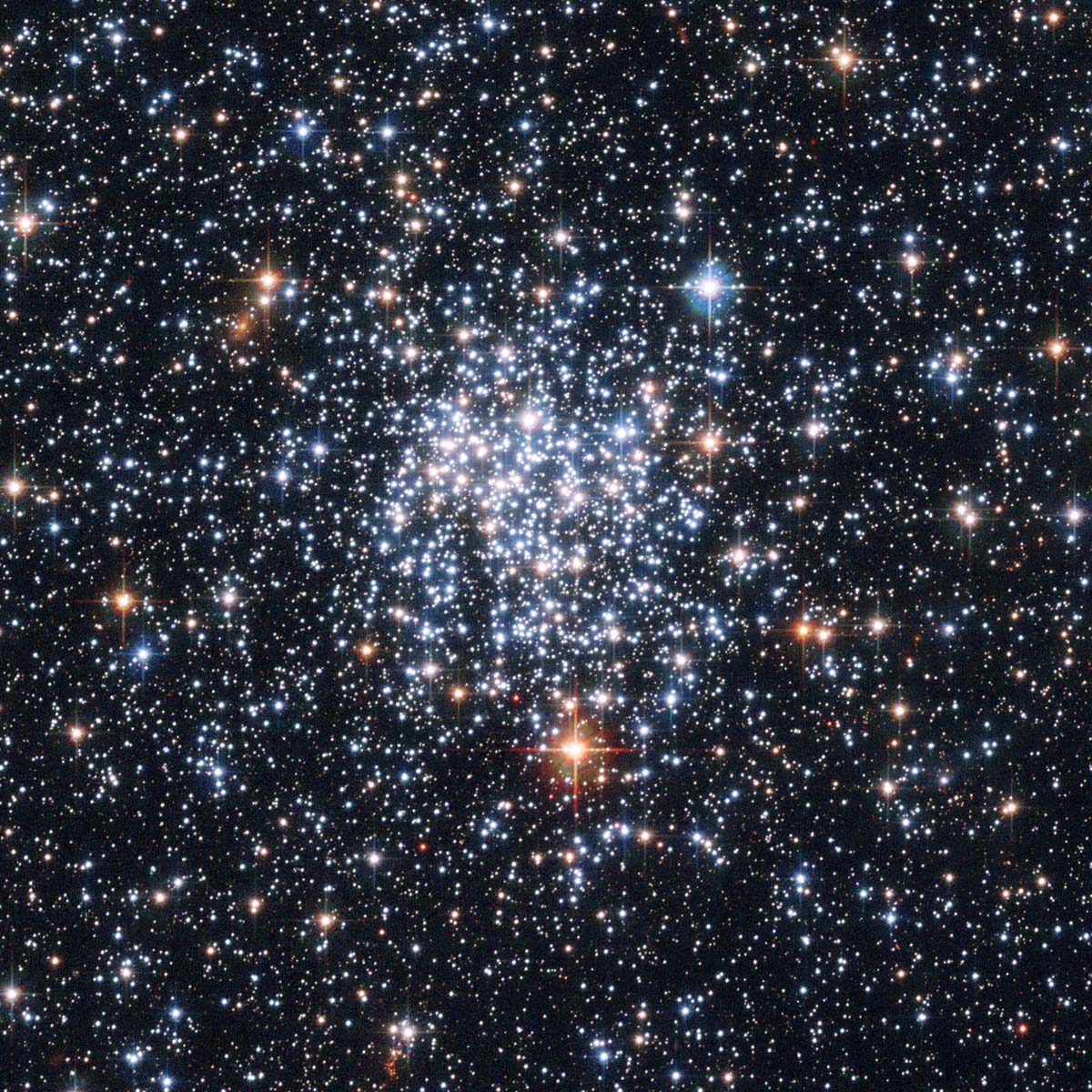
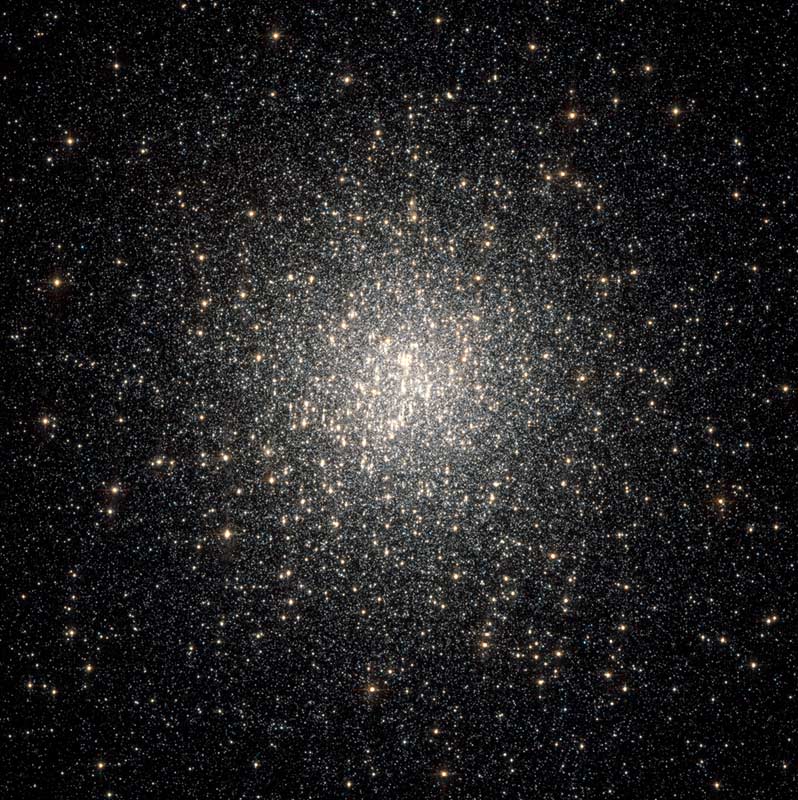
This dense swarm of stars lies at the center of the globular star cluster NGC 2808, one of the most massive globular clusters in our Milky Way galaxy. Containing more than a million stars packed into a region only about 100 light-years across, NGC 2808 presents a dazzling stellar metropolis where stars are separated by mere fractions of a light-year. What makes this ancient cluster particularly remarkable is the discovery that it contains three distinct generations of stars, challenging the long-held belief that globular clusters formed all their stars in a single burst. The varying ages and chemical compositions of these stellar populations suggest a complex formation history spanning hundreds of millions of years, making NGC 2808 a crucial laboratory for understanding how massive star clusters evolve and retain enough gas to form multiple stellar generations.
Scientific Significance
NGC 2808 fundamentally changed our understanding of globular cluster formation when Hubble observations revealed it contains three distinct stellar populations with different helium abundances. Traditional models assumed globular clusters formed all their stars in a single burst from a chemically homogeneous gas cloud. However, the presence of multiple populations in NGC 2808 — each with progressively higher helium content — indicates the cluster retained enough gas to form new stars enriched by the winds and explosions of earlier generations. This discovery implies globular clusters were once far more massive than today, having lost 90-95% of their original mass over billions of years. The extreme helium enrichment of NGC 2808's younger populations also helps explain the unusual horizontal branch morphology observed in many massive clusters. Understanding how clusters like NGC 2808 retained gas against the disruptive effects of stellar winds and supernovae remains an active area of research with implications for the early chemical evolution of galaxies.
Observation Details
Hubble observed NGC 2808 using the Advanced Camera for Surveys (ACS) in multiple broadband filters spanning ultraviolet through visible wavelengths. The ultraviolet observations were critical for separating the multiple stellar populations, as stars with different helium abundances occupy distinct locations in ultraviolet color-magnitude diagrams. The high angular resolution of ACS was essential for resolving individual stars in the cluster's extremely crowded core, where thousands of stars occupy each square arcsecond of sky. Precise photometry of over 100,000 stars enabled the construction of detailed color-magnitude diagrams revealing the triple main sequence that first demonstrated the presence of multiple populations.
Location in the Universe
Constellation
Carina
Distance from Earth
31,000 light-years
Fun Facts
- 1
NGC 2808 contains at least three distinct populations of stars with different ages and chemical compositions — a discovery that revolutionized our understanding of globular cluster formation.
- 2
With over one million stars crammed into a sphere roughly 100 light-years in diameter, the stellar density at NGC 2808's core is about 100,000 times greater than in our solar neighborhood.
- 3
NGC 2808 is so massive that it may be the stripped core of a dwarf galaxy that was absorbed by the Milky Way billions of years ago, rather than a true globular cluster.
Image credit: NASA, ESA, Hubble Space Telescope