About This Image
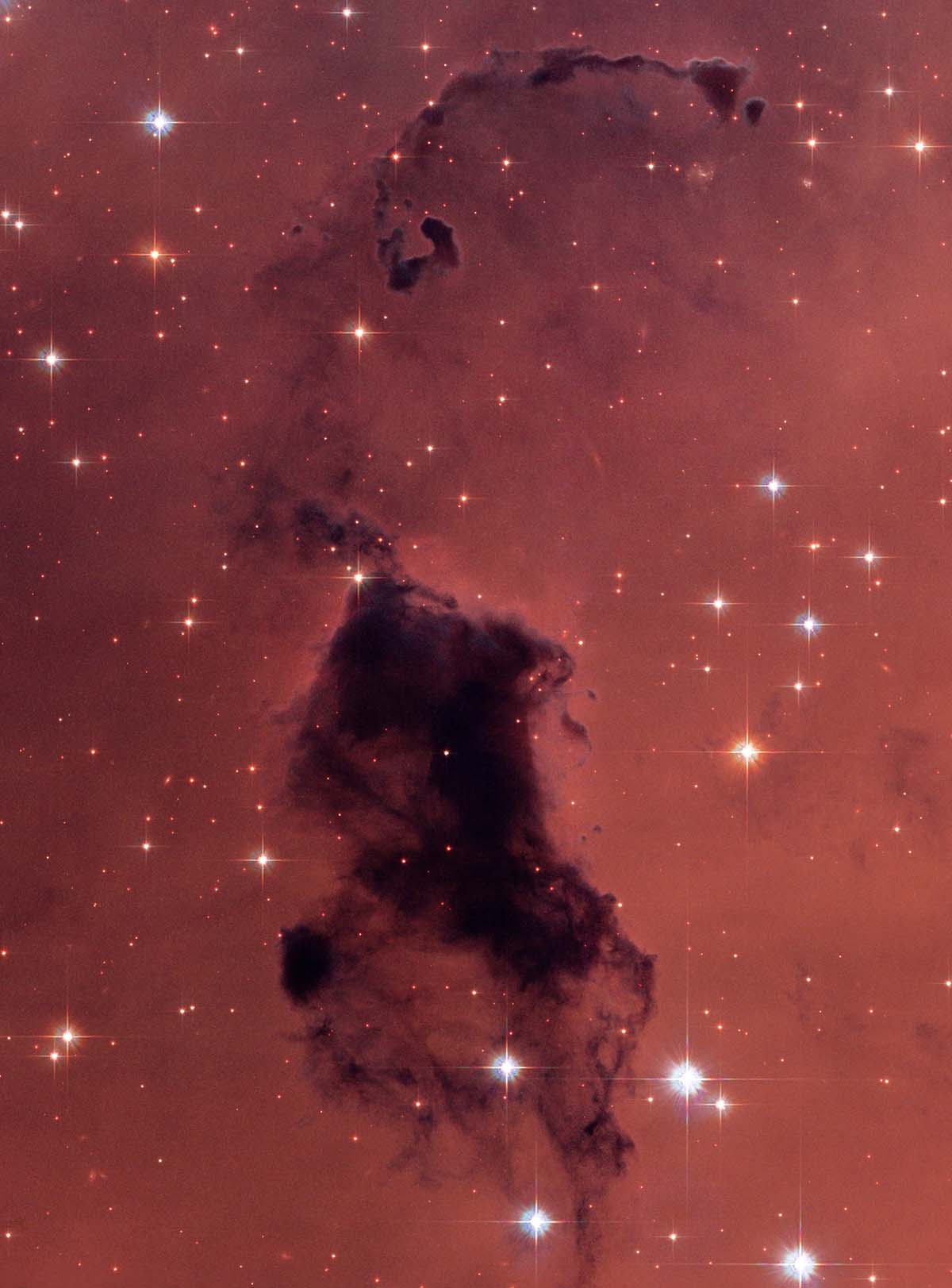
The dark knots of gas and dust in this image are called "Bok globules," and they are absorbing light in the center of the nearby nebula and star-forming region called NGC 281. Also known as the Pacman Nebula for its distinctive shape when viewed in wide-field images, NGC 281 is a busy stellar nursery where new stars are being born within dense molecular cores while older massive stars sculpt the surrounding gas with their radiation and winds.
Scientific Significance
NGC 281 is an exemplary region for studying the process of sequential star formation and the competition between stellar feedback and gravitational collapse. The Bok globules visible in this image are dense molecular cores that have survived the harsh radiation environment created by the cluster of young massive stars at the heart of the nebula. These globules are thought to be the sites of ongoing or imminent star formation, shielded from external radiation by their high density. The erosion of the globule surfaces by ultraviolet radiation creates the characteristic cometary or pillar-like shapes, with bright ionization fronts facing the radiation source and shadowed tails extending away. By studying the properties of globules at different stages of erosion, astronomers can estimate how long these structures can survive and whether they can complete the star formation process before being destroyed. NGC 281 also contains an interesting multiple star system at its center that has been studied as a test case for theories of massive star formation.
Observation Details
This image was taken with Hubble's Advanced Camera for Surveys (ACS) in filters that emphasize emission from ionized hydrogen (red) and ionized oxygen (blue-green), revealing the thermal and ionization structure of the nebula. The dark Bok globules appear in silhouette against the bright background emission, their sharp edges tracing the boundary between the cold molecular interior and the surrounding hot ionized gas. The observations resolve structures within the globules as small as a few hundred astronomical units—approaching the scale of protostellar disks.
Location in the Universe
Constellation
Cassiopeia
Distance from Earth
9,500 light-years
Fun Facts
- 1
The Bok globules in NGC 281 contain enough mass to form multiple solar systems—some are actively collapsing to form new stars right now.
- 2
NGC 281 is nicknamed the 'Pacman Nebula' because wide-field images reveal a shape resembling the classic video game character.
- 3
The nebula was discovered by American astronomer E. E. Barnard in 1881 using a small telescope.
Image credit: NASA, ESA, Hubble Space Telescope