About This Image
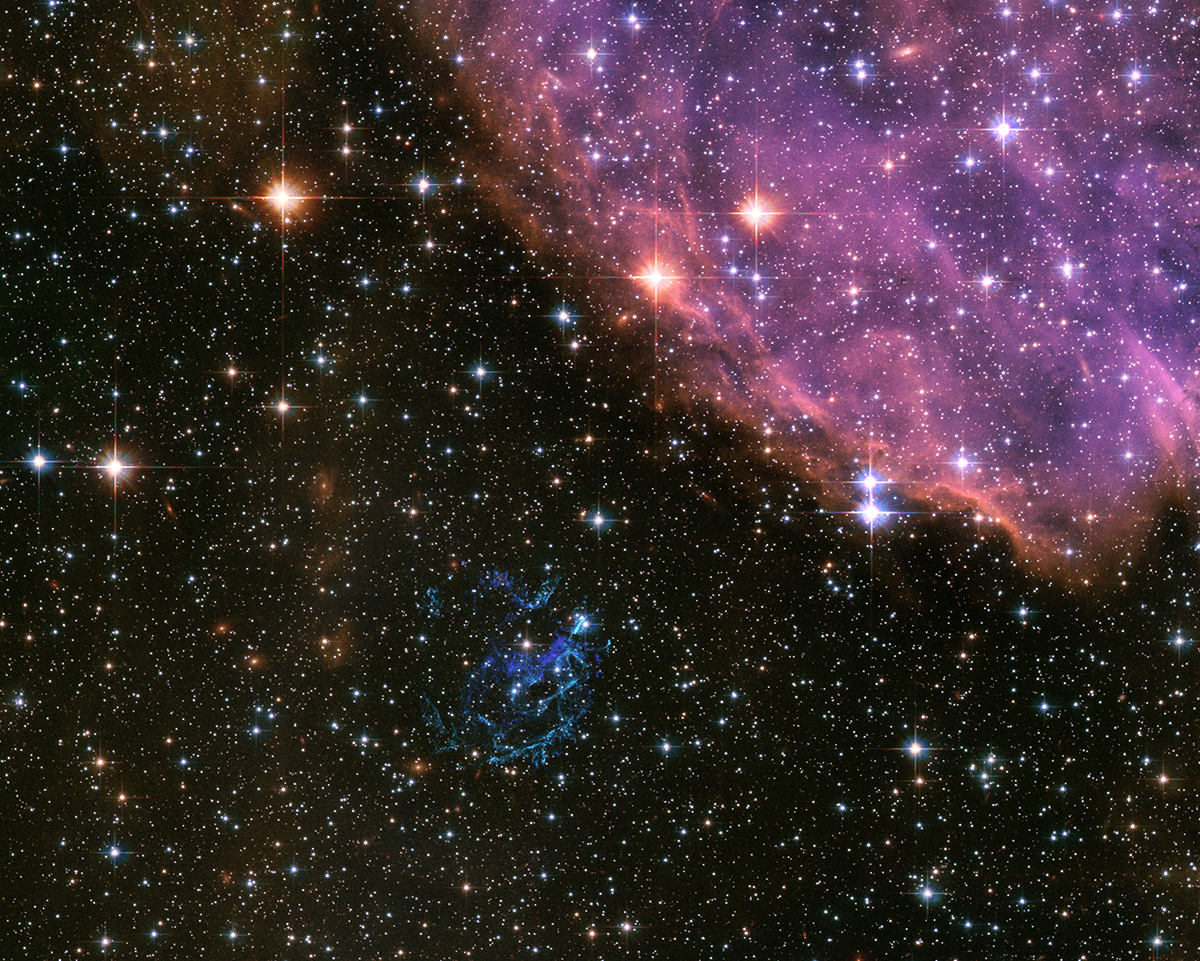
In a nearby galaxy called the Small Magellanic Cloud, a massive star exploded as a supernova and dissipated its interior into a spectacular display of colorful filaments. The supernova remnant, known as E0102, is the greenish-blue field of debris just below center. This remnant is one of the best laboratories in the universe for studying the chemical yields of massive star explosions and the physics of supernova shock waves interacting with the surrounding medium.
Scientific Significance
E0102 is one of the most important supernova remnants for understanding the nucleosynthesis that occurs during core-collapse supernovae—explosions of massive stars at the end of their lives. The prominent oxygen-rich filaments visible in the remnant are debris from the star's core that have been ejected into space by the explosion. By measuring the abundances and velocities of these elements, astronomers can test theoretical models of how heavy elements are produced in stellar cores and dispersed by supernovae. The location of E0102 in the Small Magellanic Cloud is advantageous because the distance to this satellite galaxy is well known, allowing precise measurements of the remnant's size, expansion rate, and energetics. Studies combining Hubble optical data with X-ray observations from Chandra have revealed a complex temperature and density structure within the shocked gas.
Observation Details
This composite image combines observations from Hubble and ground-based telescopes to reveal the remnant in its full context. The Hubble data, taken with the Advanced Camera for Surveys (ACS), resolve the intricate filamentary structure of the expanding debris. The characteristic bluish-green color comes from emission by doubly ionized oxygen, which dominates the optical spectrum of this oxygen-rich remnant. The observations were designed to trace the morphology and kinematics of the ejecta and compare them with X-ray observations that probe the hottest gas in the remnant.
Location in the Universe
Constellation
Tucana
Distance from Earth
190,000 light-years
Fun Facts
- 1
E0102 is estimated to be about 1,000 years old, meaning the supernova explosion was witnessed on Earth roughly when the Byzantine Empire was at its height.
- 2
The remnant is rich in oxygen, neon, and magnesium—elements that were synthesized in the core of the massive progenitor star.
- 3
E0102 is one of only a handful of supernova remnants bright enough to be studied in detail in an external galaxy.
Image credit: NASA, ESA, Hubble Space Telescope