About This Image
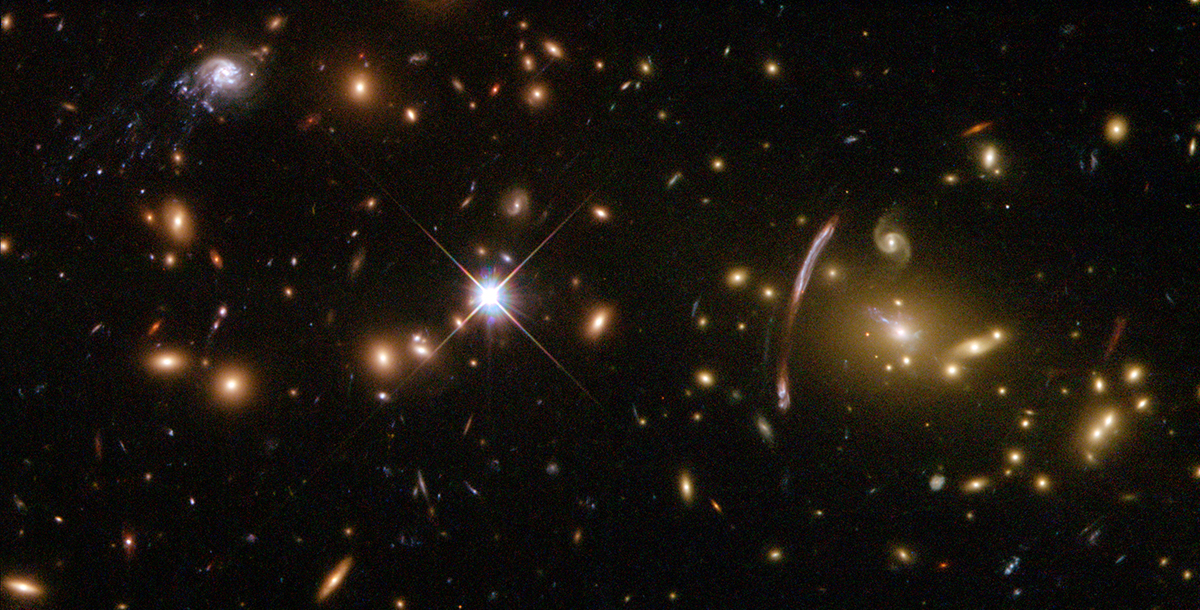
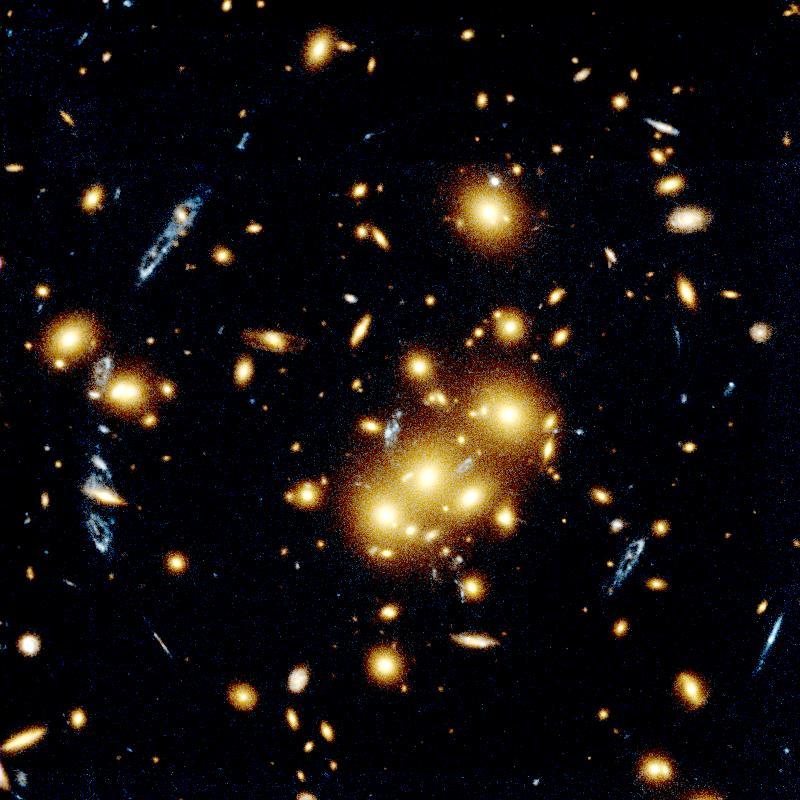
The light from a distant galaxy, nearly 10 billion light-years away, has been warped into blue arcs and streaks by the gravity of galaxy cluster 0024+1654. The cluster's gravity acts as a lens, bending and amplifying light from the background galaxy. This dramatic example of gravitational lensing allows astronomers to study galaxies that would otherwise be too faint to observe and to map the distribution of dark matter within the lensing cluster.
Scientific Significance
Galaxy cluster 0024+1654 has been pivotal in the development of gravitational lensing as a tool for cosmology and the study of dark matter. The positions and shapes of the lensed arcs depend sensitively on the mass distribution within the cluster, including both the visible galaxies and the invisible dark matter. By modeling the lensing geometry, astronomers can create detailed maps of the dark matter distribution, which typically extends well beyond the visible light of the cluster galaxies. Studies of 0024+1654 revealed that the dark matter forms a smooth halo that traces the overall cluster potential, confirming theoretical predictions. The cluster has also been used to study the properties of the distant lensed galaxy, including its star formation rate and stellar mass, taking advantage of the natural magnification provided by the cosmic lens. This early Hubble observation demonstrated the power of space-based imaging for gravitational lensing studies.
Observation Details
This image was obtained with Hubble's Wide Field Planetary Camera 2 (WFPC2) shortly after the telescope's first servicing mission restored its optical quality. The observations used multiple optical filters to capture color information and help distinguish between cluster member galaxies and the lensed background source. The characteristic blue color of the lensed arcs indicates that the background galaxy is actively forming stars, with the blue light coming from hot young stars. The image quality achievable by Hubble was essential for resolving the fine structure of the lensed arcs and enabling precise lensing models.
Location in the Universe
Constellation
Pisces
Distance from Earth
4.7 billion light-years (cluster); ~10 billion light-years (lensed galaxy)
Fun Facts
- 1
The same background galaxy appears as multiple distorted images around the cluster, creating a cosmic hall of mirrors effect.
- 2
The total magnification provided by the gravitational lens can exceed a factor of 10, making distant galaxies appear much brighter than they would otherwise.
- 3
Galaxy cluster 0024+1654 was one of the first systems where dark matter was mapped through gravitational lensing.
Image credit: NASA, ESA, Hubble Space Telescope