About This Image
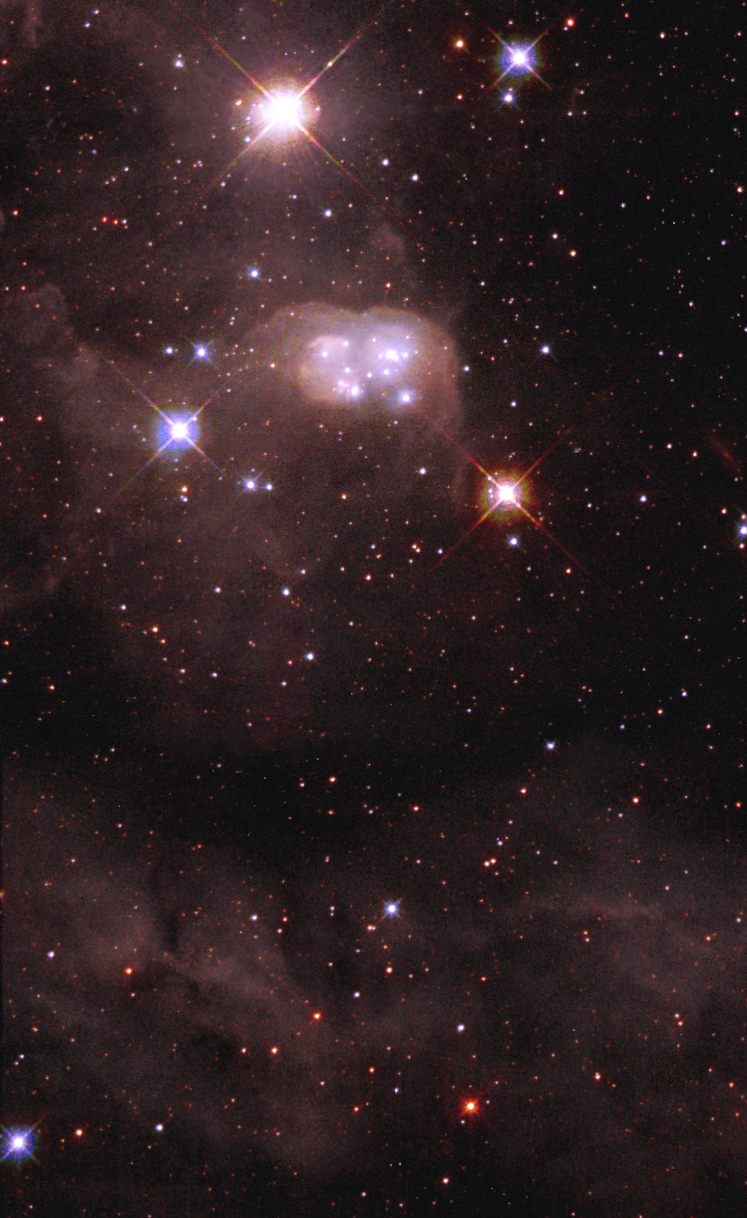
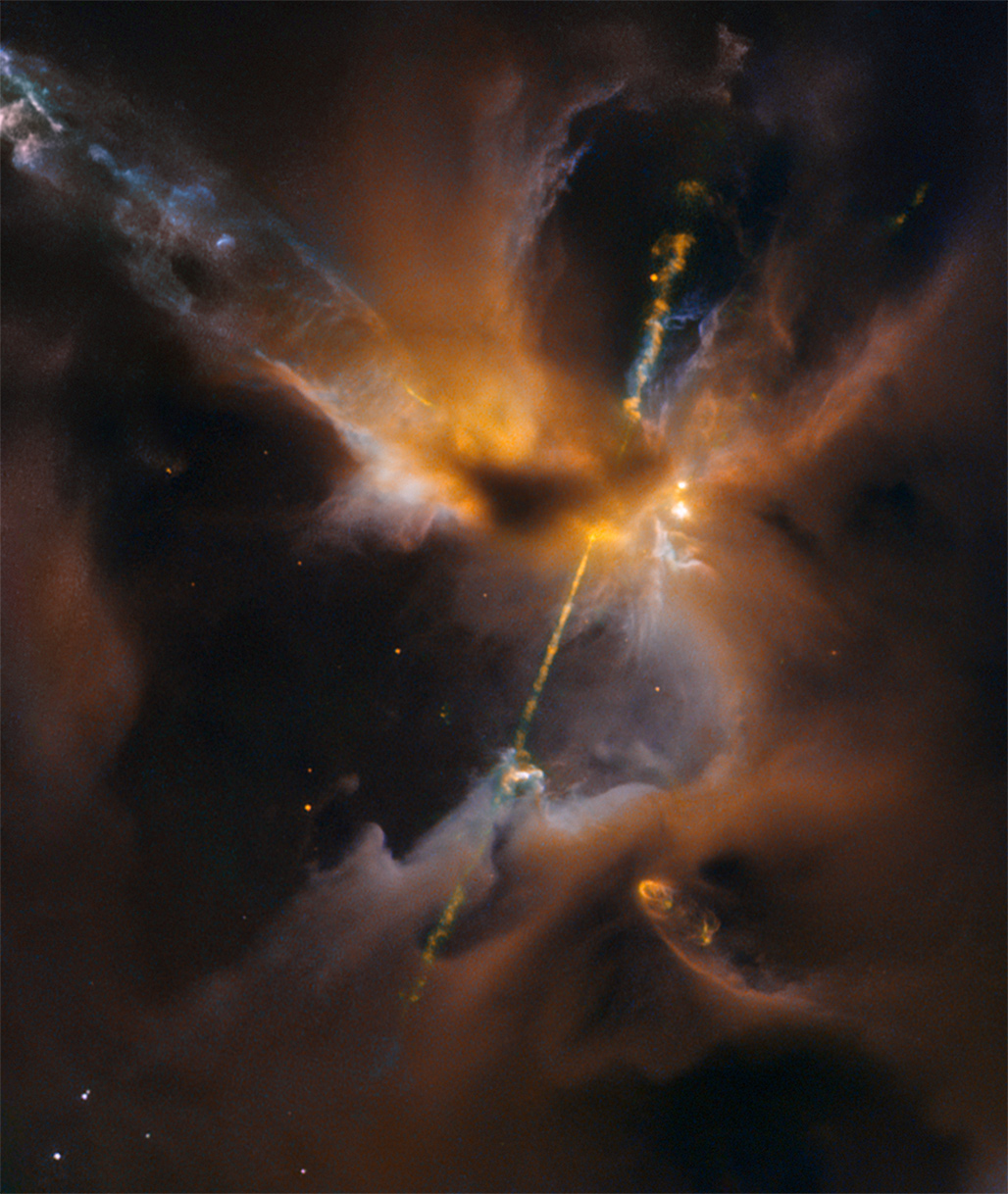
A partially obscured, newborn star near the center of this image is shooting twin jets into the surrounding gas and dust. The shocks from the collision light up patches of nebulosity collectively called Herbig-Haro 24. This young stellar object is still gathering mass from its surrounding disk while simultaneously ejecting material along its rotation axis. The jets travel at speeds of hundreds of kilometers per second and create bright bow shocks where they plow into the surrounding molecular cloud.
Scientific Significance
Herbig-Haro 24 provides a spectacular example of the bipolar outflow phenomenon that accompanies the early stages of stellar evolution. When a protostar is actively accreting material from its surrounding disk, some of that material is channeled into high-velocity jets that escape along the star's rotational poles. These jets are thought to be crucial for removing angular momentum from the system, allowing accretion to continue. The bright knots and bow shocks in Herbig-Haro objects trace the history of the jet's interaction with the ambient medium and variations in the jet's velocity and direction over time. By measuring the proper motions of these features over years of observation, astronomers can determine the jet velocity and trace the outflow back to its source star. Studies of Herbig-Haro objects have revealed that the jet phenomenon is common, if not universal, among forming stars and plays a fundamental role in the star formation process.
Observation Details
This image was captured using Hubble's Wide Field Camera 3 (WFC3) in near-infrared light, which can penetrate the dusty environment surrounding the young star. The infrared observations reveal structure that is invisible in optical light due to heavy dust extinction. The image shows both the jet material itself, glowing from shock heating, and the scattered light from the central source reflecting off the surrounding nebulosity. Multi-epoch observations of this region allow measurement of the jet proper motions, providing dynamical information about the outflow.
Location in the Universe
Constellation
Orion
Distance from Earth
1,350 light-years
Fun Facts
- 1
Herbig-Haro objects are named after astronomers George Herbig and Guillermo Haro, who first studied these peculiar nebulae in the 1950s.
- 2
The jets from the central star are moving so fast that if they were aimed at the Sun from Earth, they would cover that distance in only about a week.
- 3
The asymmetric appearance of the jets may indicate that one is pointing slightly toward us while the other points away.
Image credit: NASA, ESA, Hubble Space Telescope