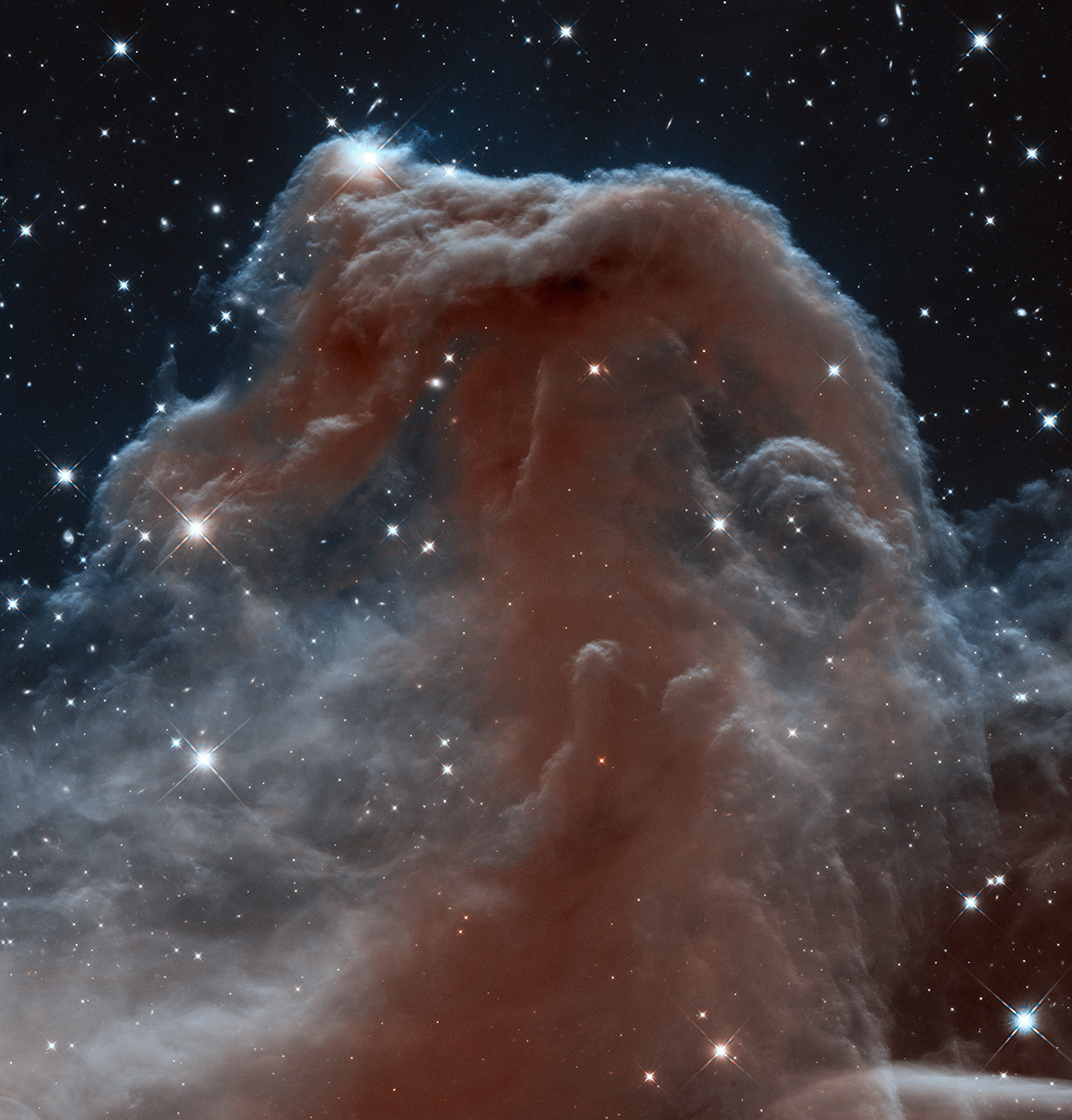
About This Image
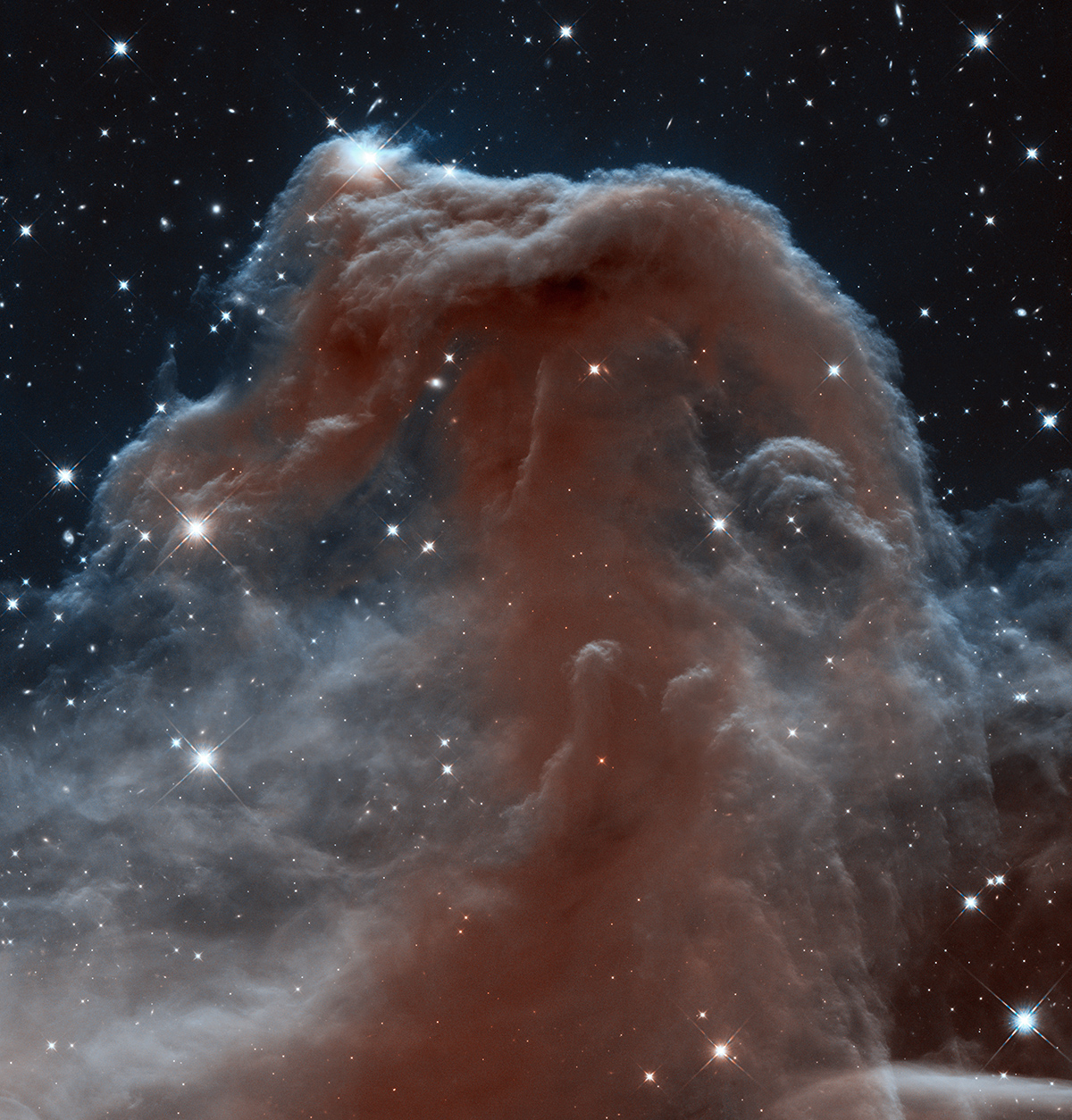
The backlit wisps along the Horsehead Nebula's upper ridge are being illuminated by a young five-star system just off the top of this image, taken in infrared light. Harsh radiation from one of these bright stars is slowly evaporating the nebula. The Horsehead is one of the most recognizable objects in the sky, its distinctive silhouette carved from a larger cloud of gas and dust. This infrared view penetrates the dusty exterior to reveal a different perspective on this iconic cosmic landmark.
Scientific Significance
The Horsehead Nebula is a dense pillar of molecular gas and dust that projects from a larger molecular cloud, sculpted by the intense radiation from nearby massive stars. Hubble's infrared observations reveal structures hidden within the dark column, including newborn stars still embedded in their dusty cocoons. The interplay between the radiation field and the dense molecular material is creating a photodissociation region at the nebula's surface, where molecules are broken apart by ultraviolet light. Studying these boundary layers helps astronomers understand the chemistry and physics of star formation. The Horsehead also serves as an example of how dense clumps within molecular clouds can resist erosion long enough to form stars, while less dense material is stripped away. The survival of such features depends on a delicate balance between the cloud's self-gravity and the destructive effects of external radiation.
Observation Details
This image was captured in infrared light using Hubble's Wide Field Camera 3 (WFC3) and was released in 2013 to celebrate the telescope's 23rd anniversary. The infrared observations use filters at 1.1 and 1.6 microns, wavelengths that pass through dust much more readily than visible light. This allows astronomers to see into the heart of the nebula and detect young stellar objects that would be invisible at optical wavelengths. The image reveals the glowing edges of the cloud where gas is being heated by external radiation, as well as the cooler interior regions where new stars are forming.
Location in the Universe
Constellation
Orion
Distance from Earth
1,500 light-years
Fun Facts
- 1
The Horsehead Nebula was first recorded on a photographic plate in 1888 by Williamina Fleming at the Harvard College Observatory.
- 2
In infrared light, the Horsehead appears ghostly and ethereal rather than its familiar dark silhouette, because infrared penetrates the dust that blocks visible light.
- 3
The Horsehead will likely be eroded away by stellar radiation in about 5 million years—a brief moment in cosmic time.
Image credit: NASA, ESA, Hubble Space Telescope