About This Image
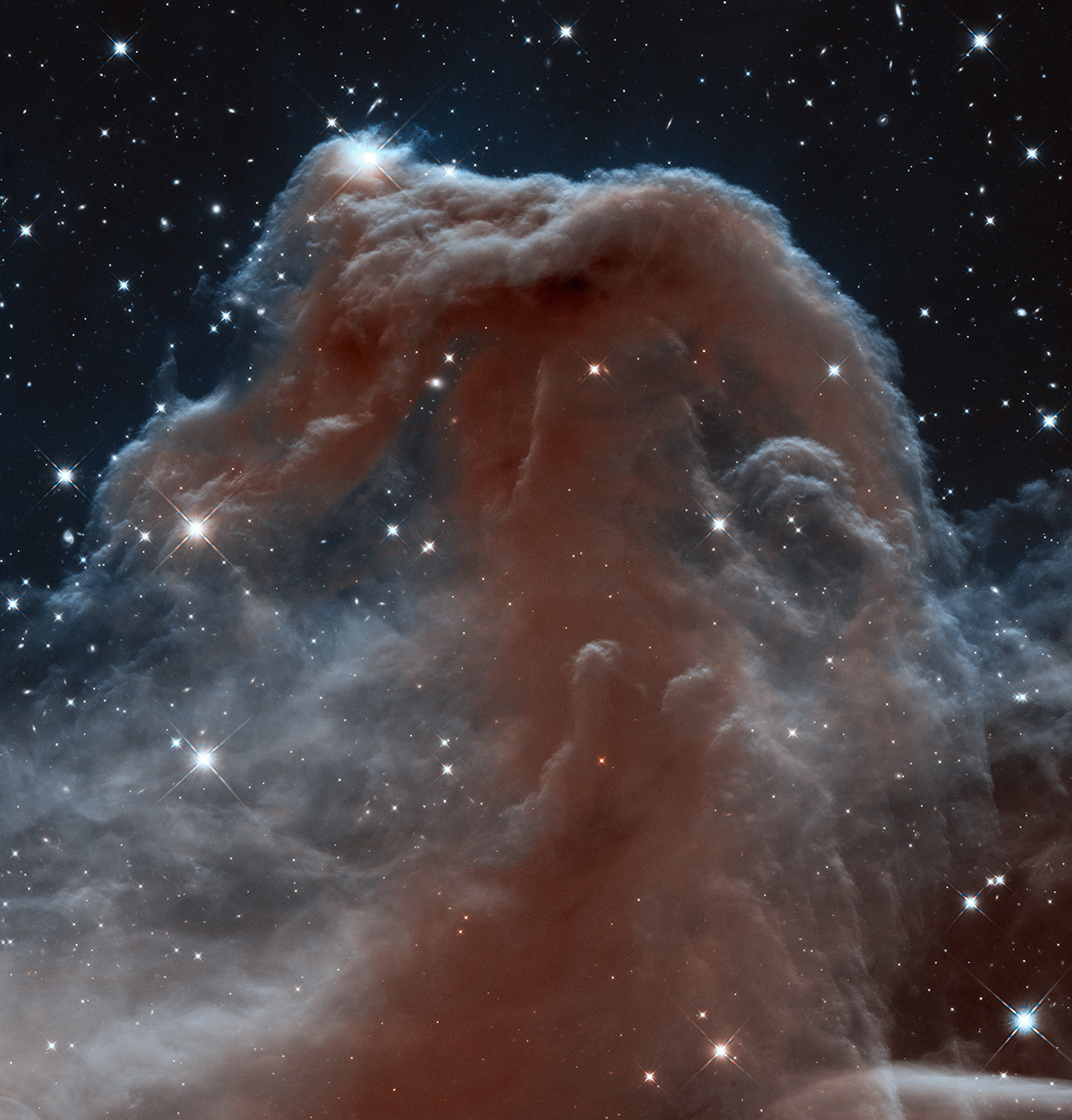
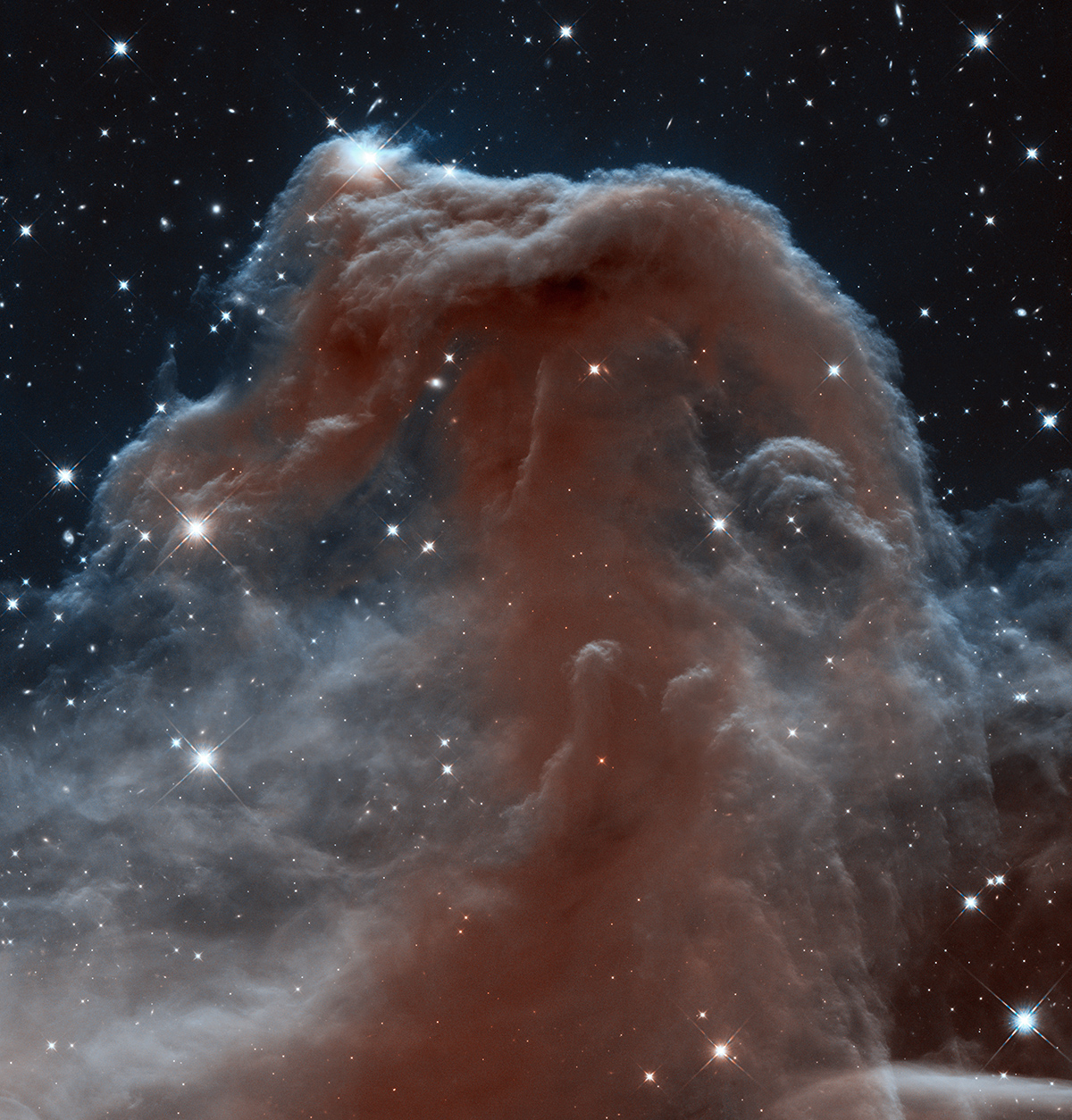
The backlit wisps along the Horsehead Nebula's upper ridge are being illuminated by a young five-star system just off the top of this image, taken in infrared light. Harsh radiation from one of these bright stars is slowly evaporating the nebula. This view emphasizes different structures within the famous cloud, showing the subtle variations in density and temperature that characterize this sculpted pillar of interstellar material.
Scientific Significance
The detailed structure visible in this infrared image of the Horsehead Nebula reveals the complex physics of photodissociation regions (PDRs)—the interface layers between fully ionized gas and cold molecular clouds. As ultraviolet radiation from nearby stars penetrates into the cloud, it sequentially ionizes atoms, dissociates molecules, and heats the gas, creating a layered structure with distinct physical and chemical properties. By observing these layers at different wavelengths, astronomers can map the transition from the harsh ionized environment to the sheltered molecular interior where star formation can occur. The preservation of the Horsehead shape over cosmic timescales indicates that the head must contain a particularly dense core that resists photoevaporation. Such dense condensations may be the seeds of future star formation, and their study helps constrain models of how molecular clouds fragment and collapse.
Observation Details
This infrared observation was taken as part of Hubble's imaging campaign for the Horsehead Nebula, using the Wide Field Camera 3 (WFC3) near-infrared channel. The observations employed multiple narrow-band and broad-band filters to trace both the stellar continuum and specific spectral features associated with heated dust and gas. The comparison of this infrared image with optical observations dramatically illustrates how different wavelengths reveal different physical structures within the same astronomical object. The data contribute to multi-wavelength studies combining radio, infrared, optical, and X-ray observations.
Location in the Universe
Constellation
Orion
Distance from Earth
1,500 light-years
Fun Facts
- 1
The Horsehead rises approximately 3 light-years above the surrounding cloud—tall enough that light would take three years to travel from its base to its top.
- 2
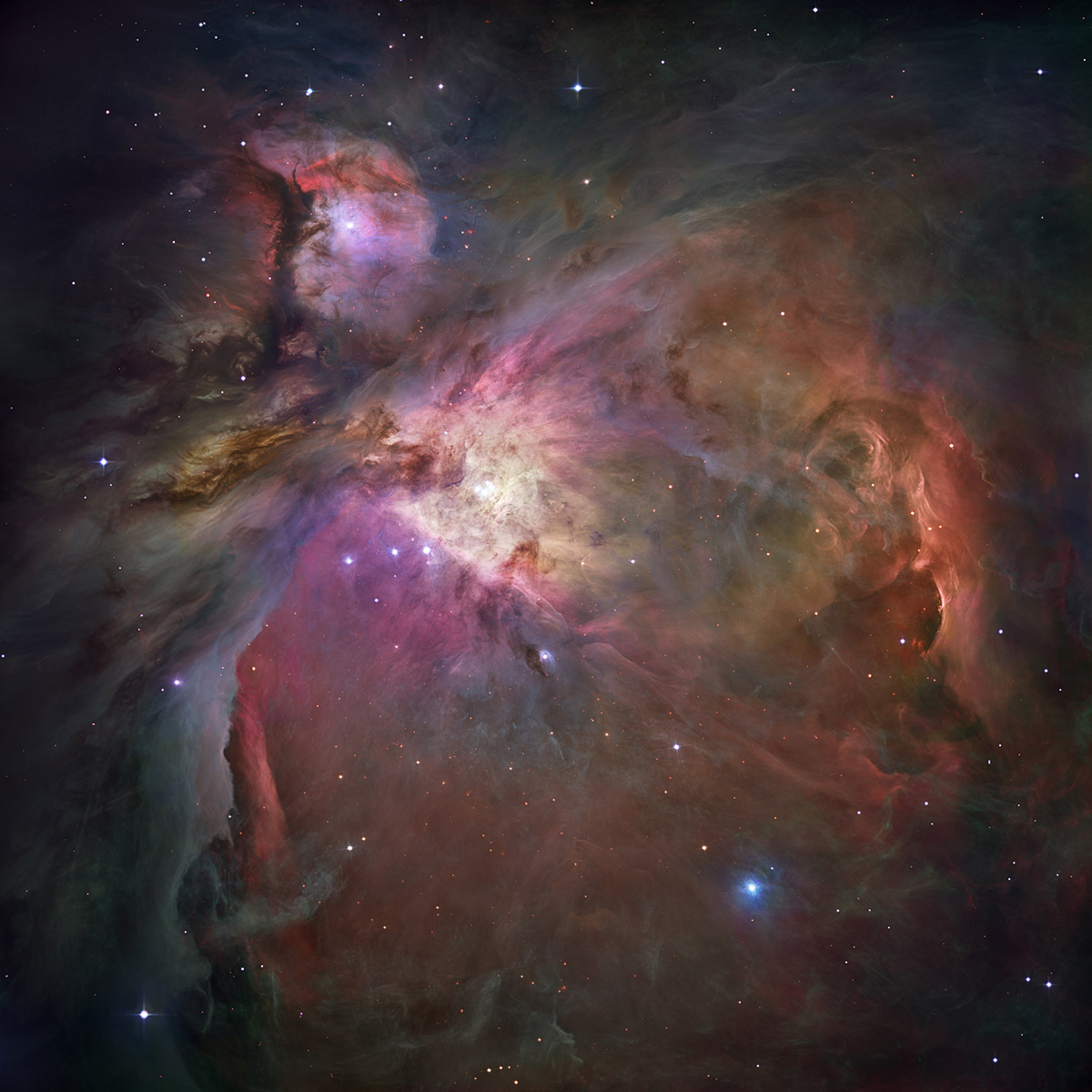
The nebula is located within the Orion Molecular Cloud Complex, one of the nearest regions of active star formation to Earth.
- 3
Despite its fame, the Horsehead is challenging to observe visually with amateur telescopes because of the low surface brightness of the surrounding emission nebula.
Image credit: NASA, ESA, Hubble Space Telescope