About This Image
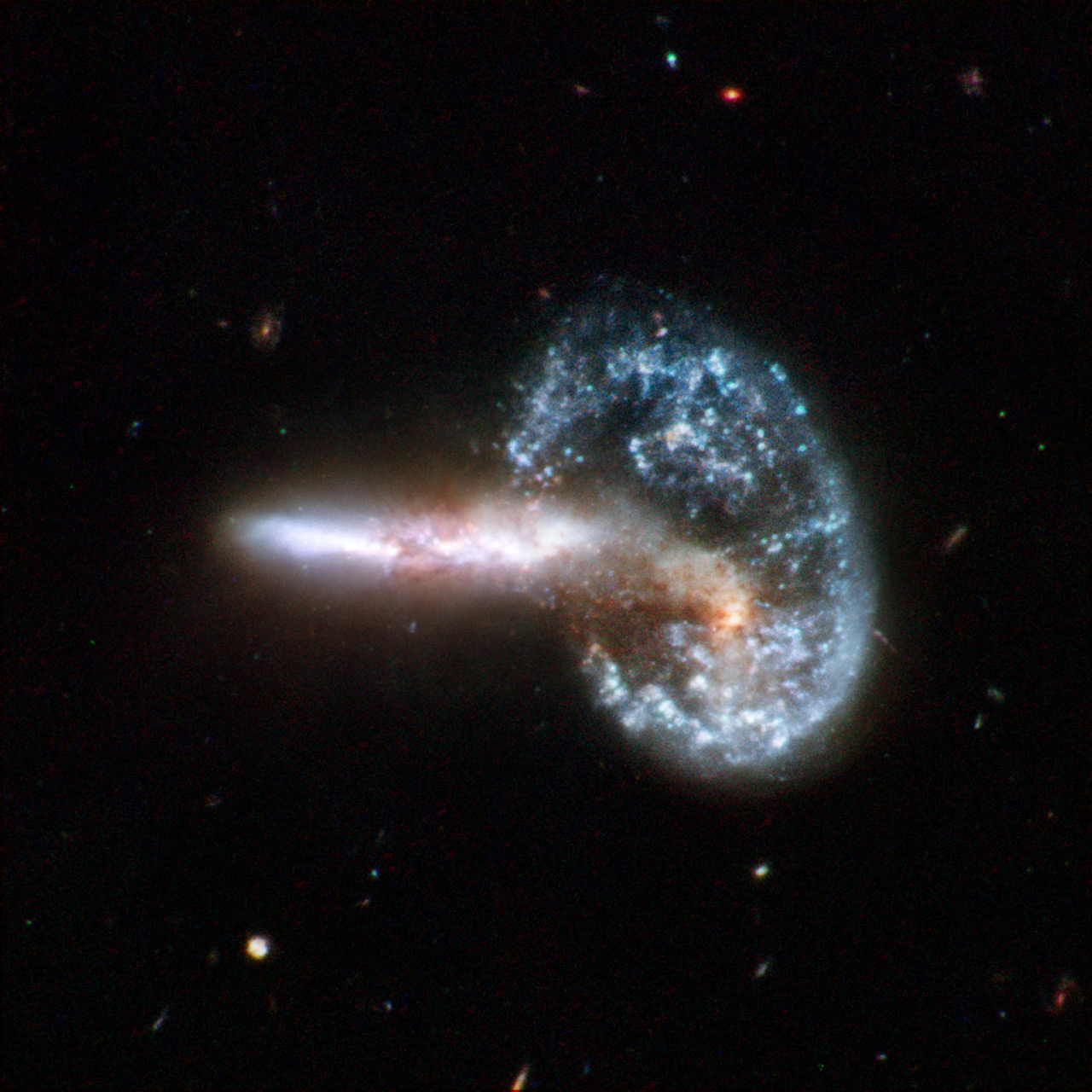
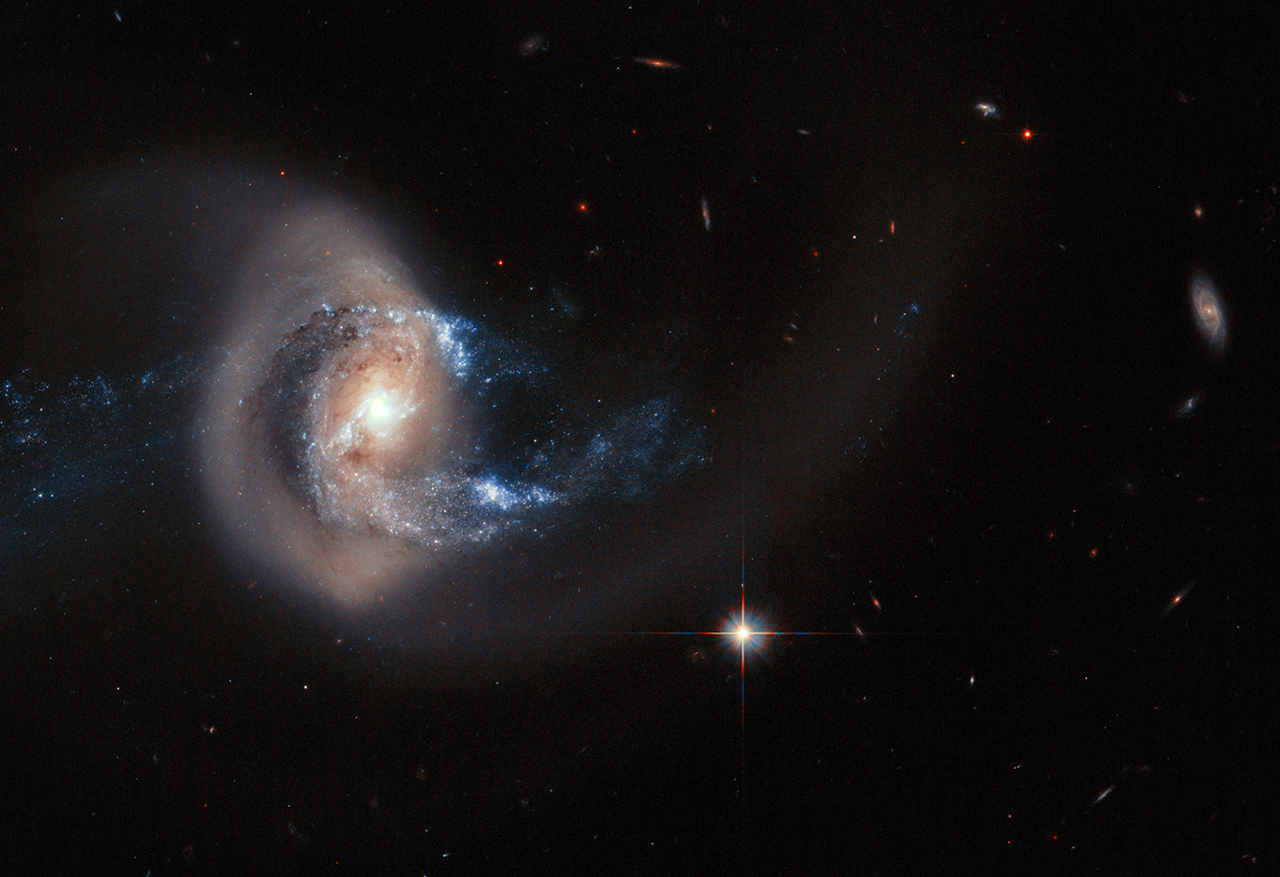
The disrupted galaxy NGC 7714 displays a striking smoke-ring-like structure. The golden loop is made of Sun-like stars that have been pulled deep into space, far from the galaxy's center, by the gravity of a nearby galaxy that lies just out of view. This dramatic distortion is the result of an ongoing collision with its neighbor galaxy NGC 7715, which passed close to NGC 7714 approximately 100-200 million years ago, triggering intense star formation and reshaping both galaxies.
Scientific Significance
NGC 7714 provides a spectacular example of how galaxy interactions trigger extreme episodes of star formation. The close passage of NGC 7715 through or near NGC 7714 created gravitational tides that drew material outward into the distinctive ring and loop structures while simultaneously compressing gas in the central regions, igniting intense starburst activity. The ring visible in this image contains a chain of bright star-forming regions where gas has been piled up by the interaction. Studies of this system help astronomers understand the relationship between interaction dynamics and starburst intensity, as well as the timescales over which triggered star formation proceeds. The comparison of the observed morphology with numerical simulations has allowed reconstruction of the collision geometry and timing, demonstrating that the encounter likely occurred 100-200 million years ago when the intruder galaxy passed within about 50,000 light-years of NGC 7714's center.
Observation Details
This image was captured using Hubble's Wide Field Camera 3 (WFC3) in multiple optical filters that highlight both the stellar populations and ionized gas distributions. The golden color of the ring indicates that it is dominated by stars similar to our Sun, while the blue knots trace regions of active star formation containing hot, young stars. The image reveals fine details of the interaction morphology, including the bridge of material connecting NGC 7714 to its off-frame companion NGC 7715. These observations support studies of triggered star formation and interaction-driven galaxy evolution.
Location in the Universe
Constellation
Pisces
Distance from Earth
100 million light-years
Fun Facts
- 1
NGC 7714 is undergoing a 'starburst' event, forming stars at a rate 10 to 20 times higher than normal for a galaxy of its size.
- 2
The distinctive ring structure will eventually disperse as the gravitational effects of the collision subside over the next few hundred million years.
- 3
The pair NGC 7714/7715 is part of Halton Arp's Atlas of Peculiar Galaxies, cataloged as Arp 284.
Image credit: NASA, ESA, Hubble Space Telescope