About This Image
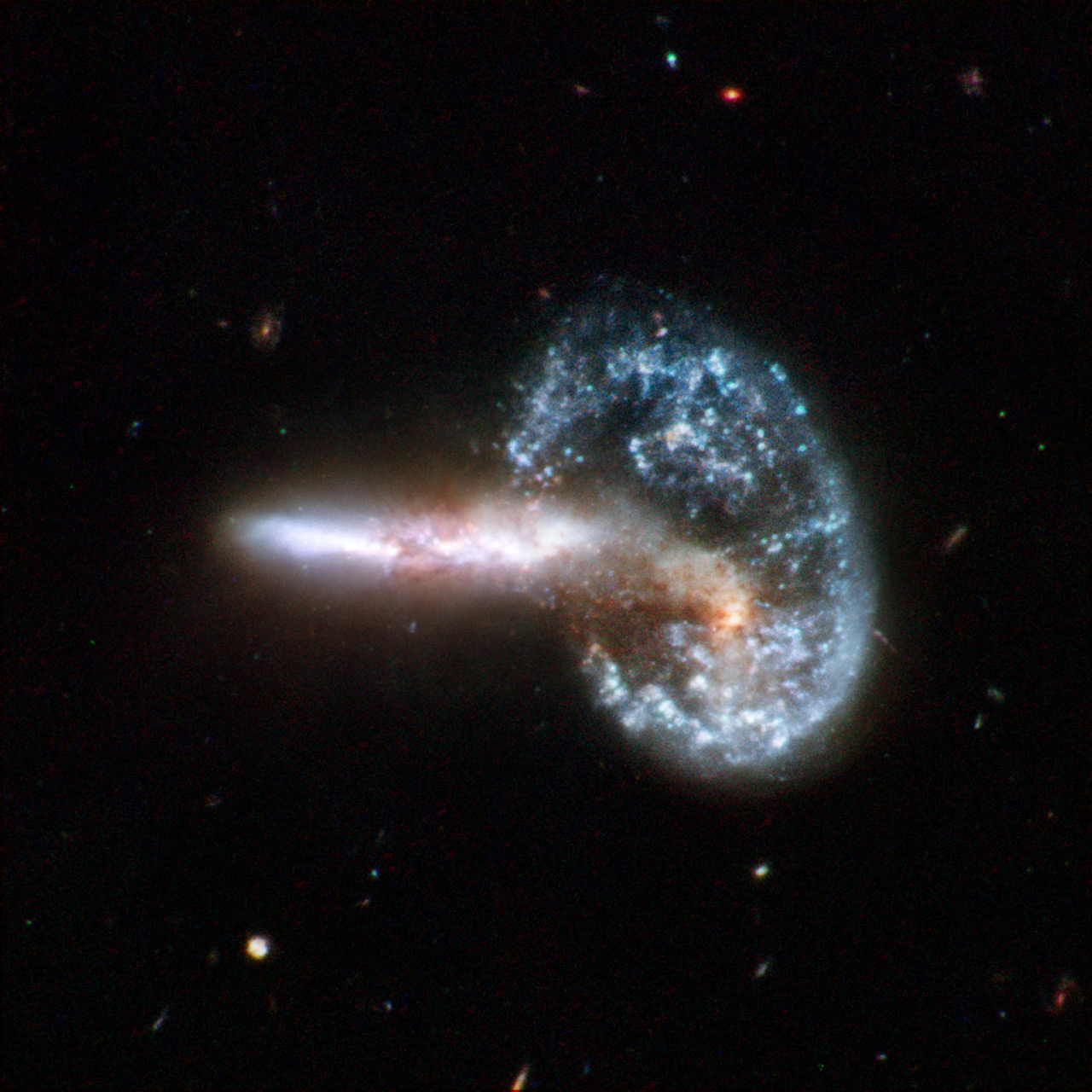
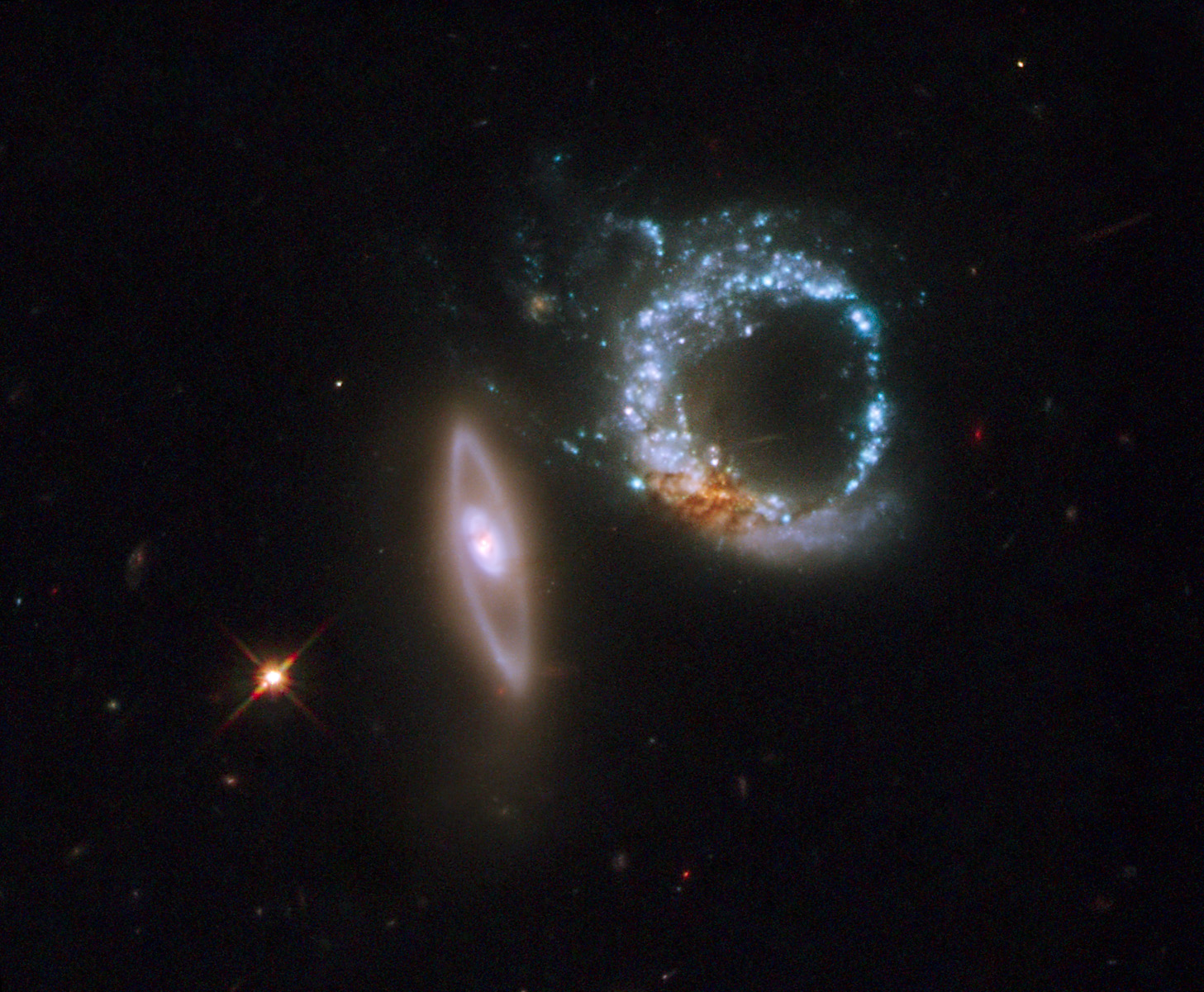
Arp 147 consists of a pair of interacting galaxies. The left-most galaxy in this image appears nearly edge-on to our line of sight and features a smooth ring of starlight. The right-most galaxy exhibits a clumpy, blue ring of intense star formation. This striking pair demonstrates the dramatic transformations that galaxies undergo during close encounters, with the ring structure in the right galaxy triggered by the passage of its companion.
Scientific Significance
Arp 147 provides another spectacular example of ring galaxy formation, but with an interesting twist: the intruder galaxy (on the left) has also been affected by the collision, appearing to have developed its own ring-like structure. This mutual distortion offers opportunities to study how both participants in a collision respond to the gravitational interaction. The blue ring in the right-hand galaxy is a textbook example of collision-triggered star formation, where the density wave created by the intruder's passage compressed gas to the point of gravitational collapse. The presence of X-ray bright sources within the ring indicates that some of the massive stars formed in the collision have already evolved and collapsed into compact objects. The age gradient across the ring—with the outermost regions being youngest—traces the outward propagation of the star formation wave and allows measurement of its expansion velocity.
Observation Details
This image combines observations from Hubble's Wide Field Planetary Camera 2 (WFPC2) in optical wavelengths with data from other observatories. The Hubble observations resolve the blue ring into individual star-forming complexes and reveal the smooth stellar distribution in both the intruder galaxy's ring and the central regions of both systems. The image was selected for release in 2008 to commemorate NASA's 50th anniversary. Complementary observations from the Chandra X-ray Observatory detected multiple X-ray point sources within the blue ring, identified as accreting stellar-mass black holes or neutron stars.
Location in the Universe
Constellation
Cetus
Distance from Earth
440 million light-years
Fun Facts
- 1
The blue ring in Arp 147 formed when one galaxy punched through the disk of another, triggering a wave of star formation that expanded outward in a ring pattern.
- 2
The ring contains young, massive blue stars that formed within the last 15 million years—a blink of an eye in cosmic terms.
- 3
X-ray observations have detected several black holes within the blue ring, likely formed from the most massive of the newly created stars.
Image credit: NASA, ESA, Hubble Space Telescope