About This Image
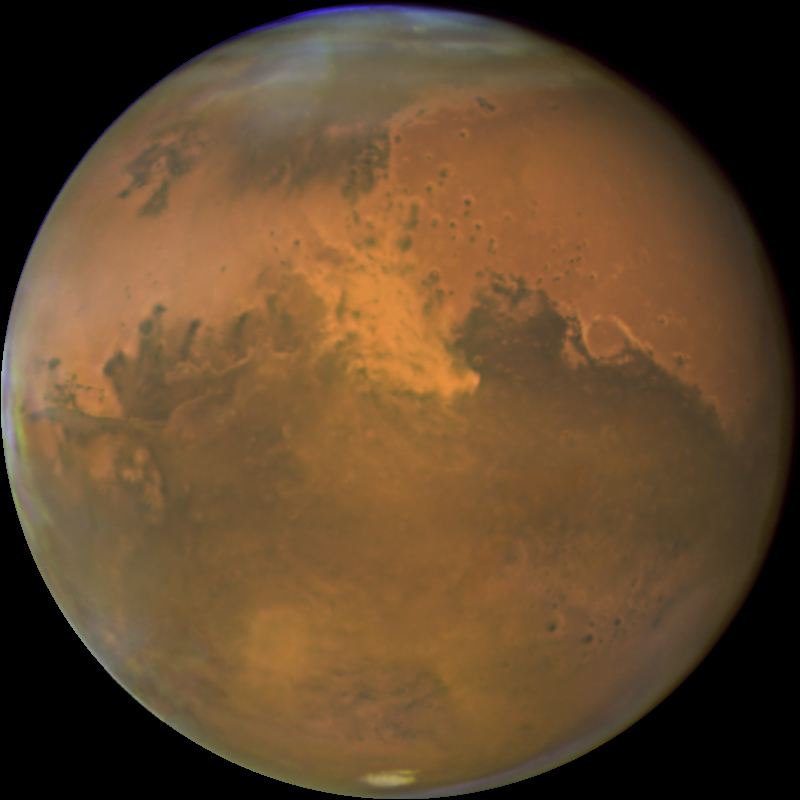
This image captures a dust storm on Mars. The dust storm, which is nearly in the middle of the planet in this image, is about 930 miles long measured diagonally. Hubble's sharp vision allows astronomers to monitor weather and climate phenomena on Mars with detail rivaling spacecraft in orbit around the Red Planet. This observation captured one of the regional dust storms that can develop into global events obscuring the entire Martian surface.
Scientific Significance
Monitoring Martian dust storms is crucial for understanding both the planet's climate system and for planning future human missions. Dust storms on Mars can dramatically affect surface conditions, raising temperatures in the atmosphere by tens of degrees while cooling the surface by blocking sunlight. The mechanisms that allow regional storms like this one to sometimes escalate into global events remain an active area of research. Hubble observations complement the detailed views from Mars orbiters by providing global context and continuous monitoring that orbiting spacecraft, which see only portions of the planet at any time, cannot achieve. Understanding dust storm behavior is also essential for human exploration planning, as global dust events could pose significant challenges for solar-powered equipment and surface operations during extended missions.
Observation Details
This image was taken with Hubble's Advanced Camera for Surveys (ACS) during a favorable opposition of Mars, when the planet was relatively close to Earth. The observations used visible light filters that emphasize contrast between the bright dust clouds and the darker surface features. Hubble's location above Earth's atmosphere eliminates the blurring effects of atmospheric turbulence that limit the resolution of ground-based Mars observations. The image resolves features as small as about 30 miles across on the Martian surface, comparable to the resolution achieved by some early Mars orbiters.
Location in the Universe
Constellation
N/A
Distance from Earth
Varies (avg. 140 million miles)
Fun Facts
- 1
Mars dust storms can grow from regional events like this one to global storms that completely obscure the planet's surface for months at a time.
- 2
The dust on Mars is so fine (about 1.5 microns in size) that it can remain suspended in the thin atmosphere for extended periods.
- 3
During the 2018 global dust storm, NASA's Opportunity rover lost power when dust blocked sunlight from its solar panels, ending its 15-year mission.
Image credit: NASA, ESA, Hubble Space Telescope