About This Image
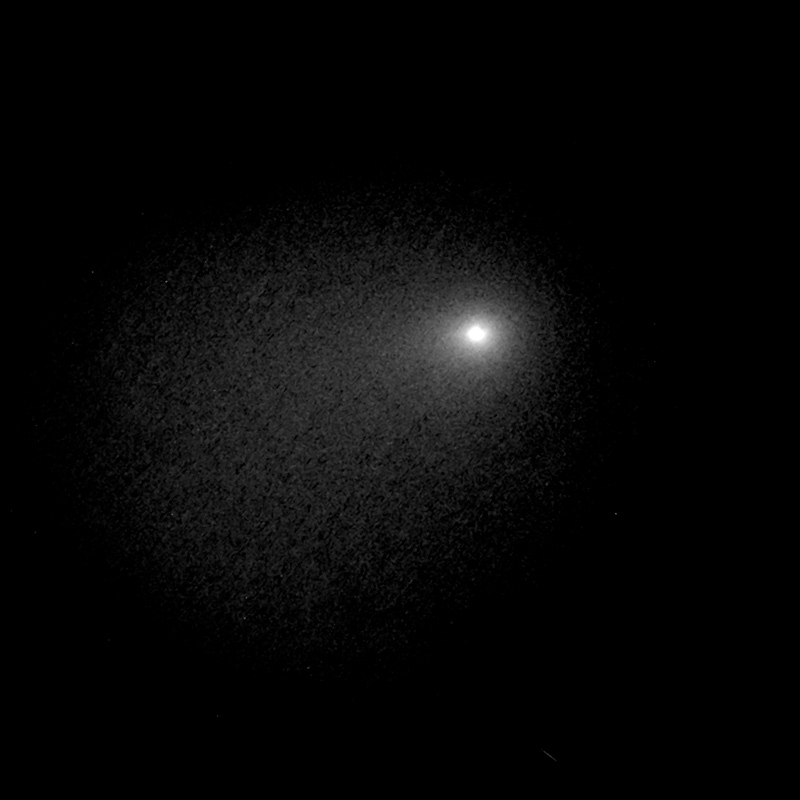
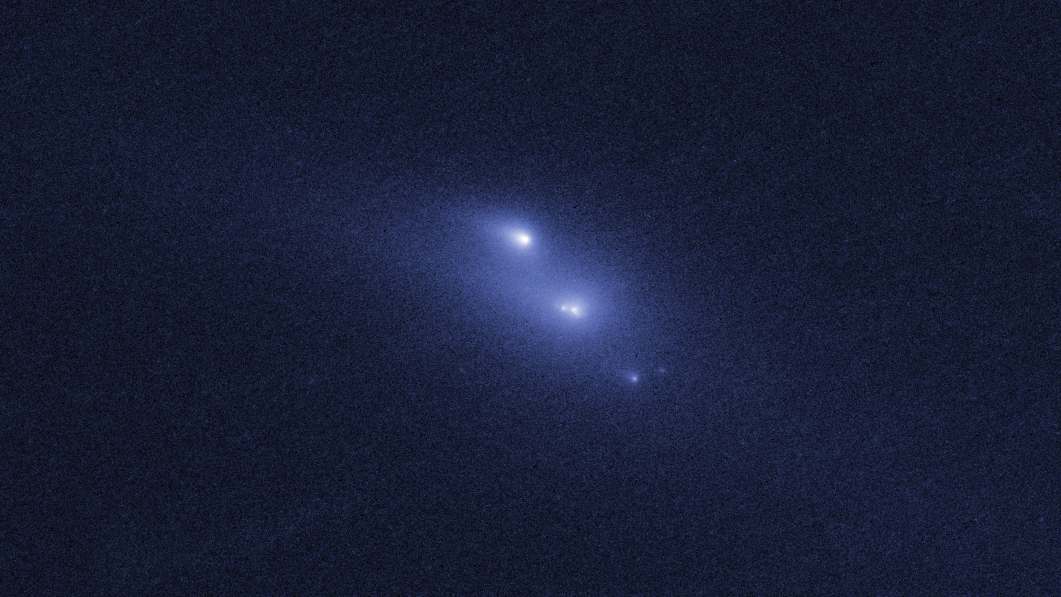
This image shows an asteroid called P/2013 R3 as it was breaking apart. The asteroid's fragments were slowly drifting away from each other and had tails of dust pushed back by the pressure of sunlight. This unprecedented observation of an asteroid disintegrating in real-time provided the first direct evidence that asteroids can be torn apart by the subtle pressure of solar radiation—a process known as the YORP effect.
Scientific Significance
The disintegration of P/2013 R3 provided the first direct observation of an asteroid being destroyed by rotational fission caused by the YORP effect. This effect occurs when solar radiation absorbed and re-emitted by an irregular asteroid creates a tiny torque that gradually changes the asteroid's spin rate over millions of years. Eventually, the rotation can become fast enough that centrifugal force exceeds the weak gravitational binding holding the rubble-pile asteroid together, and it literally spins itself apart. Before this observation, the YORP effect was predicted theoretically and inferred from statistical studies of asteroid spins, but had never been directly witnessed in action. The observation confirmed that many asteroids are loosely consolidated rubble piles rather than solid rock, and it has implications for understanding asteroid populations, binary asteroid formation, and planetary defense strategies for deflecting potentially hazardous objects.
Observation Details
Hubble observed P/2013 R3 multiple times over several months in 2013 and 2014, tracking the evolution of the fragmenting body. The observations used the Wide Field Camera 3 (WFC3) in visible light, with the high resolution essential for distinguishing the individual fragments and their dust tails. The time series of observations revealed that the fragments were separating at a gentle rate consistent with rotational fission rather than a violent collision. The dust tails pointing away from the Sun in each image confirmed that solar radiation pressure was actively affecting the debris.
Location in the Universe
Constellation
N/A
Distance from Earth
Varies (observed at ~300 million miles)
Fun Facts
- 1
P/2013 R3 broke into at least 10 distinct fragments, with the four largest pieces each about 200 meters wide—roughly the length of two football fields.
- 2
The fragments were drifting apart at speeds of about 1.5 kilometers per hour—slower than a person walks—showing the gentle nature of the breakup.
- 3
The discovery that sunlight alone can destroy an asteroid helps explain why there are so few small asteroids with fast rotation rates.
Image credit: NASA, ESA, Hubble Space Telescope