About This Image
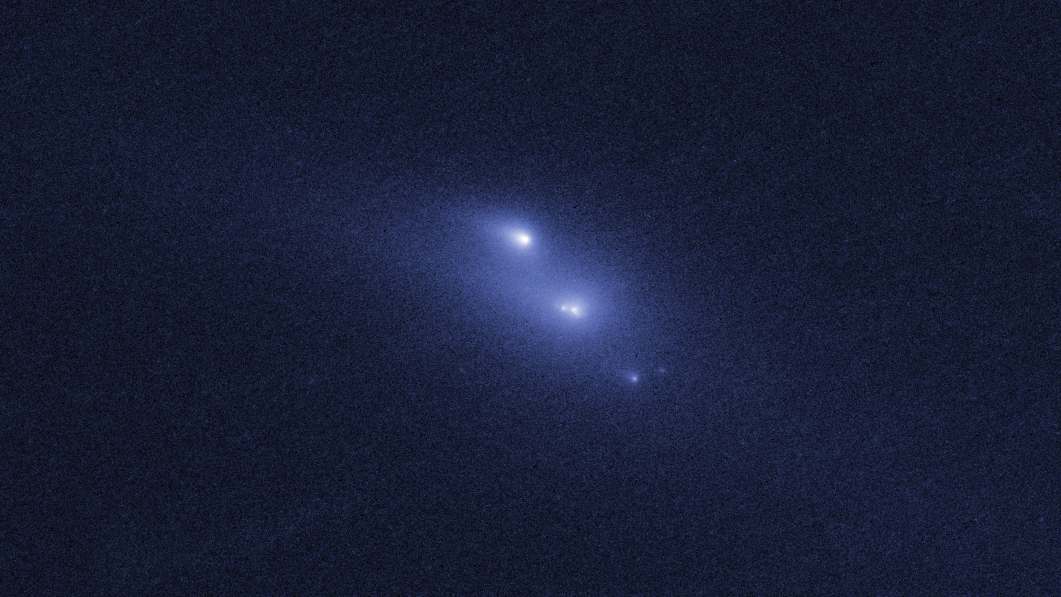
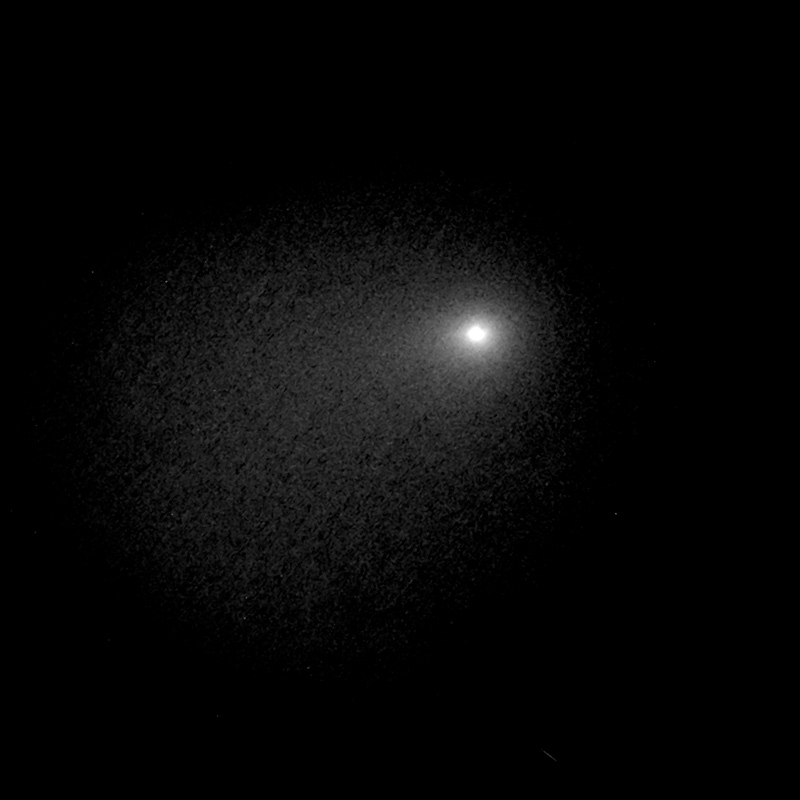
Comet Siding Spring (C/2013 A1) had a close encounter with Mars on October 19, 2014. On that date the comet passed within approximately 87,000 miles of Mars (or about one-third the distance between Earth and the Moon). This was one of the closest observed cometary flybys of any planet, and Hubble captured this image of the comet during its approach. The observation provided crucial data about the comet's nucleus and activity ahead of its historic Mars encounter.
Scientific Significance
Comet Siding Spring's close flyby of Mars presented a unique opportunity to study the effects of a cometary close encounter on a planetary body with a thin atmosphere. The comet's coma—the cloud of gas and dust surrounding the nucleus—swept over Mars, depositing material into the Martian atmosphere. Spacecraft orbiting Mars detected the chemical signatures of cometary material and observed meteors in the Martian atmosphere caused by dust particles. Hubble observations before the encounter helped characterize the comet's activity level, nucleus size (estimated at 400-700 meters), and the structure of its dust and gas coma. These observations were essential for predicting the intensity of the Mars encounter and planning the spacecraft protection measures. The event also provided a natural experiment for understanding how cometary impacts may have delivered water and organic molecules to planets in the early solar system.
Observation Details
Hubble observed Comet Siding Spring using the Wide Field Camera 3 (WFC3) in both optical and ultraviolet wavelengths. The observations tracked the comet's activity as it approached the inner solar system and its distance from the Sun decreased. Ultraviolet observations were particularly valuable for detecting emissions from water and other volatile compounds in the coma. The high spatial resolution of Hubble allowed astronomers to separate the compact nucleus region from the extended coma and tail, providing better estimates of the nucleus size than would be possible from ground-based observations.
Location in the Universe
Constellation
Ophiuchus
Distance from Earth
Varied (closest to Mars: 87,000 miles)
Fun Facts
- 1
Comet Siding Spring originated in the Oort Cloud, the distant shell of icy bodies that surrounds our solar system at distances of up to 50,000 times Earth's distance from the Sun.
- 2
NASA repositioned its Mars orbiters to shield them from potential dust impacts during the comet's closest approach.
- 3
This was the comet's first and only visit to the inner solar system—it won't return for millions of years, if ever.
Image credit: NASA, ESA, Hubble Space Telescope