About This Image
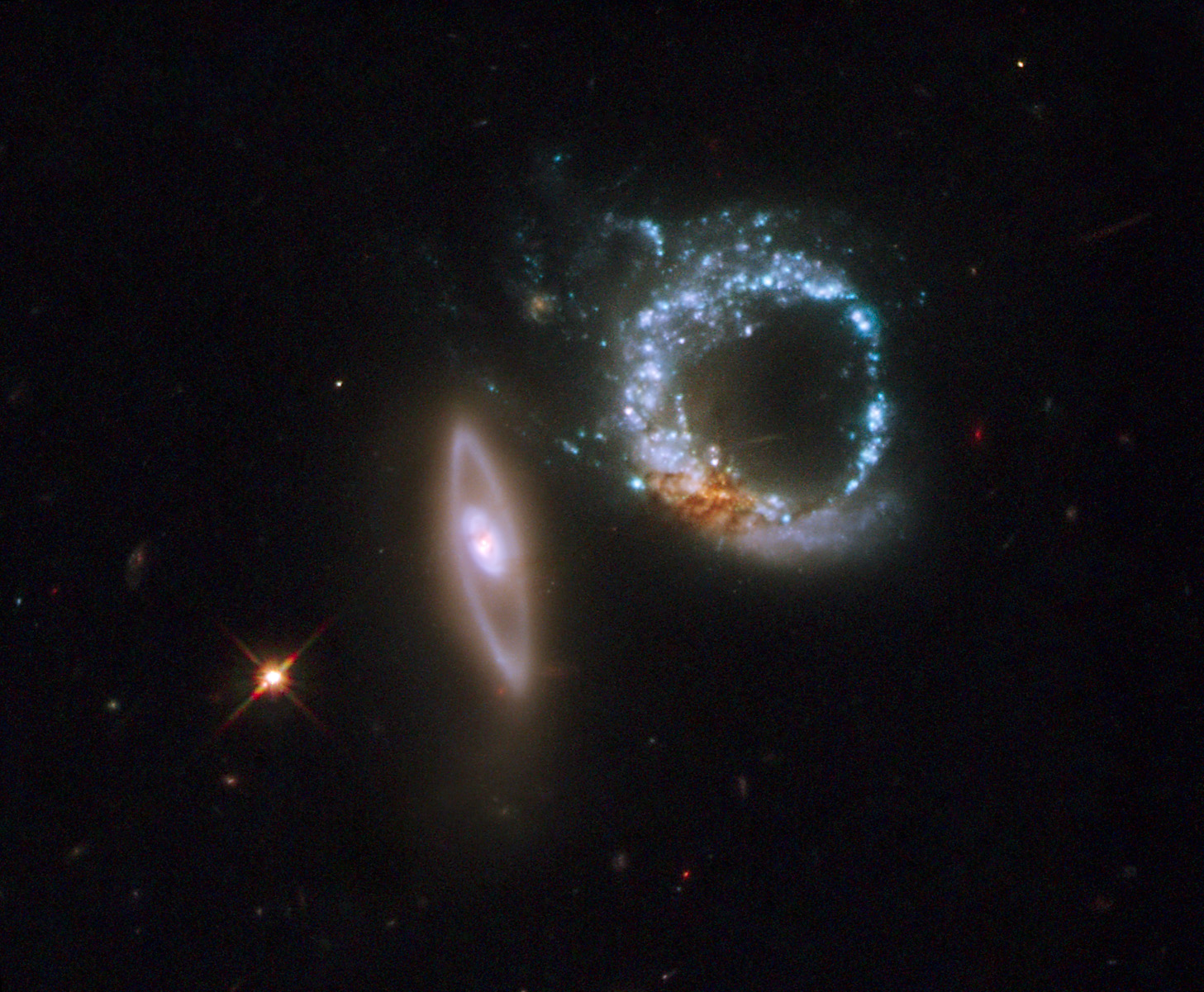
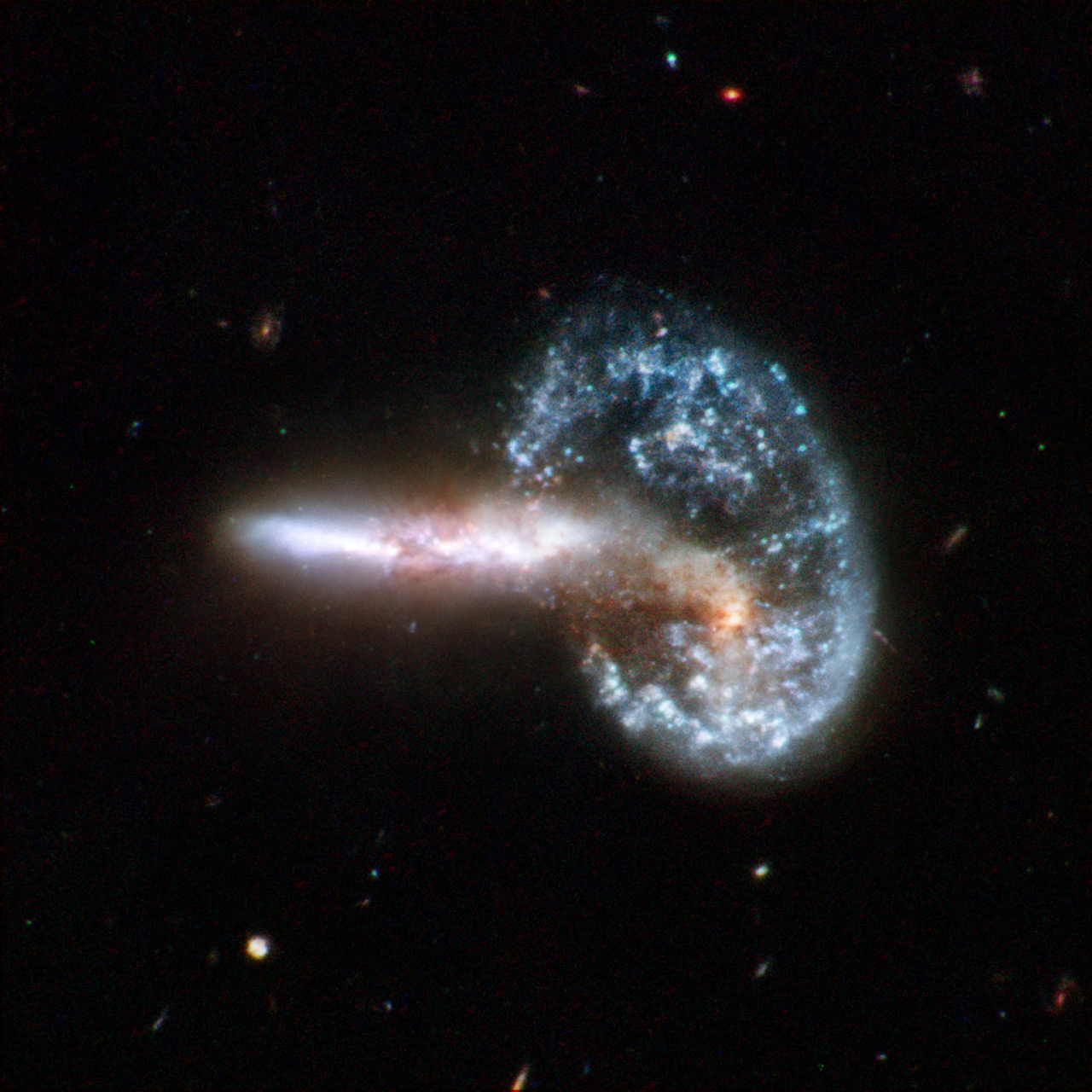
Arp 148 is the aftermath of an encounter between two galaxies, resulting in a ring-shaped galaxy and an elongated companion. The shapes and arrangement of the galaxies suggest that this is a snapshot of an ongoing collision. The striking ring structure formed when one galaxy plunged directly through the center of the other, triggering a circular wave of star formation that expanded outward like ripples from a stone dropped in a pond. The blue ring is lit up by massive young stars formed in the wake of this cosmic collision.
Scientific Significance
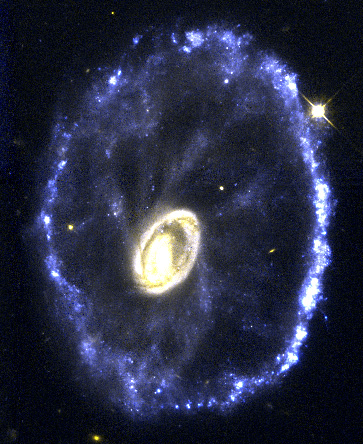
Arp 148 is a textbook example of a collisional ring galaxy, a rare type of system that forms through a specific geometric alignment during galaxy interactions. When a smaller galaxy passes through the center of a larger disk galaxy, it creates a symmetric density wave that propagates outward, compressing gas and triggering intense star formation along the expanding ring. The study of ring galaxies like Arp 148 provides unique insights into the physics of galaxy collisions and the propagation of star formation through galactic disks. Computer simulations have successfully reproduced the morphology of Arp 148 and similar systems, confirming our understanding of the collision dynamics. These systems also serve as laboratories for studying triggered star formation, as the ring contains a well-defined episode of star birth that can be dated precisely.
Observation Details
This image was captured using Hubble's Wide Field Planetary Camera 2 (WFPC2) as part of a survey of peculiar galaxies from Halton Arp's Atlas of Peculiar Galaxies. The multi-band observations allow astronomers to map the distribution of young blue stars in the ring and older red stars in the nuclear regions of both galaxies. The sharp resolution of Hubble reveals the complex structure within the ring, including individual star-forming knots and tidal features that trace the gravitational disturbance of the collision.
Location in the Universe
Constellation
Ursa Major
Distance from Earth
450 million light-years
Fun Facts
- 1
The ring in Arp 148 is approximately 30,000 light-years in diameter—about one-third the size of the Milky Way's disk.
- 2
This type of galaxy collision is called a 'bull's-eye' or 'cartwheel' collision because one galaxy passed nearly perfectly through the center of another.
- 3
The collision will continue for hundreds of millions of years, eventually merging the two galaxies into a single, larger elliptical galaxy.
Image credit: NASA, ESA, Hubble Space Telescope