About This Image
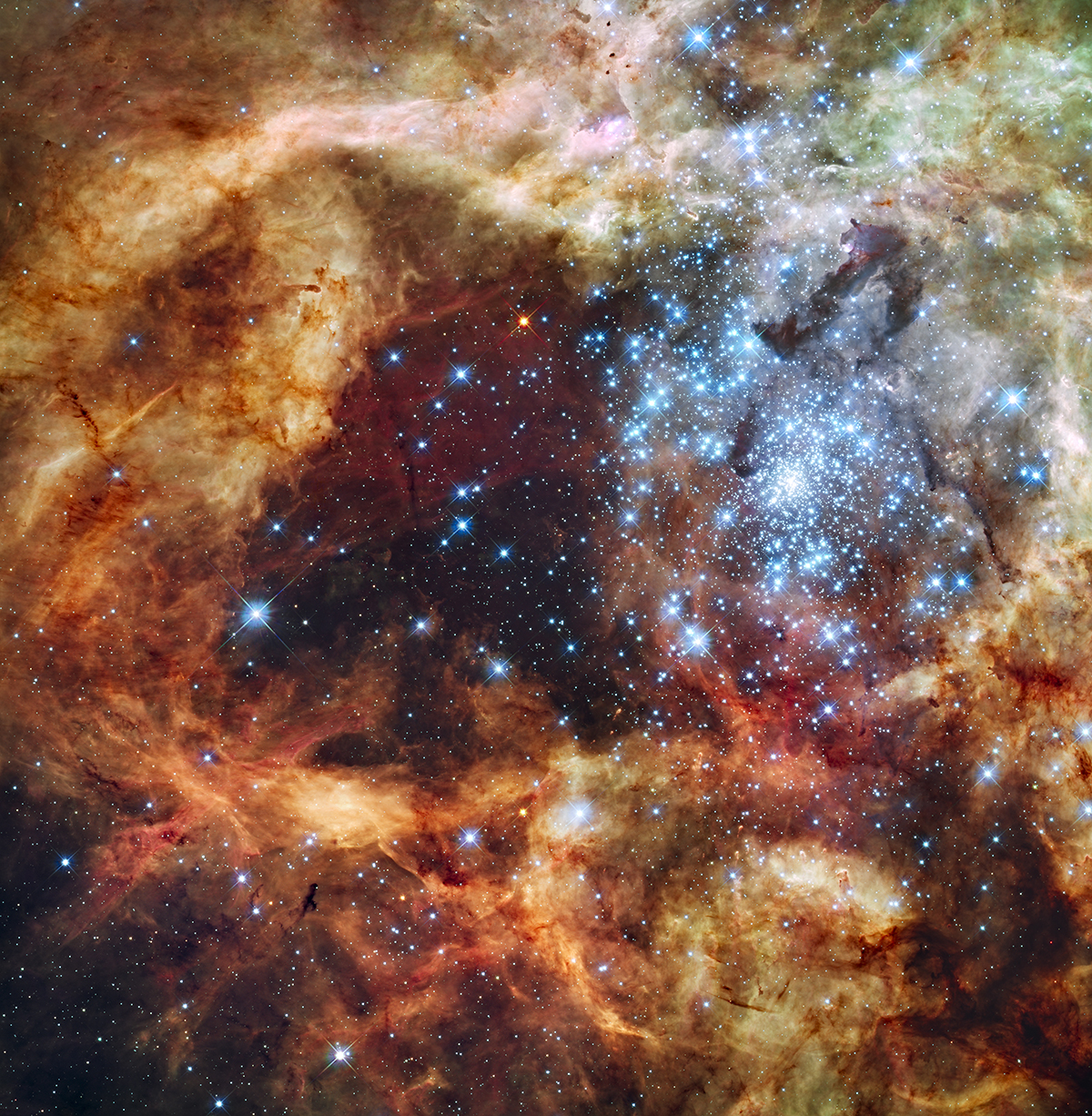
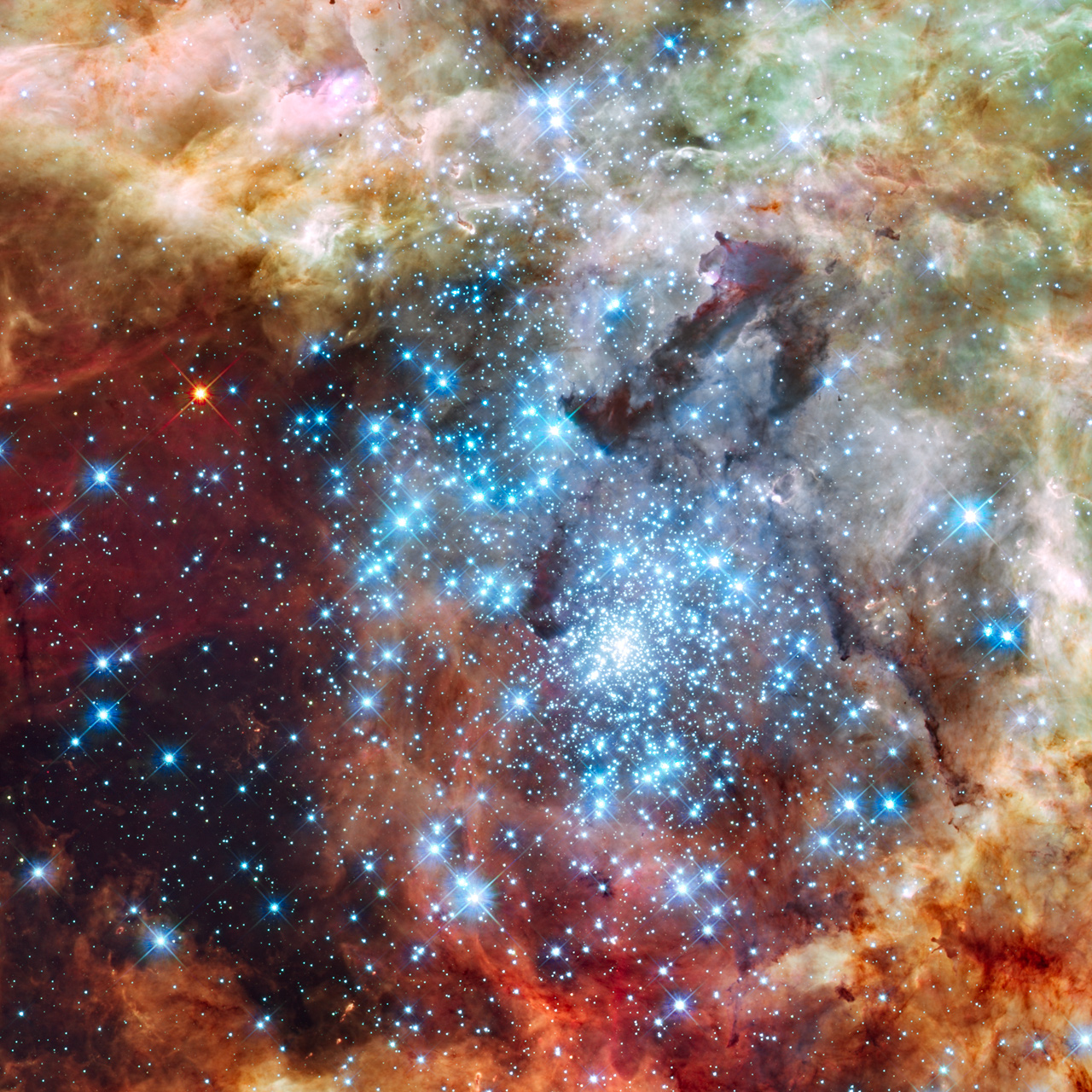
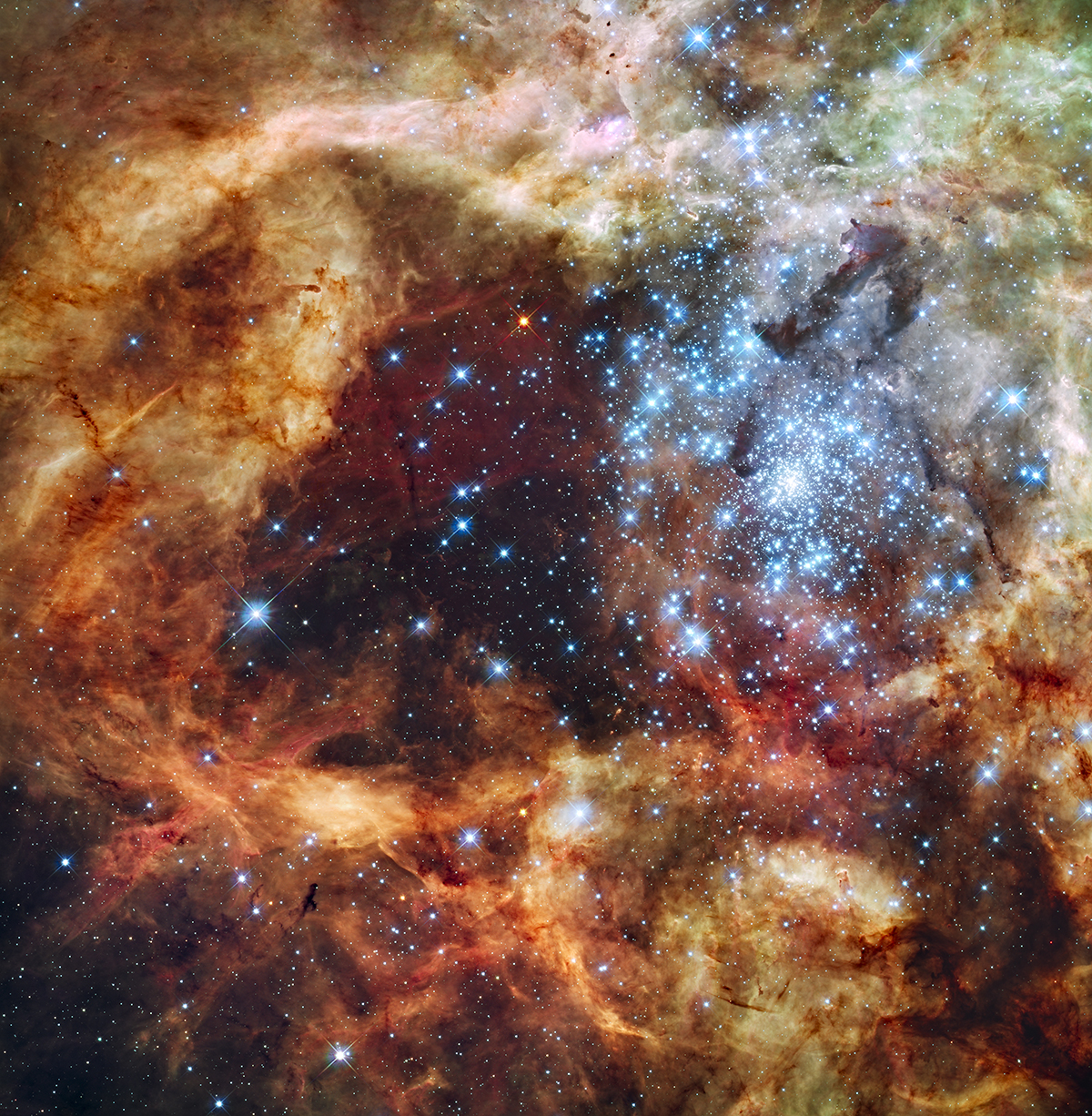
This massive, young stellar grouping, called R136, is only a few million years old and resides in the 30 Doradus Nebula, a turbulent star-birth region in the Large Magellanic Cloud, a satellite galaxy of our Milky Way. This view captures a different portion of the Tarantula Nebula, showcasing the complex web of ionized gas, dust pillars, and stellar winds that characterize this extraordinary region of cosmic creation.
Scientific Significance
The 30 Doradus Nebula complex offers an unparalleled view of how massive star formation affects its surrounding environment on scales from individual protostars to entire galactic structures. The intense radiation and powerful winds from the R136 cluster and other massive stars have created a network of bubbles, filaments, and pillars that trace the complex feedback between star formation and the interstellar medium. Dense pillar structures, similar to the famous Pillars of Creation in the Eagle Nebula but on a larger scale, are being sculpted by the radiation field and may themselves harbor the next generation of stars. The 30 Doradus region contains multiple generations of star formation occurring simultaneously, from very young embedded protostars still accreting material to the evolved massive stars whose deaths will soon enrich the region with heavy elements. This multi-generational aspect makes it ideal for studying the self-propagating nature of star formation.
Observation Details
These observations were made with Hubble's Wide Field Camera 3 (WFC3) in both optical and near-infrared wavelengths. The multi-filter imaging allows astronomers to distinguish between emission from ionized hydrogen, doubly ionized oxygen, and other species, tracing temperature and density variations across the nebula. Near-infrared observations penetrate the dust to reveal embedded stellar populations invisible at optical wavelengths. The observations are part of the Hubble Tarantula Treasury Project, a comprehensive imaging survey of this unique star-forming region.
Location in the Universe
Constellation
Dorado
Distance from Earth
160,000 light-years
Fun Facts
- 1
The Tarantula Nebula was originally classified as a star when it was first cataloged, because at the distance of the LMC it appeared point-like in early telescopes.
- 2
The nebula spans approximately 300 light-years across—large enough to contain hundreds of smaller nebulae like the Orion Nebula.
- 3
Supernova 1987A, the nearest supernova to Earth observed in modern times, exploded in the outskirts of the Tarantula Nebula.
Image credit: NASA, ESA, Hubble Space Telescope