About This Image
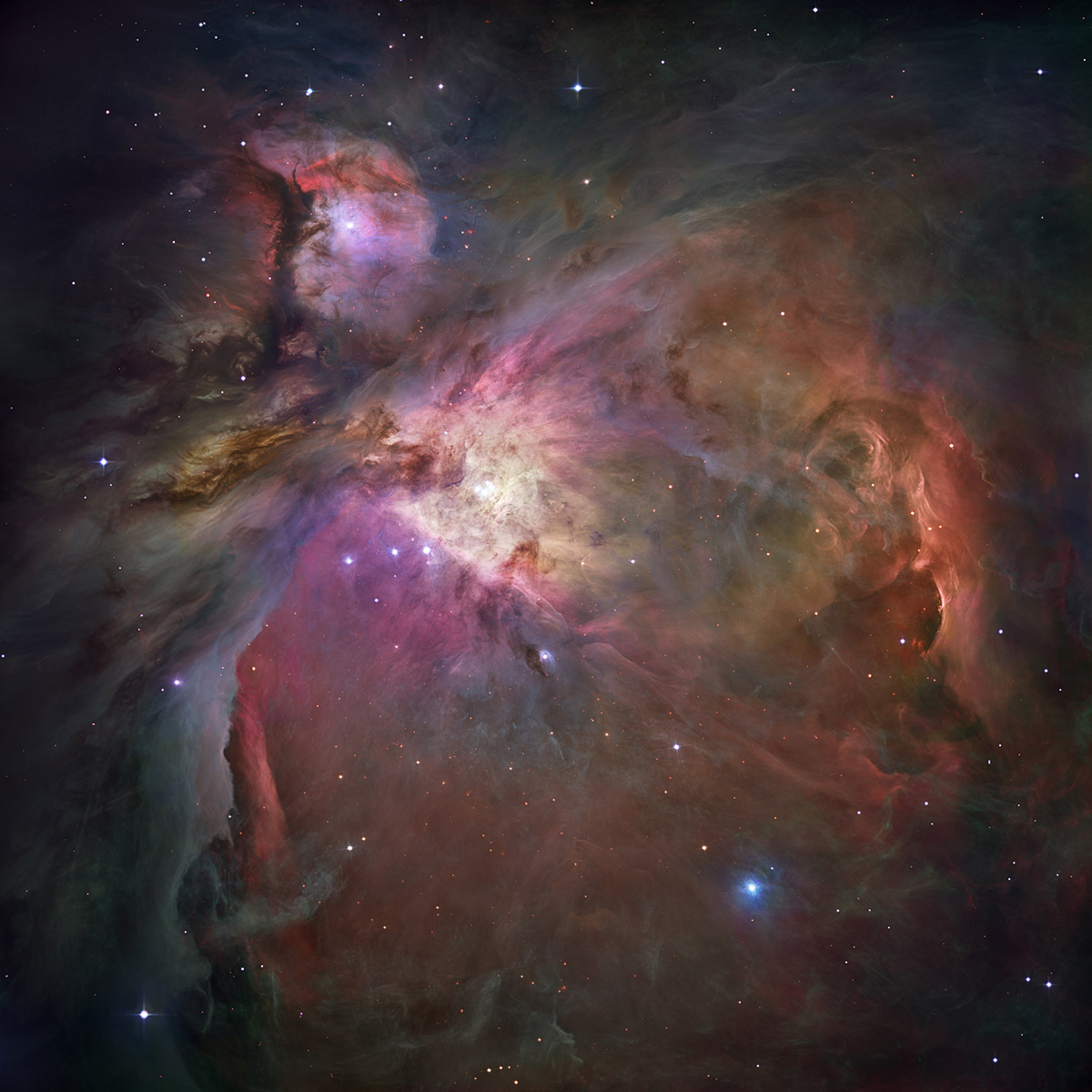
The Orion Nebula is the nearest star-forming region to Earth. Massive, young stars are shaping the nebula with their winds and radiation. Pillars of dense gas may be the homes of budding stars. The bright central region is the home of the four heftiest stars in the nebula. This cosmic nursery has been producing new stars for millions of years and contains thousands of young stellar objects at various stages of formation, from collapsing cloud cores to fully formed stars surrounded by planet-forming disks.
Scientific Significance
The Orion Nebula is one of the most studied objects in the sky because it provides an accessible laboratory for understanding star formation. At only 1,344 light-years away, it is close enough for Hubble to resolve individual protostars, protoplanetary disks, and the complex interactions between young stars and their natal gas clouds. The massive O-type stars of the Trapezium cluster illuminate the nebula and are gradually eroding it from within, creating the distinctive cavity structure visible in images. The nebula contains stars ranging from recently formed objects still embedded in their birth clouds to slightly older stars that have cleared their surroundings. By studying stars at different evolutionary stages within this single region, astronomers can piece together the timeline of stellar evolution from cloud collapse to main sequence star. The discovery of hundreds of protoplanetary disks (called 'proplyds') in the Orion Nebula has provided crucial insights into planet formation.
Observation Details
This image is part of one of the most detailed astronomical images ever produced, combining 520 Hubble images taken between 2004 and 2005. The observations used multiple cameras including ACS and NICMOS to capture both optical and infrared light. The full mosaic covers an area of sky approximately one degree across—about twice the apparent diameter of the full Moon—and reveals unprecedented detail in the nebula's structure. The optical observations trace ionized hydrogen and oxygen, while infrared data penetrate the dusty regions to reveal embedded young stars.
Location in the Universe
Constellation
Orion
Distance from Earth
1,344 light-years
Fun Facts
- 1
The Orion Nebula is visible to the naked eye as a fuzzy patch in Orion's sword, making it the nearest region of massive star formation visible without a telescope.
- 2
The four central stars, known as the Trapezium, are so luminous that together they produce more light than 100,000 Suns.
- 3
Many of the young stars in the Orion Nebula are surrounded by protoplanetary disks that may eventually form solar systems like our own.
Image credit: NASA, ESA, Hubble Space Telescope