About This Image
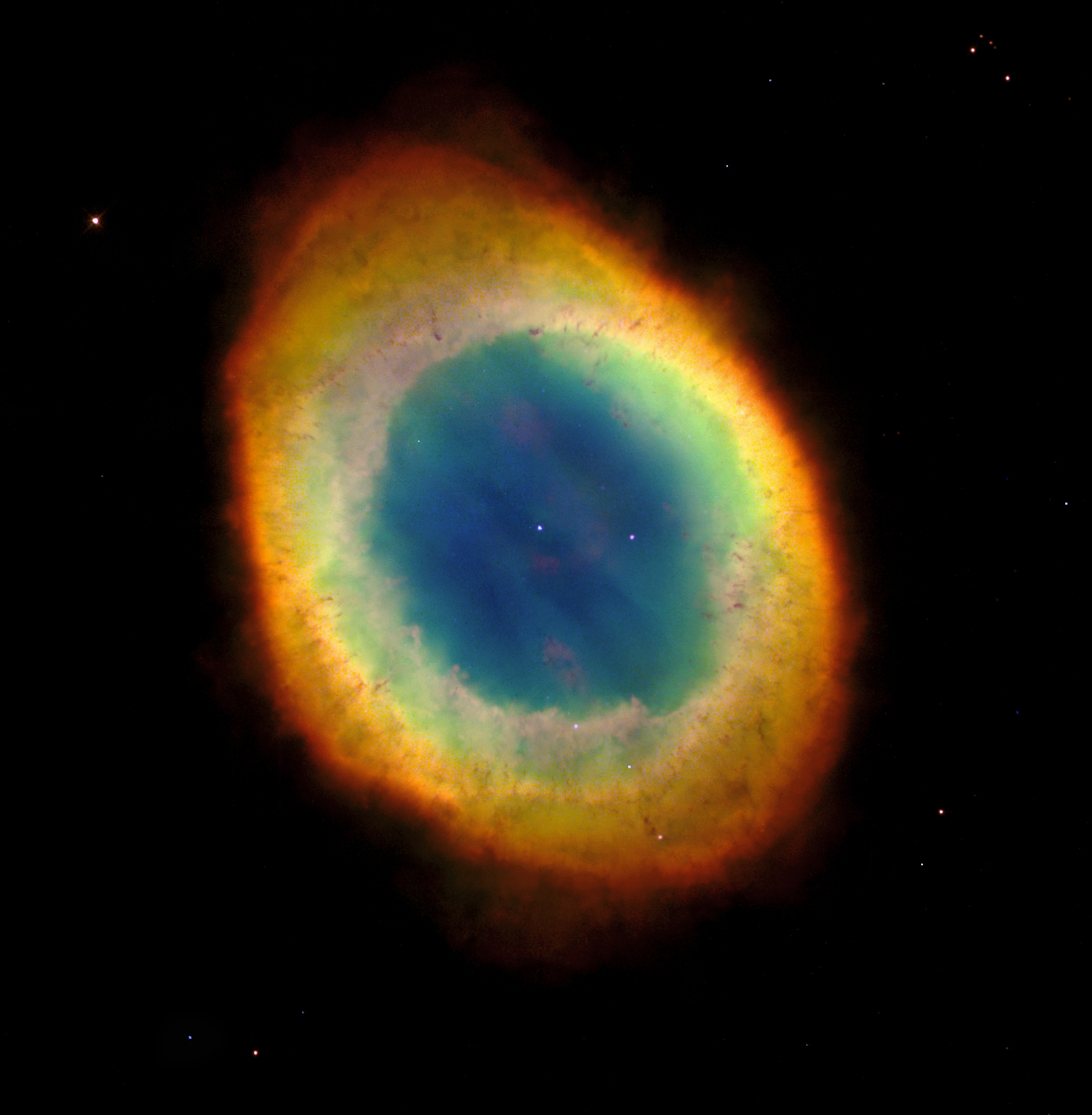
About a light-year across, the Ring Nebula is formed by a dying star floating in a blue haze of hot gas at its center. This image reveals elongated, dark clumps of material embedded in the gas at the edge of the nebula. The Ring Nebula is a planetary nebula—the glowing shell of gas expelled by a Sun-like star in its final stages of evolution. The central white dwarf, the exposed core of the original star, illuminates and ionizes the expanding shell, creating one of the most iconic objects in the night sky.
Scientific Significance
The Ring Nebula (M57) is one of the best-studied planetary nebulae and serves as a prototype for understanding the late stages of stellar evolution for Sun-like stars. When a star with a mass between about 0.8 and 8 solar masses exhausts its nuclear fuel, it expels its outer layers in a series of thermal pulses, creating the planetary nebula. The Ring Nebula's relatively simple structure and favorable viewing geometry make it ideal for testing models of planetary nebula formation and evolution. Hubble observations have revealed that the nebula has a complex three-dimensional structure, with the bright ring representing a dense equatorial torus and fainter material extending along the poles. The dark knots visible in the ring are thought to be dense condensations formed during the ejection process, and their survival and evolution provide insights into the interactions between stellar winds and the expelled envelope.
Observation Details
This image was taken with Hubble's Wide Field Planetary Camera 2 (WFPC2) in narrow-band filters that isolate emission from specific ions, including hydrogen, ionized oxygen, and ionized nitrogen. The different colors in the image correspond to these different chemical species, revealing the temperature and ionization structure of the nebula. The observations captured detail as small as a few hundred astronomical units across, equivalent to a few times the size of our solar system at the distance of the Ring Nebula. This resolution reveals the complex structure of the nebular shell and the embedded dark globules.
Location in the Universe
Constellation
Lyra
Distance from Earth
2,300 light-years
Fun Facts
- 1
The Ring Nebula's classic ring shape is actually a projection effect—it is more accurately described as a barrel or cylinder viewed from one end.
- 2
The central white dwarf has a surface temperature of about 125,000 Kelvin—more than 20 times hotter than the Sun's surface.
- 3
The nebula is expanding at about 20 kilometers per second and will eventually disperse into the interstellar medium over the next 10,000 years.
Image credit: NASA, ESA, Hubble Space Telescope