About This Image
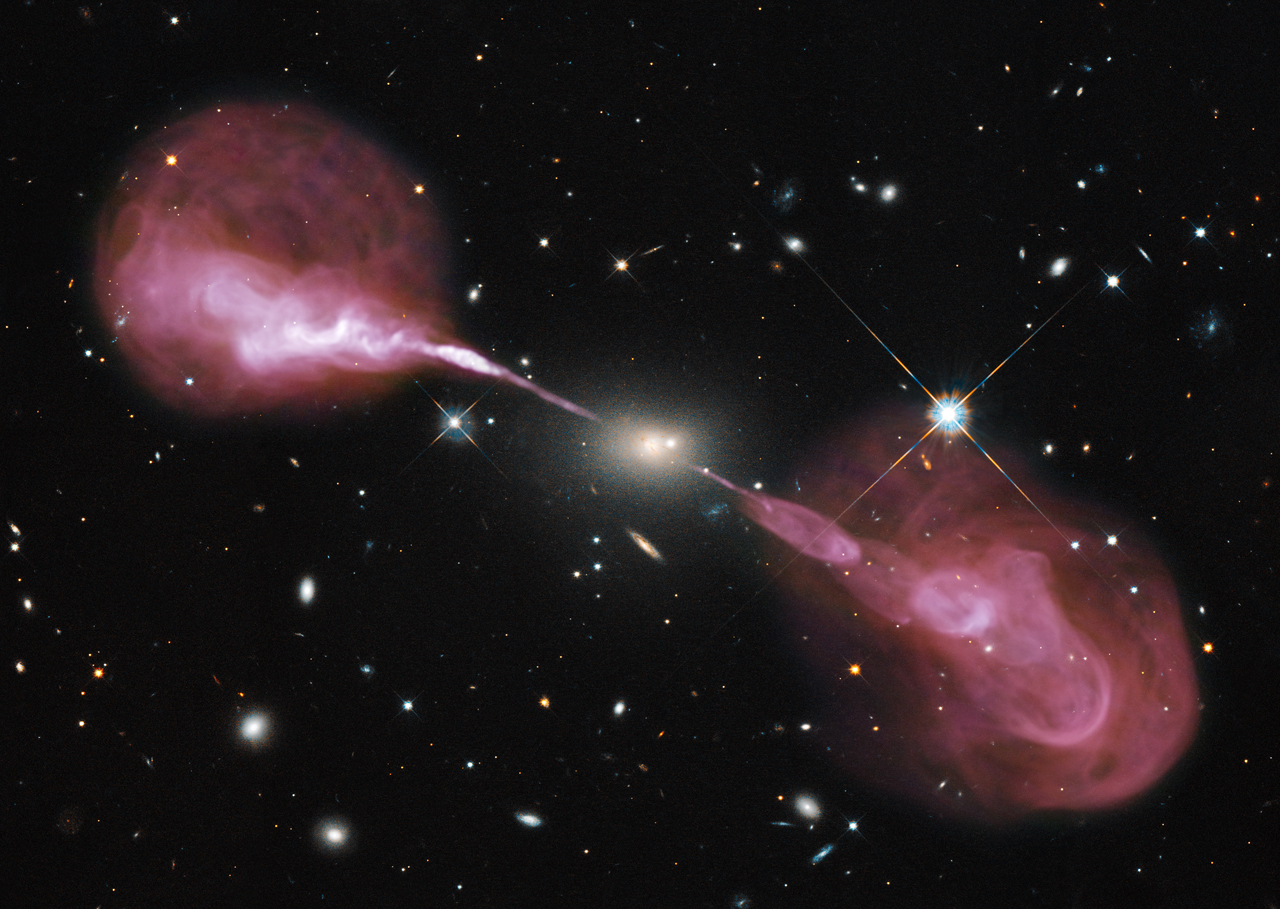
At the center of this image sits a large galaxy called Hercules A that harbors a supermassive black hole more than a thousand times as massive as the one in the Milky Way's center. Radio observations reveal large jets shooting away from the galaxy's core. This composite image combines optical light from Hubble with radio emissions captured by the Karl G. Jansky Very Large Array, revealing the dramatic interplay between the central black hole and the surrounding intergalactic medium. The jets extend for nearly a million light-years on either side of the galaxy, making Hercules A one of the most powerful radio sources in the sky.
Scientific Significance
Hercules A provides one of the most spectacular examples of AGN feedback—the process by which energy released by a supermassive black hole regulates star formation in its host galaxy and affects the surrounding environment. The powerful jets emanating from the central black hole inject enormous amounts of energy into the intergalactic medium, heating the surrounding gas and preventing it from cooling and forming stars. This feedback mechanism is thought to be crucial for explaining why the most massive galaxies in the universe stopped forming stars billions of years ago, despite containing vast reservoirs of hot gas. The detailed structure of the Hercules A jets, including the ring-like features and hotspots visible in radio observations, traces the history of the black hole's activity over millions of years. By studying these features, astronomers can reconstruct the episodic nature of black hole accretion and jet production.
Observation Details
This striking composite image combines optical observations from Hubble's Wide Field Camera 3 (WFC3) with radio data from the Karl G. Jansky Very Large Array (VLA). The Hubble data reveal the stellar population of the host galaxy, a massive elliptical system typical of powerful radio galaxies. The VLA observations at 5 GHz frequency show the detailed structure of the relativistic jets, including multiple knots and the characteristic back-flowing plumes where the jets have decelerated upon encountering the ambient medium. The combination of optical and radio data allows astronomers to study the connection between the galaxy's stellar properties and its nuclear activity.
Location in the Universe
Constellation
Hercules
Distance from Earth
2.1 billion light-years
Fun Facts
- 1
The supermassive black hole at the center of Hercules A has a mass of about 2.5 billion solar masses—roughly 1,000 times more massive than the black hole in the center of our Milky Way.
- 2
The radio jets from Hercules A release as much energy in one second as the Sun will produce over its entire 10-billion-year lifetime.
- 3
The jets create huge cavities in the surrounding hot gas, displacing material with a mass equivalent to hundreds of millions of stars.
Image credit: NASA, ESA, Hubble Space Telescope