About This Image
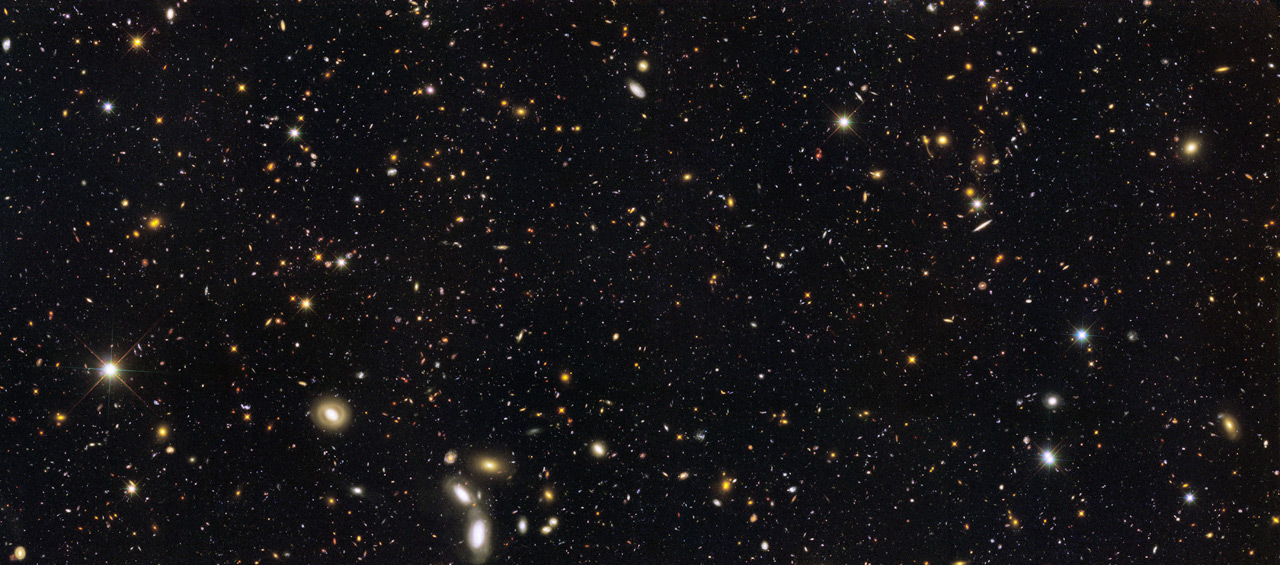
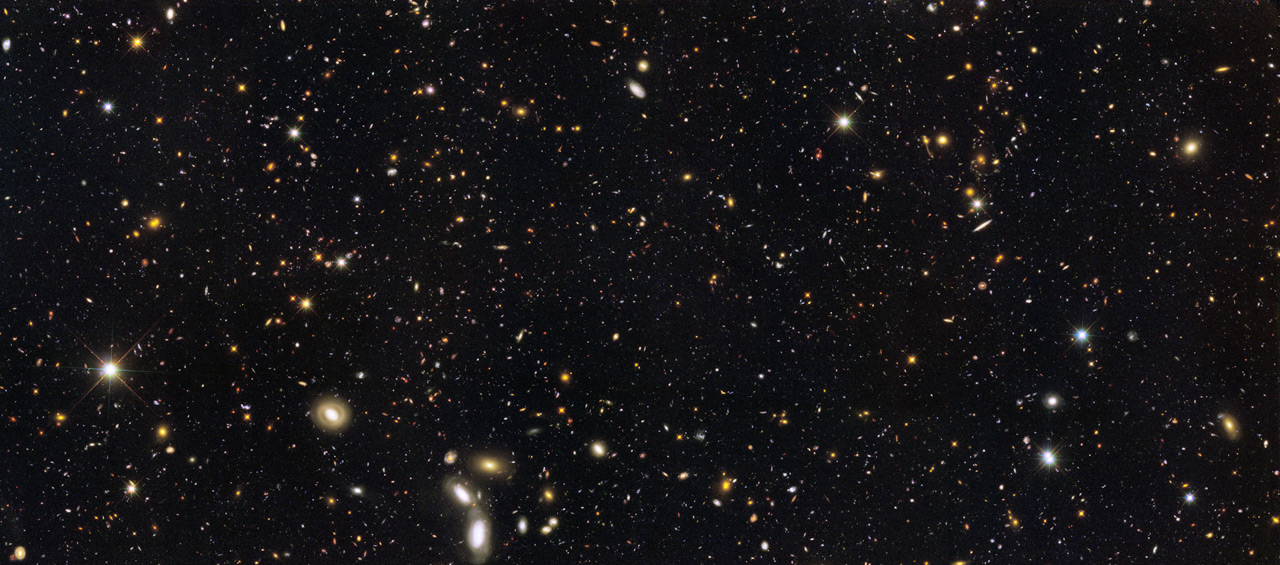
More than 12 billion years of cosmic history are shown in this panoramic view of thousands of galaxies in various stages of assembly. The view covers a portion of the southern field of a galaxy census called the Great Observatories Origins Deep Survey (GOODS). This deep observation penetrates through billions of years of cosmic time, revealing the gradual transformation of the universe from a place dominated by small, irregular galaxies to one filled with the majestic spirals and ellipticals we see in the nearby universe.
Scientific Significance
The GOODS South Field has provided crucial constraints on the metallicity evolution of galaxies over cosmic time. Metallicity—the abundance of elements heavier than hydrogen and helium—is a key tracer of chemical enrichment by successive generations of stars. By obtaining spectra of galaxies at different cosmic epochs in this field, astronomers have traced how the heavy element content of galaxies has increased over billions of years as stars have synthesized and dispersed metals through supernovae and stellar winds. These studies have revealed that the most massive galaxies reached near-solar metallicities early in cosmic history, while less massive galaxies have continued to enrich slowly over time. The metallicity-mass relationship observed at different redshifts provides fundamental constraints on models of gas inflow, star formation, and feedback in galaxy evolution.
Observation Details
This image represents observations taken as part of the extended GOODS program in 2004, which added additional optical filters and exposure time to the original survey. The deep z-band observations were particularly important for detecting galaxies at redshifts above 5, where the Lyman break feature is redshifted into this filter. Careful attention was paid to flat-fielding and background subtraction to achieve the photometric precision required for reliable photometric redshifts. The final mosaics were calibrated to an absolute accuracy of better than 2% across all filters.
Location in the Universe
Constellation
Fornax
Distance from Earth
Up to 13 billion light-years
Fun Facts
- 1
If every galaxy in the entire sky were counted, the total would exceed 200 billion—and the GOODS field contains a representative sample of this cosmic population.
- 2
Many galaxies in this field are still forming at rates of hundreds of solar masses per year, compared to the Milky Way's modest 1-2 solar masses per year.
- 3
The light from the most distant galaxies in this image left its source when the universe was only about 700 million years old.
Image credit: NASA, ESA, Hubble Space Telescope