About This Image
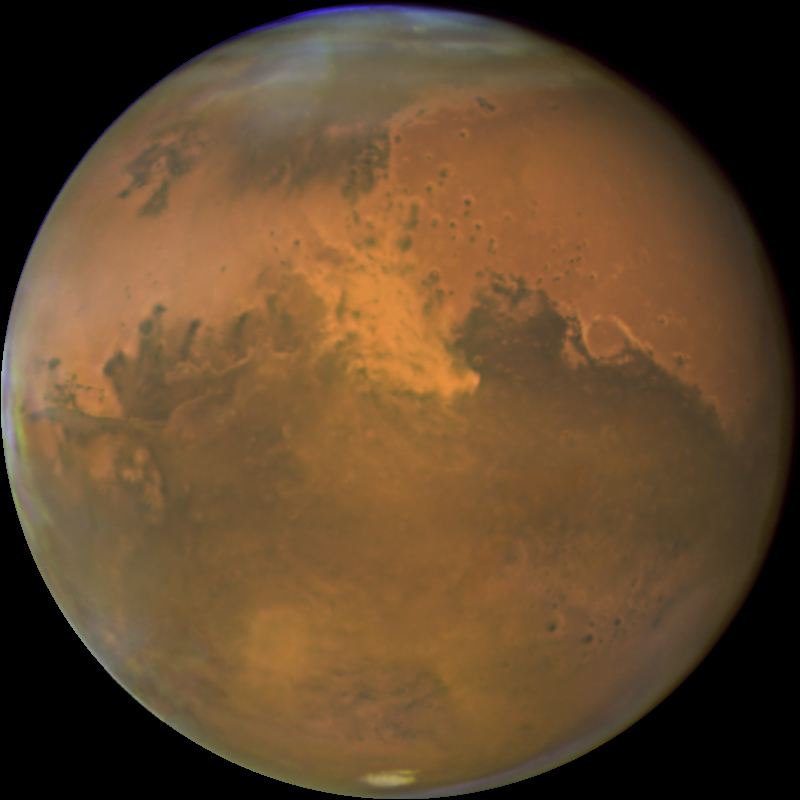
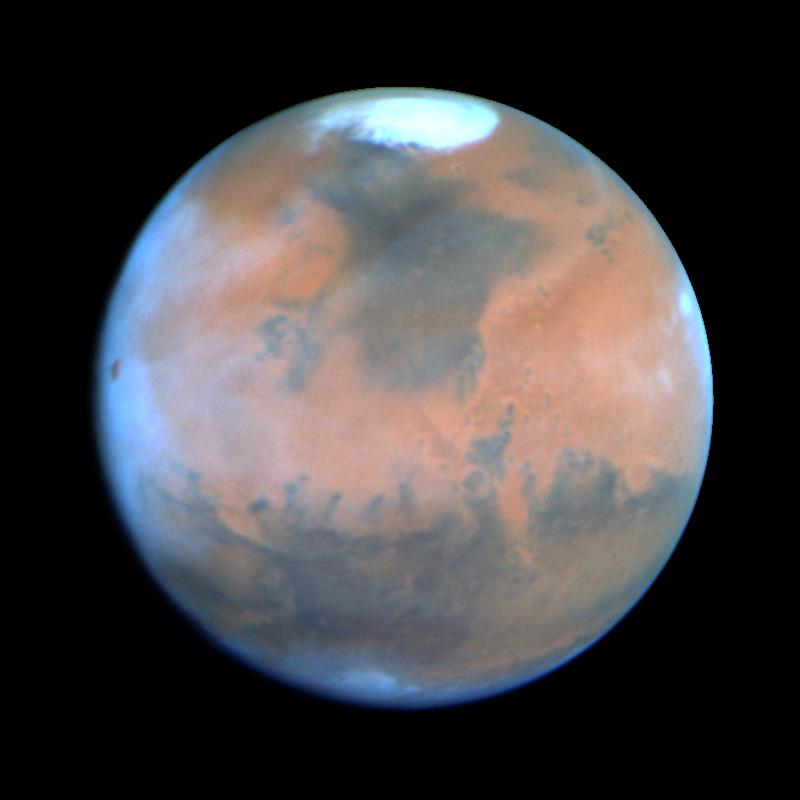
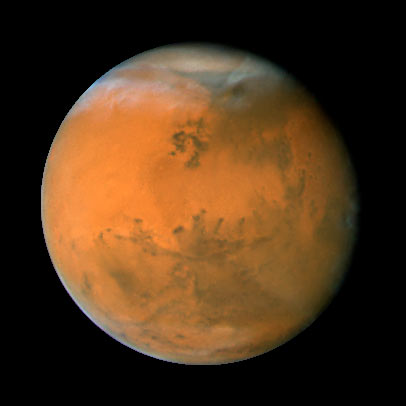
Hubble captured this image of Mars soon before the planet made its closest approach to Earth in 2007. White clouds cover the north polar region. The long, dark feature to the lower left of center is the canyon system Valles Marineris.
Scientific Significance
Mars monitoring helps scientists model atmospheric circulation, dust transport, and seasonal polar cap changes over long timescales. Full-disk Hubble views provide global context that complements orbiter missions.
Observation Details
Hubble used visible-light imaging with multiple filters and short exposures to reduce rotational blur, revealing cloud structure, dust streaks, and major surface features such as Valles Marineris.
Location in the Universe
Constellation
N/A (Solar System)
Distance from Earth
35 to 250 million miles (varies)
Fun Facts
- 1
Hubble can resolve global Martian weather patterns from Earth orbit.
- 2
The north polar cap combines permanent water ice with seasonal carbon-dioxide frost.
- 3
Long-term Hubble monitoring links older Mars observations with modern spacecraft data.
Image credit: NASA, ESA, Hubble Space Telescope