About This Image
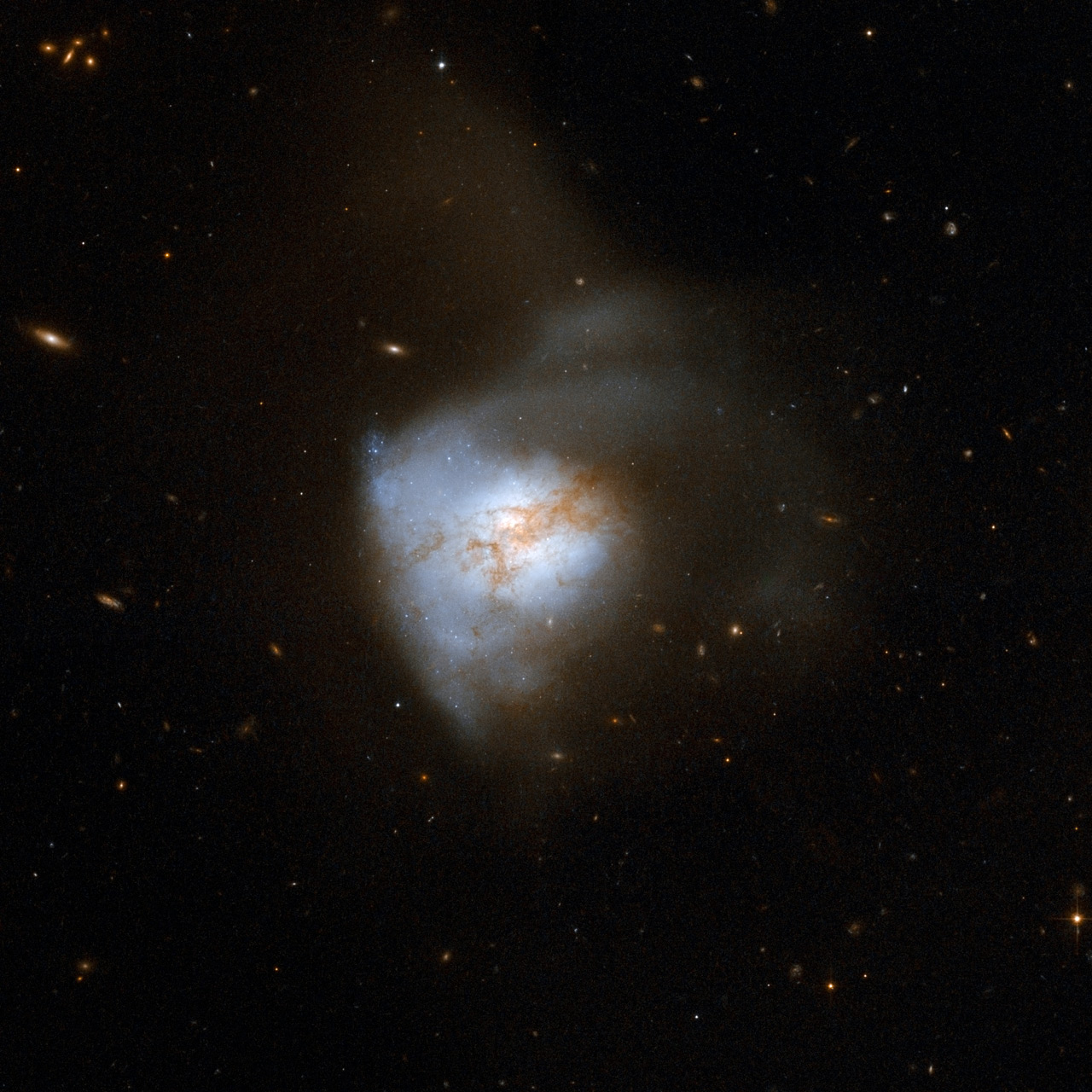
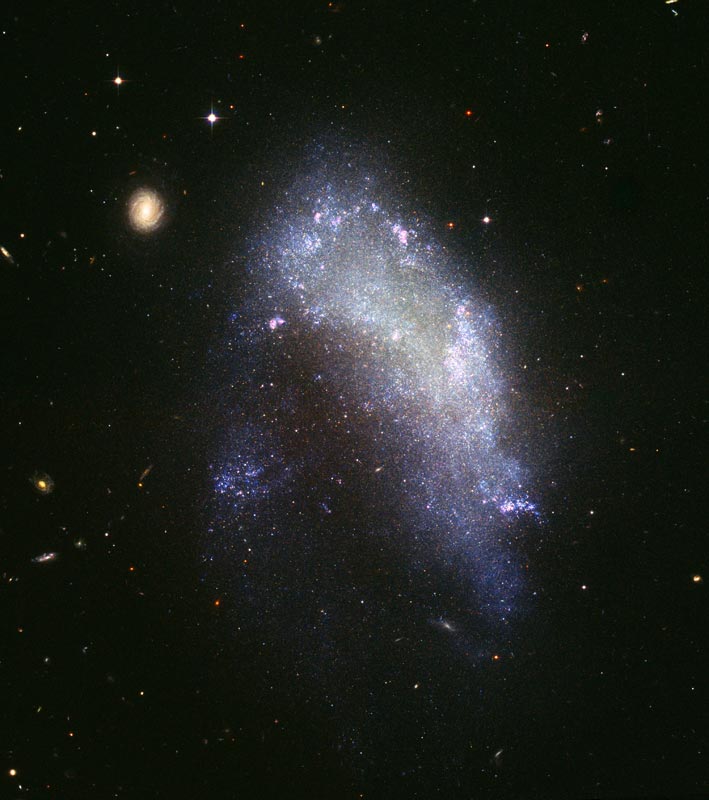
This striking image captures NGC 1427A, an irregular dwarf galaxy caught in the midst of a gravitational drama within the Fornax galaxy cluster. The galaxy's distorted, asymmetric shape bears witness to the powerful gravitational forces exerted by its larger galactic neighbors, which are warping and stretching its structure as it plunges through the cluster at high speed. This cosmic interaction is triggering bursts of star formation throughout the galaxy as gas clouds are compressed by the encounter. NGC 1427A's chaotic appearance and active star-forming regions make it a prime example of how gravitational interactions shape galactic evolution, transforming orderly structures into irregular, dynamic systems. As the dwarf galaxy continues its journey through the Fornax cluster, it may eventually be torn apart completely by tidal forces, with its stars and gas absorbed into larger galaxies.
Scientific Significance
NGC 1427A is one of the most vivid examples of ram pressure stripping and tidal disruption actively transforming a galaxy in real time. As it plunges through the hot intracluster medium of the Fornax Cluster, the pressure exerted on its interstellar gas compresses clouds on the leading edge and strips gas from the trailing side, creating a pronounced asymmetry in both its gas distribution and star formation pattern. This process demonstrates one of the primary mechanisms by which galaxy clusters process and ultimately destroy their smaller member galaxies — a phenomenon critical for understanding why cluster environments are dominated by gas-poor elliptical and lenticular galaxies. The triggered starburst along NGC 1427A's leading edge provides a clean example of ram-pressure-induced star formation, allowing astronomers to study how external compression affects the star formation process. The galaxy also contributes to the buildup of intracluster light — the diffuse glow of stars liberated from their parent galaxies — which accounts for a significant fraction of the total stellar mass in galaxy clusters.
Observation Details
Hubble captured this image of NGC 1427A using the Advanced Camera for Surveys (ACS) in broadband optical filters including B, V, and I bands, supplemented by narrowband H-alpha imaging to trace ionized gas associated with active star formation. The ACS observations resolved individual young star clusters and OB associations across the galaxy's distorted body, revealing the strong concentration of recent star formation along the leading edge of the galaxy's motion through the cluster. The spatial distribution of star clusters of different ages was used to reconstruct the recent interaction history. Comparison with X-ray observations from the Chandra telescope mapped the hot intracluster medium responsible for the ram pressure stripping visible in Hubble's optical images.
Location in the Universe
Constellation
Fornax
Distance from Earth
62 million light-years
Fun Facts
- 1
NGC 1427A is hurtling through the Fornax Cluster at roughly 600 kilometers per second — so fast that the ram pressure from the cluster's hot intergalactic gas is visibly deforming the galaxy's shape, stretching it into an arrow-like form pointing away from the cluster center.
- 2
The intense burst of star formation triggered by the galaxy's plunge through the cluster has produced brilliant blue star clusters containing stars less than 10 million years old — stellar infants by cosmic standards.
- 3
Astronomers estimate that NGC 1427A will be completely destroyed within the next billion years, its stars scattered into the intergalactic space of the Fornax Cluster and its gas stripped away entirely by ram pressure.
Image credit: NASA, ESA, Hubble Space Telescope