About This Image
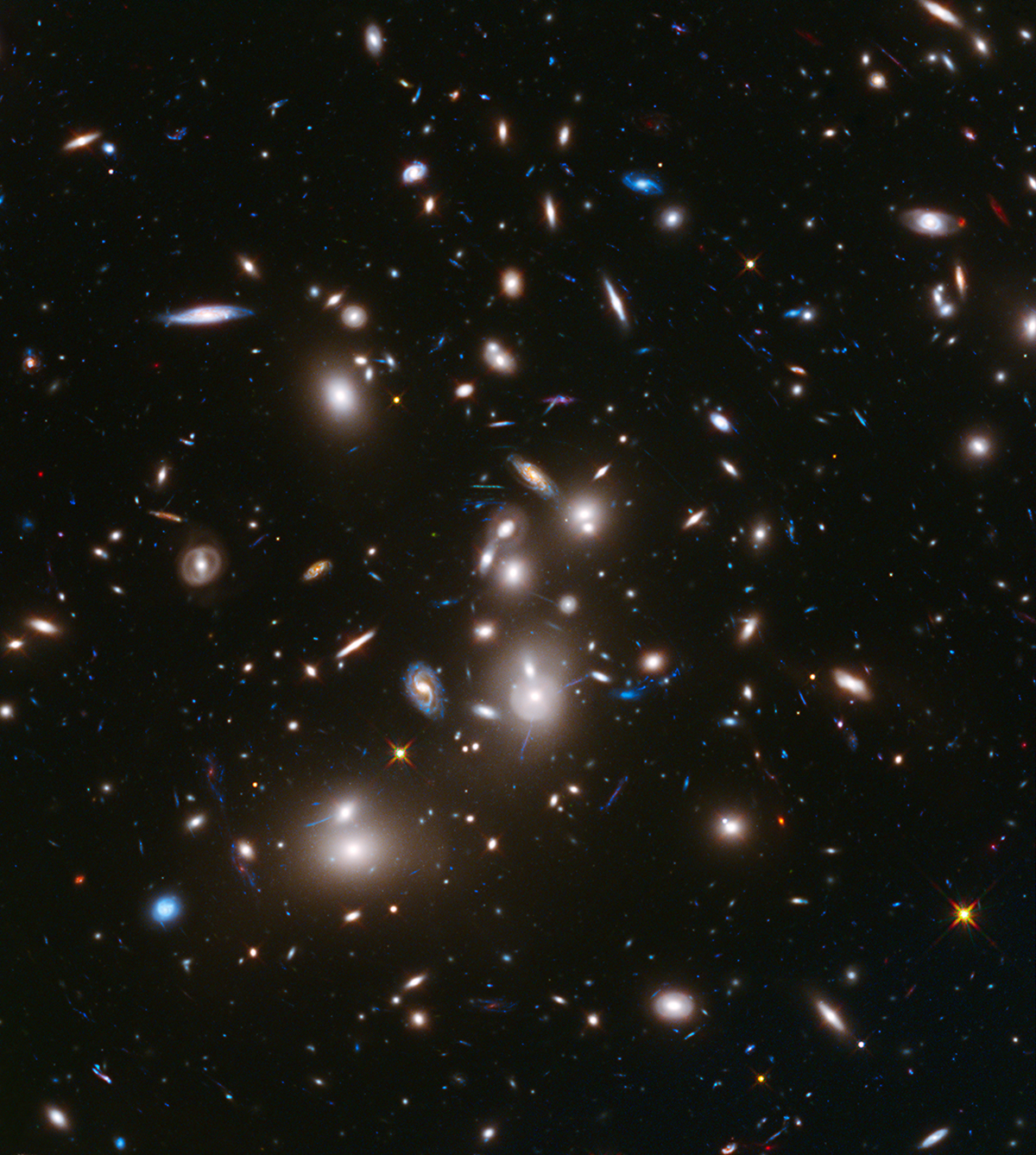
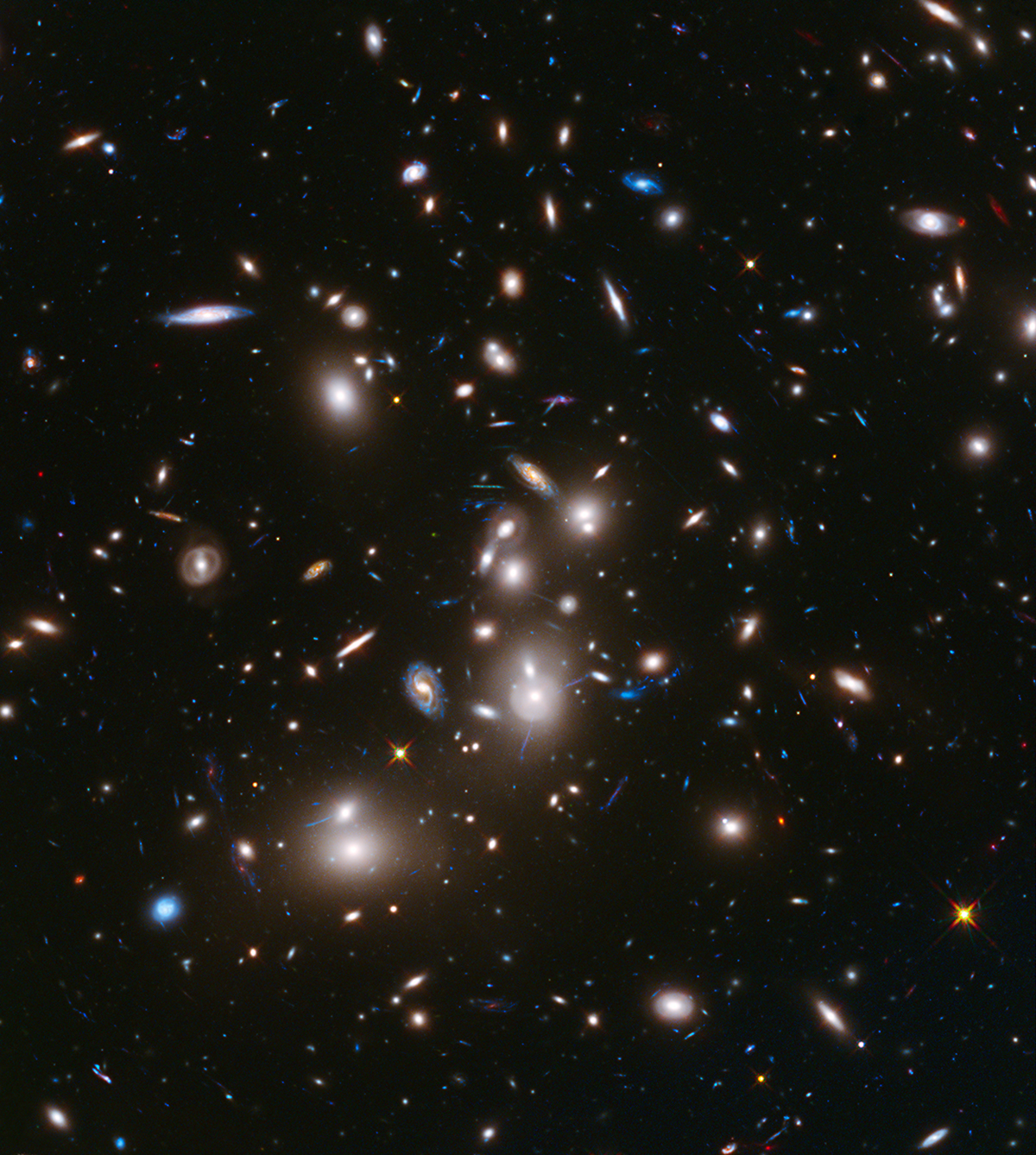
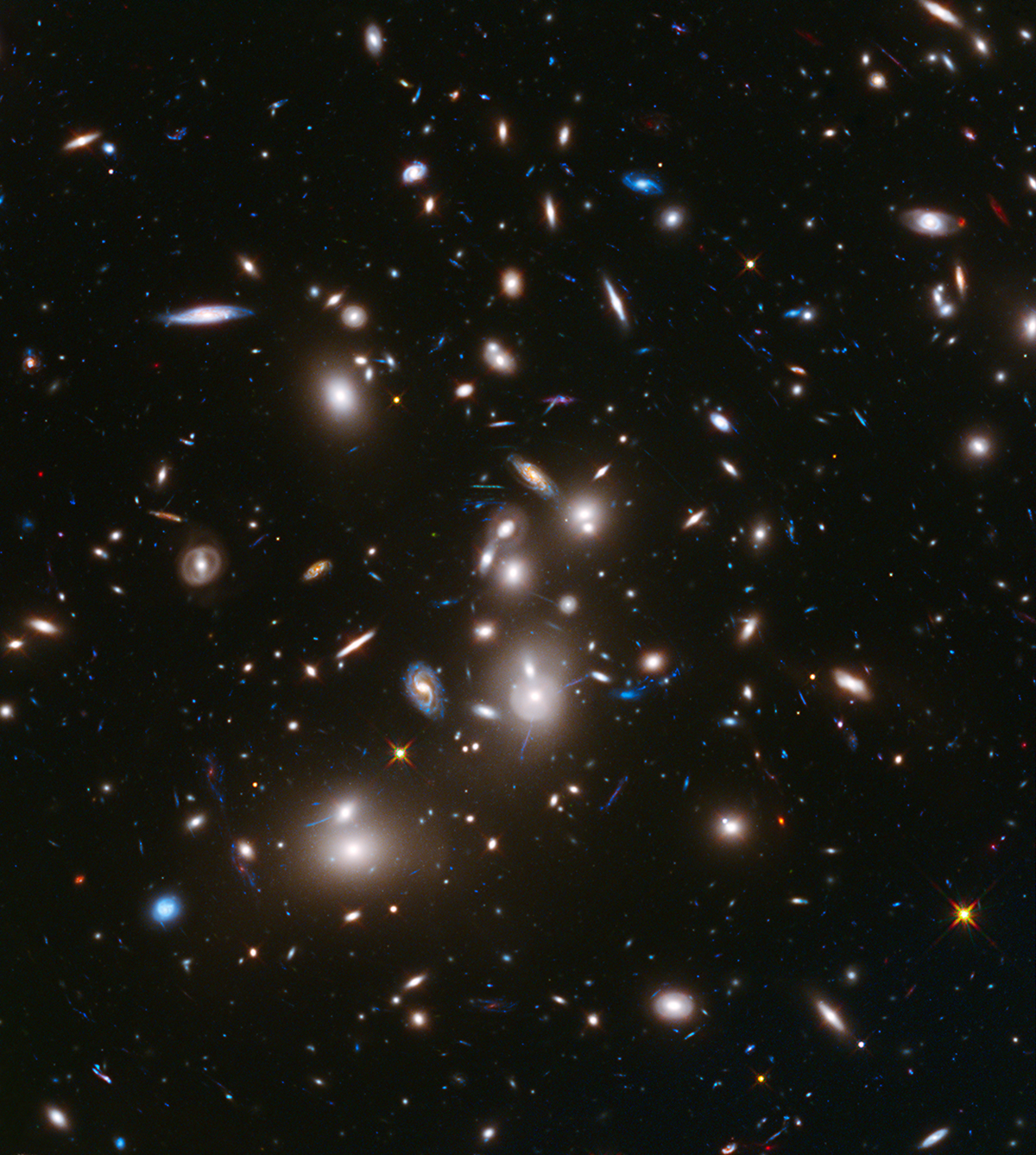
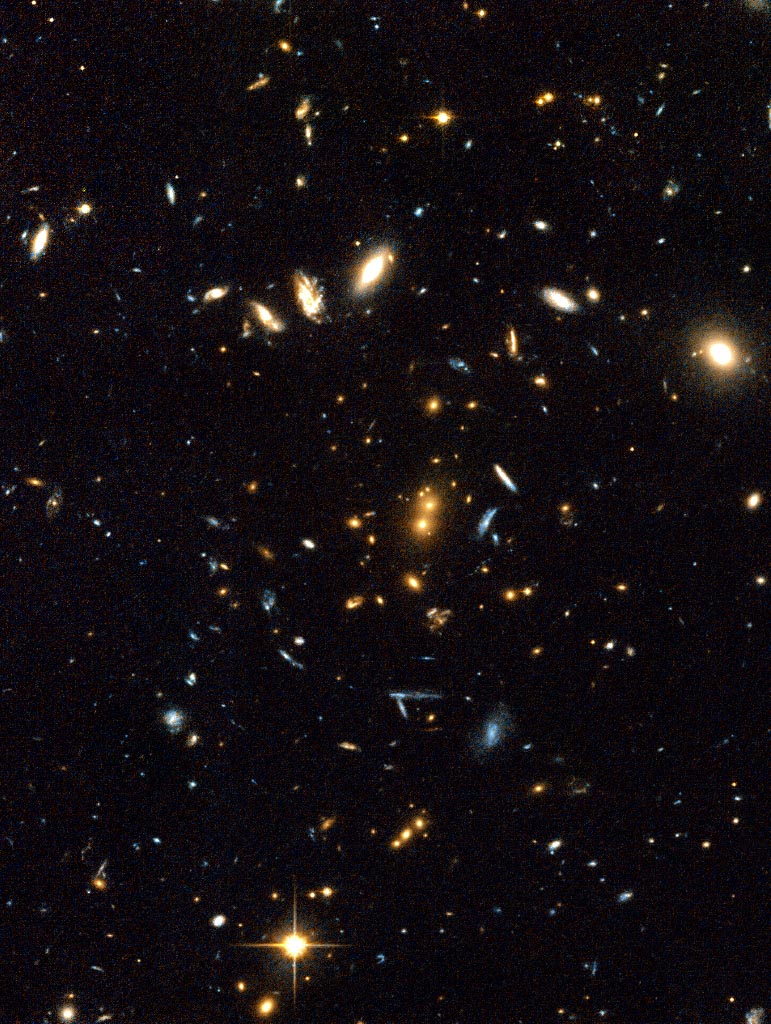
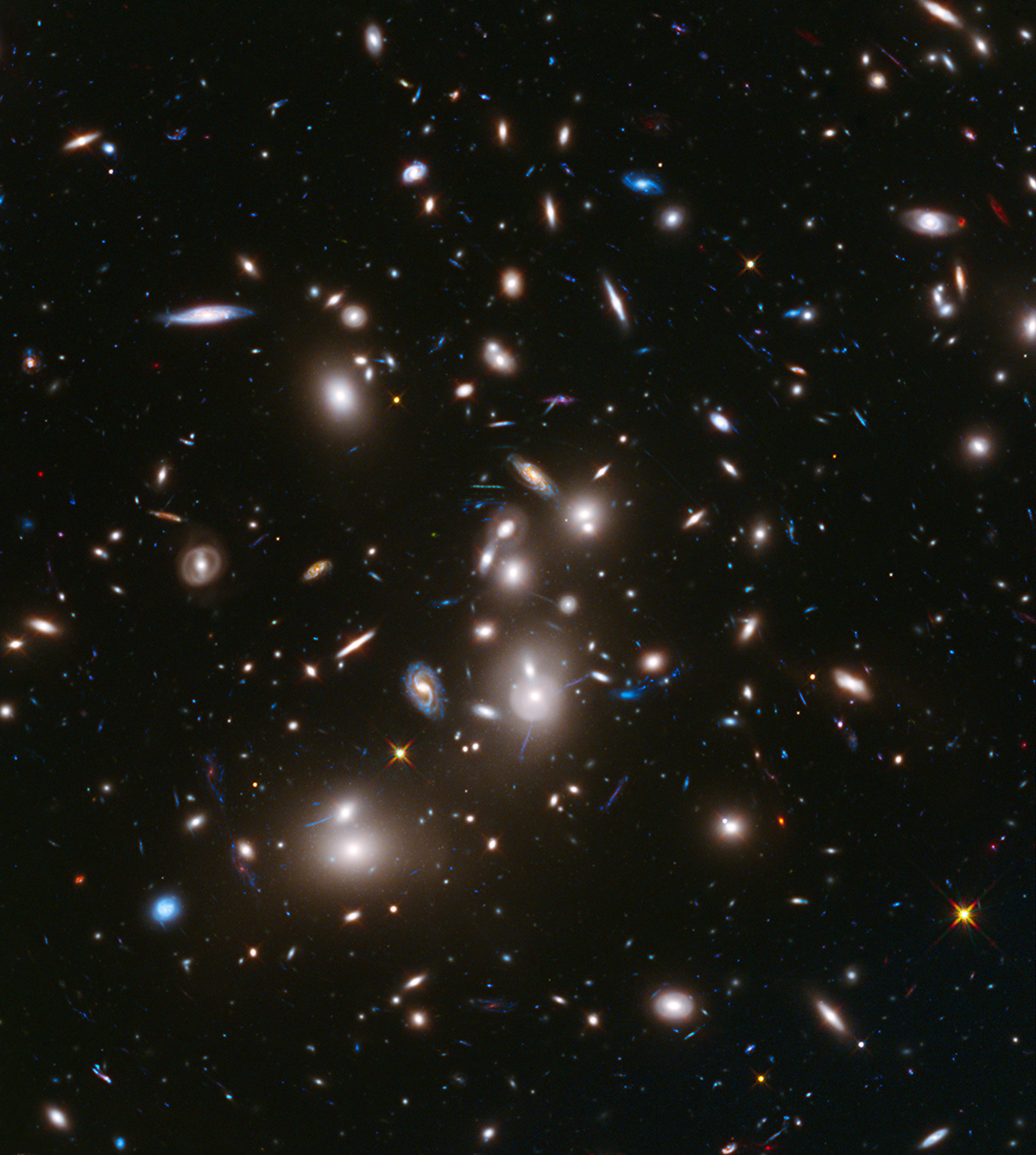
This view of Abell 2744 highlights the extraordinary diversity of galaxies found within and behind this massive galaxy cluster. Pandora's Cluster contains several hundred member galaxies spanning a wide range of types — from giant elliptical galaxies with smooth, featureless profiles to blue spiral galaxies still actively forming stars. Beyond the cluster, the powerful gravitational lens reveals a treasury of background galaxies at vastly different cosmic distances, their images distorted into arcs, streaks, and multiple copies by the warped spacetime around the cluster. The deep Hubble imaging captures galaxies spanning over 12 billion years of cosmic history in a single frame, making Abell 2744 one of the most information-rich patches of sky ever observed.
Scientific Significance
The accumulated observations of Abell 2744 have made it one of the most well-characterized gravitational lenses in the sky. Precise mass models of the cluster enable astronomers to correct for the lensing distortion and recover the true shapes, sizes, and luminosities of background galaxies, providing an unbiased census of the distant galaxy population. Studies using this cluster have measured the ultraviolet luminosity function of galaxies during the epoch of reionization, constraining the role of early galaxies in ionizing the intergalactic medium. The variety of lensing configurations — from strong lensing near the cluster core to weak lensing in the outskirts — provides complementary information about the mass distribution at different radii, enabling detailed tests of dark matter halo profiles predicted by cosmological simulations.
Observation Details
This observation used Hubble's Advanced Camera for Surveys and Wide Field Camera 3 in a carefully designed filter set spanning from ultraviolet through near-infrared wavelengths. The broad wavelength coverage was essential for determining photometric redshifts of the lensed galaxies, as the spectral energy distribution shifts systematically with distance. The depth of the imaging reached 29th magnitude in several bands, sufficient to detect galaxies roughly one billion times fainter than the faintest stars visible to the naked eye. Data processing included careful removal of intracluster light — the diffuse glow from stars stripped from cluster galaxies — to reveal the faintest background sources.
Location in the Universe
Constellation
Sculptor
Distance from Earth
3.5 billion light-years
Fun Facts
- 1
The galaxies visible in this single Hubble image span a vast range of cosmic distances — from relatively nearby objects a few hundred million light-years away to some of the most distant galaxies ever detected, over 13 billion light-years from Earth.
- 2
Abell 2744 is so massive that it bends light from background galaxies by measurable angles, creating distorted images that astronomers can reverse-engineer to map the invisible dark matter throughout the cluster.
- 3
The hot gas between galaxies in Abell 2744 reaches temperatures exceeding 100 million degrees Celsius, emitting X-rays that Chandra Space Telescope has mapped in detail to complement Hubble's optical view.
Image credit: NASA, ESA, Hubble Space Telescope