About This Image
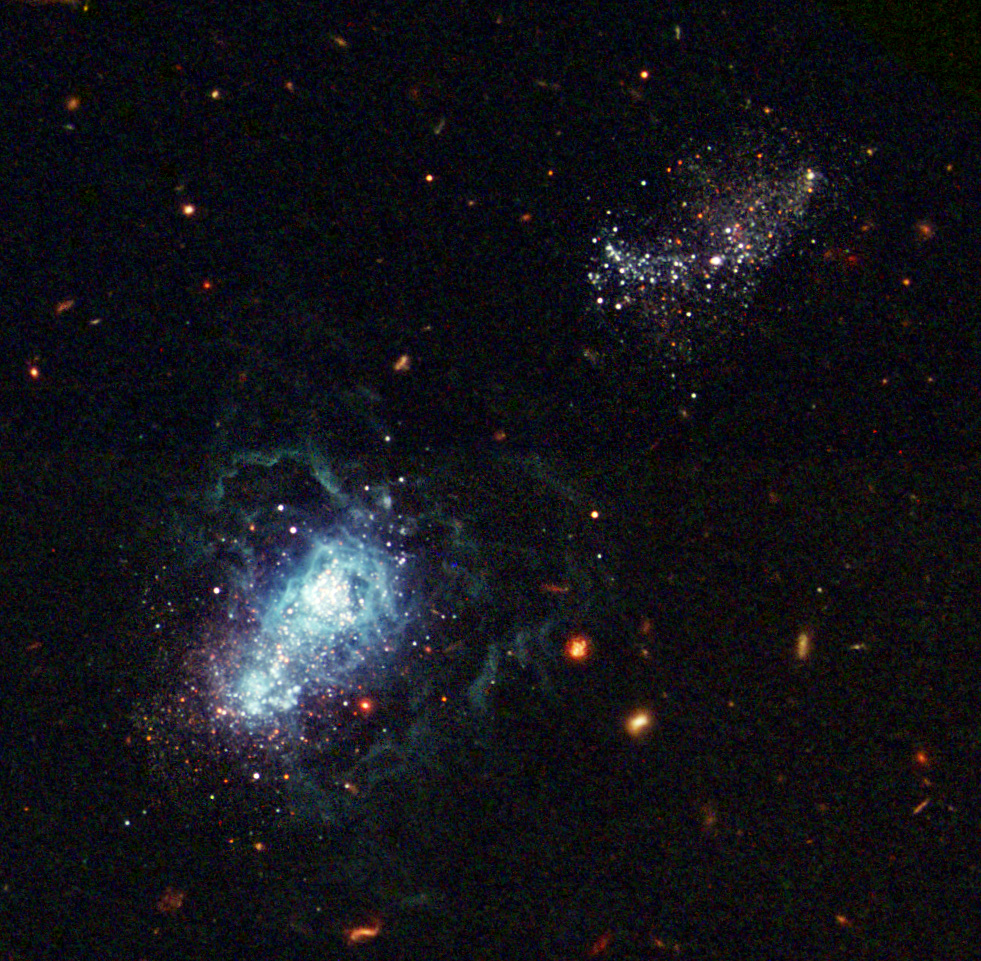
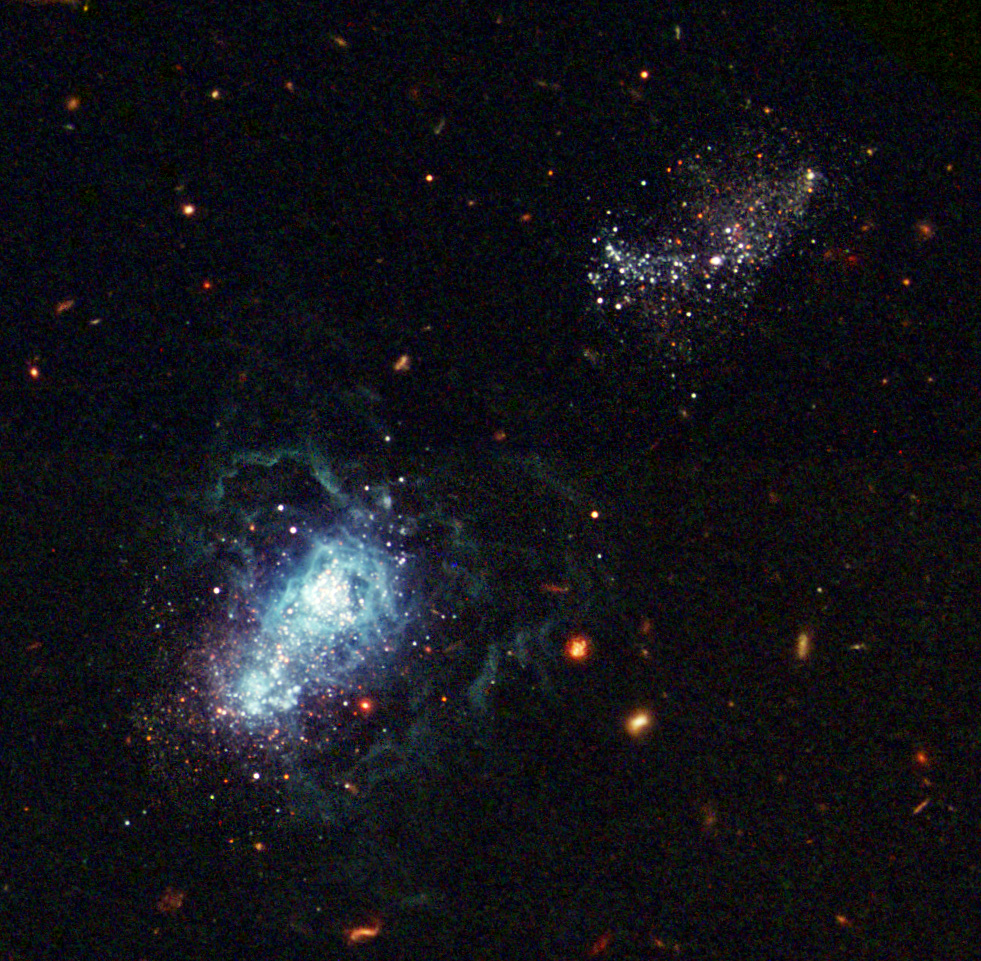
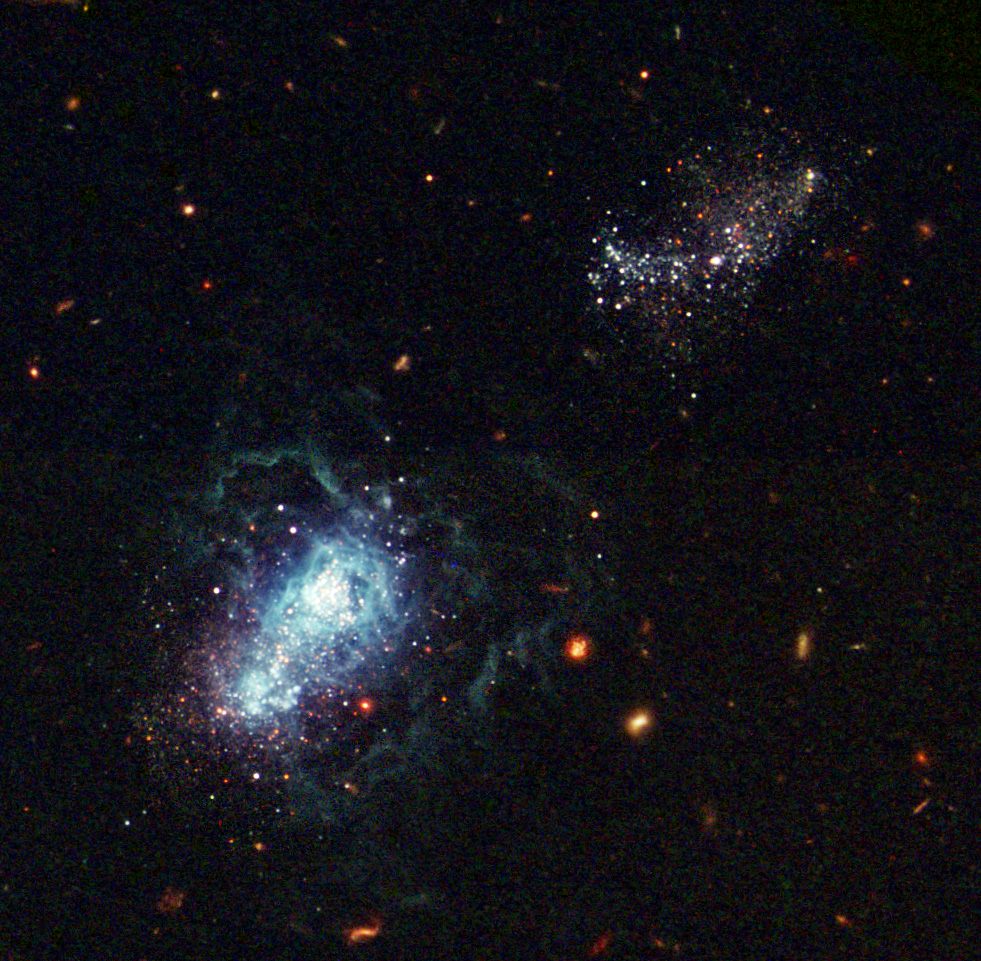
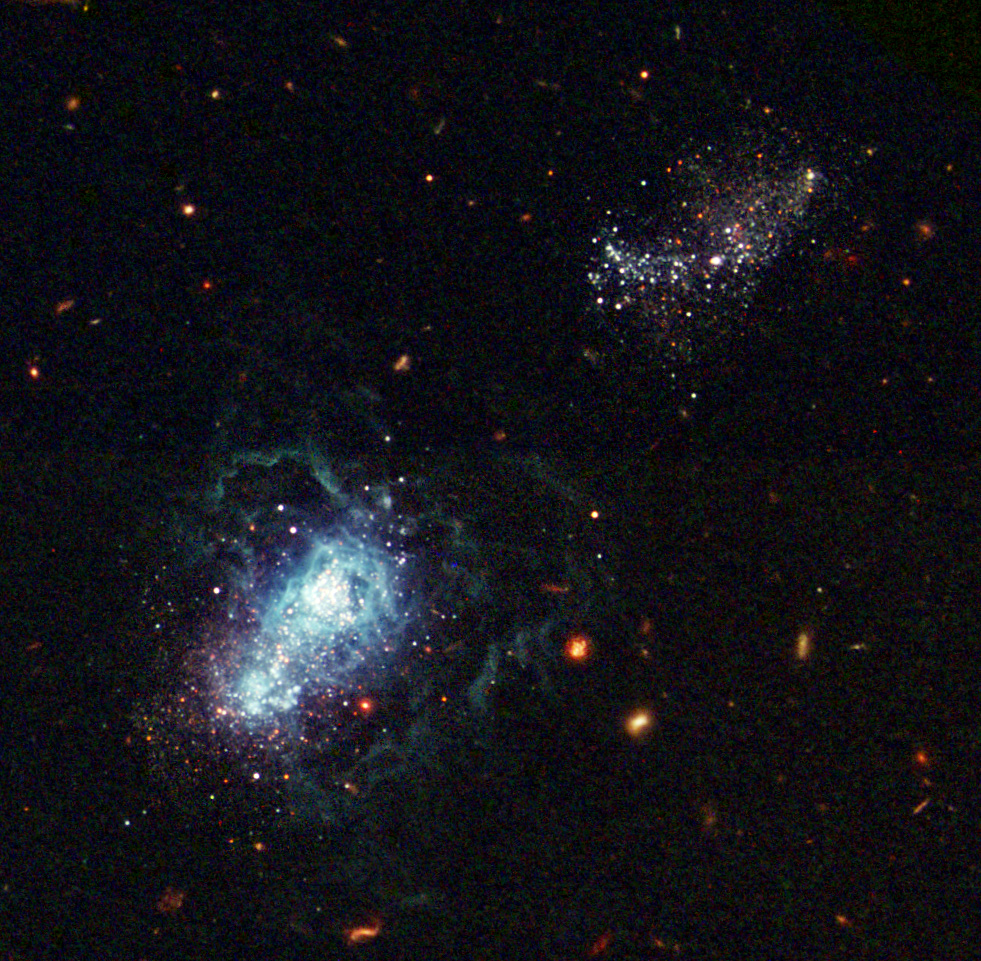
This Hubble image of I Zwicky 18 highlights the galaxy's extraordinary gaseous environment, revealing the complex interplay between star formation and gas dynamics in one of the universe's most chemically primitive systems. Vast shells and filaments of ionized hydrogen extend well beyond the compact stellar body of the galaxy, sculpted by the cumulative energy of stellar winds and supernova explosions from successive episodes of star formation. The morphology of these gaseous structures provides critical evidence for the powerful feedback mechanisms that regulate star formation in low-mass galaxies. I Zwicky 18's gaseous halo contains clues about how dwarf galaxies lose their metals and how the intergalactic medium becomes enriched with heavy elements over cosmic time.
Scientific Significance
The gaseous properties of I Zwicky 18 make it an essential object for understanding the baryon cycle in dwarf galaxies — the process by which gas is accreted, converted to stars, enriched with heavy elements, and expelled back into the intergalactic medium. The galaxy's supernova-driven outflows are energetic enough to potentially eject metal-enriched gas entirely from the galaxy's shallow gravitational potential well, explaining its persistently low metallicity despite billions of years of intermittent star formation. Observations of the ionized gas kinematics reveal expanding shell structures with velocities of 30 to 50 kilometers per second, confirming active mechanical feedback. The ratio of expelled metals to retained metals in I Zwicky 18 provides a critical empirical constraint for models of galactic chemical evolution, particularly at the low-mass end of the galaxy mass function.
Observation Details
This observation employed narrowband filters on Hubble's WFPC2 to isolate the emission from ionized hydrogen (H-alpha) and doubly ionized oxygen ([O III]), providing a detailed map of the galaxy's warm ionized gas. The narrowband imaging effectively separates the nebular emission from the stellar continuum, revealing filamentary structures and shell-like features in the interstellar and circumgalactic medium that are invisible in broadband images. By comparing the H-alpha and [O III] emission morphologies, astronomers could map spatial variations in gas excitation and ionization conditions across the galaxy.
Location in the Universe
Constellation
Ursa Major
Distance from Earth
59 million light-years
Fun Facts
- 1
The gaseous halo of I Zwicky 18 extends several thousand light-years beyond its visible stars, containing more mass in neutral hydrogen gas than in all of its stars combined — a vast reservoir of potential future star-forming fuel.
- 2
I Zwicky 18's oxygen abundance is only about three percent of the Sun's value, placing it among the most oxygen-poor galaxies ever measured and making its gas composition remarkably close to primordial Big Bang nucleosynthesis predictions.
- 3
Radio observations have revealed that I Zwicky 18 is embedded in a much larger cloud of neutral hydrogen gas that extends over 30,000 light-years, dwarfing the tiny optical galaxy visible in Hubble images.
Image credit: NASA, ESA, Hubble Space Telescope