About This Image
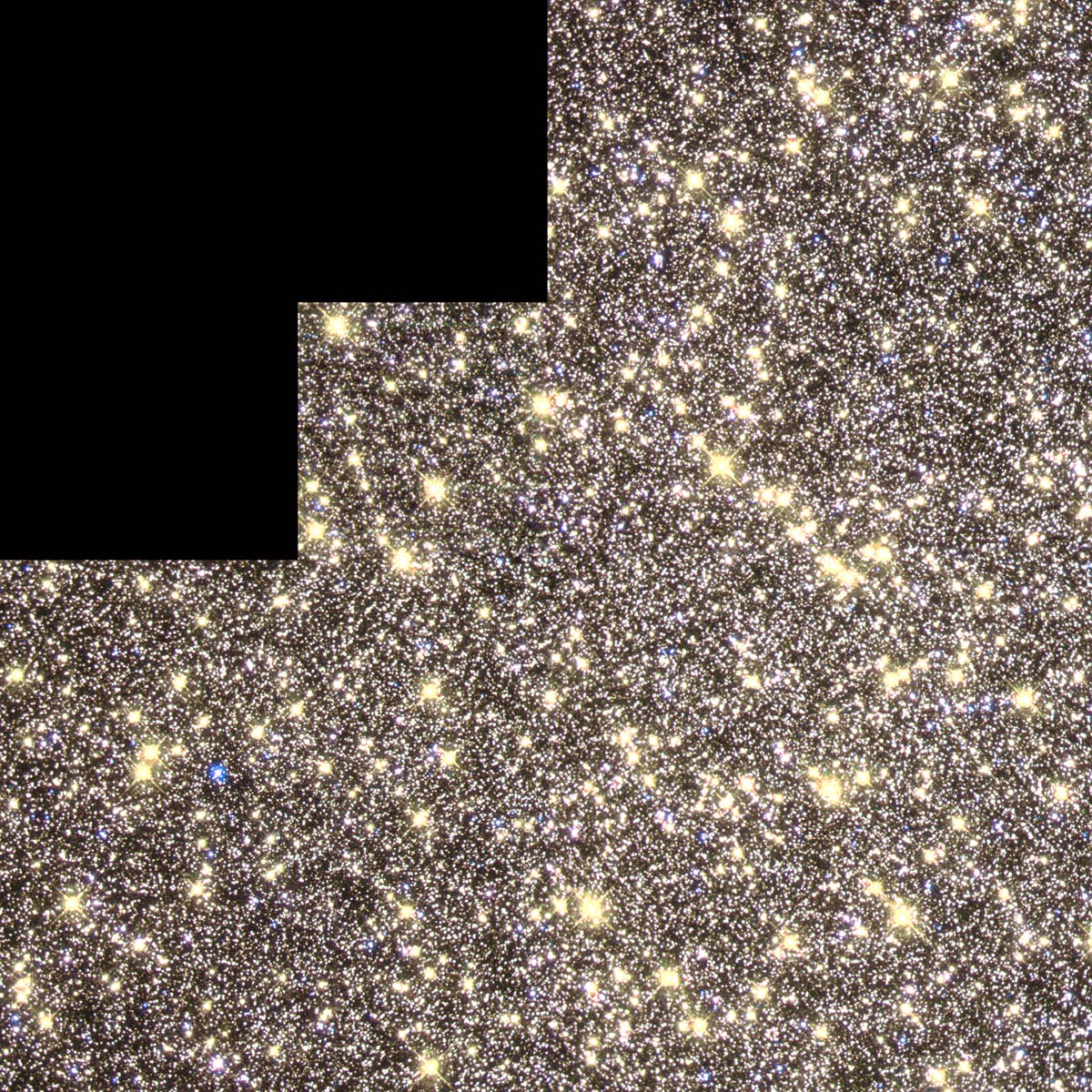
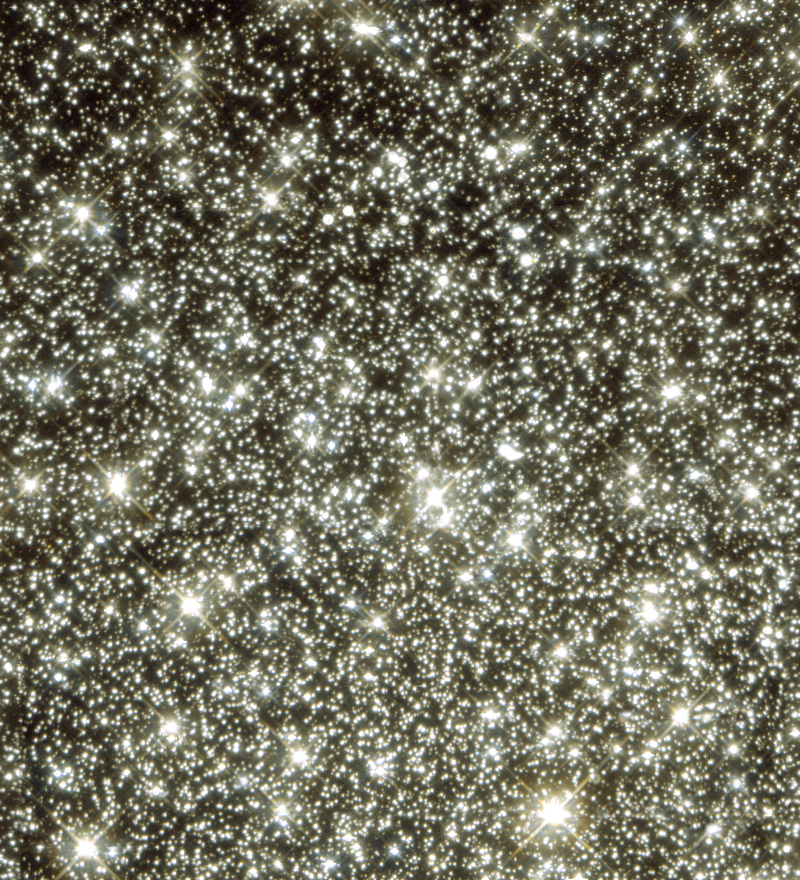
Messier 22 is one of the nearest and brightest globular star clusters visible from Earth, located approximately 10,600 light-years away in the constellation Sagittarius near the rich star fields of the galactic center. This ancient stellar congregation contains roughly 70,000 stars gravitationally bound into a dense, roughly spherical swarm about 70 light-years in diameter. M22 was among the first globular clusters ever discovered, having been noted by the German astronomer Abraham Ihle in 1665, and it has been a target of astronomical study for over three centuries. Hubble's sharp view resolves the cluster's densely packed core into individual stars, revealing a stunning tapestry of golden and reddish ancient stars alongside bluer stragglers that appear paradoxically young. M22 is also notable for being one of only four globular clusters known to contain a planetary nebula, the ephemeral remnant of a dying star embedded within its ancient population.
Scientific Significance
M22 holds a distinguished place in stellar astrophysics as one of the closest and best-studied globular clusters, providing a critical benchmark for understanding the ages, chemical compositions, and dynamical evolution of the Milky Way's oldest stellar systems. Its proximity allows Hubble to resolve stars down to very faint luminosities, enabling construction of deep color-magnitude diagrams that reveal the cluster's stellar population in extraordinary detail. These diagrams have shown that M22, like Omega Centauri, contains at least two distinct stellar populations with different iron abundances — a discovery that challenges the classical view of globular clusters as simple, single-population systems. The presence of the planetary nebula IRAS 18333-2357 within M22 provides a rare opportunity to study late-stage stellar evolution in a dense cluster environment, where gravitational interactions may strip away nebular material more rapidly than in the field. M22 has also been used as a gravitational microlensing target to search for compact dark objects within the cluster.
Observation Details
This image was captured using Hubble's Wide Field and Planetary Camera 2 (WFPC2) in multiple visible-light filters, resolving the densely packed stellar core of M22 into thousands of individual stars. The observations required precise pointing and careful exposure timing to avoid saturation of the brightest red giant stars while still detecting the fainter main-sequence stars that carry critical information about the cluster's age and metallicity. The resulting color-magnitude diagram extended several magnitudes below the main-sequence turnoff point, providing robust age estimates for the cluster. Hubble's resolution was essential for this work, as the extreme stellar density in M22's core makes ground-based photometry unreliable due to crowding effects.
Location in the Universe
Constellation
Sagittarius
Distance from Earth
10,600 light-years
Fun Facts
- 1
M22 is one of only four globular clusters known to harbor a planetary nebula — designated IRAS 18333-2357 — a rare and fleeting phenomenon since planetary nebulae fade away in just a few tens of thousands of years, an eyeblink compared to the cluster's 12-billion-year age.
- 2
Despite containing roughly 70,000 stars packed into a sphere just 70 light-years across, M22 is bright enough to be visible to the naked eye under dark skies, appearing as a fuzzy patch of light in the constellation Sagittarius.
- 3
M22 sits almost directly along the line of sight toward the center of the Milky Way, meaning Hubble observations must peer through substantial foreground dust and stars to reveal the cluster's true stellar population.
Image credit: NASA, ESA, Hubble Space Telescope