About This Image
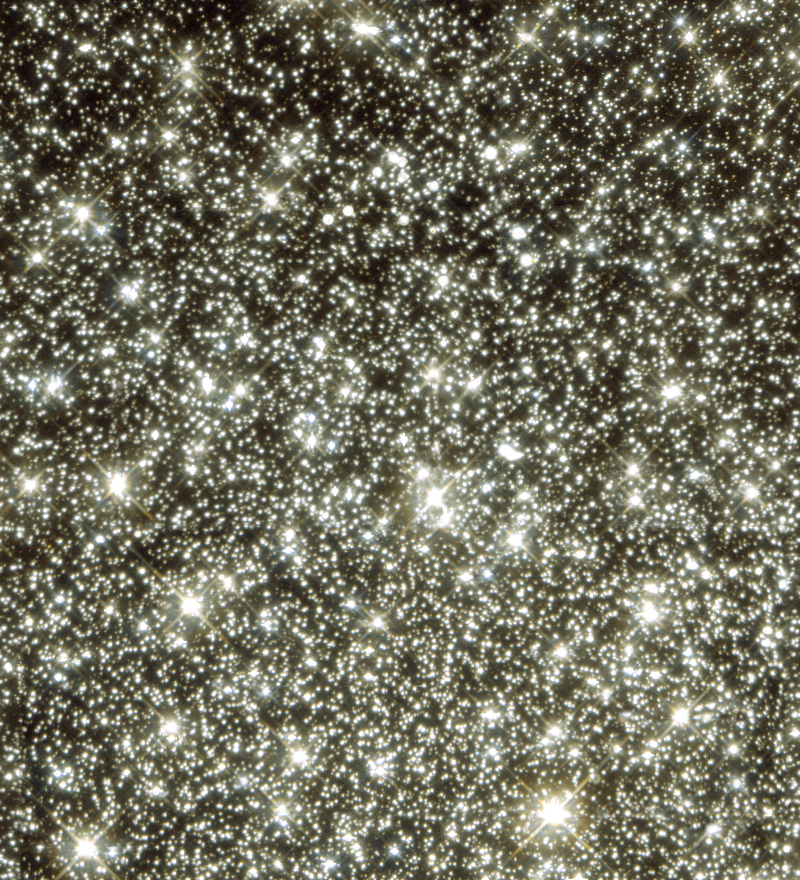
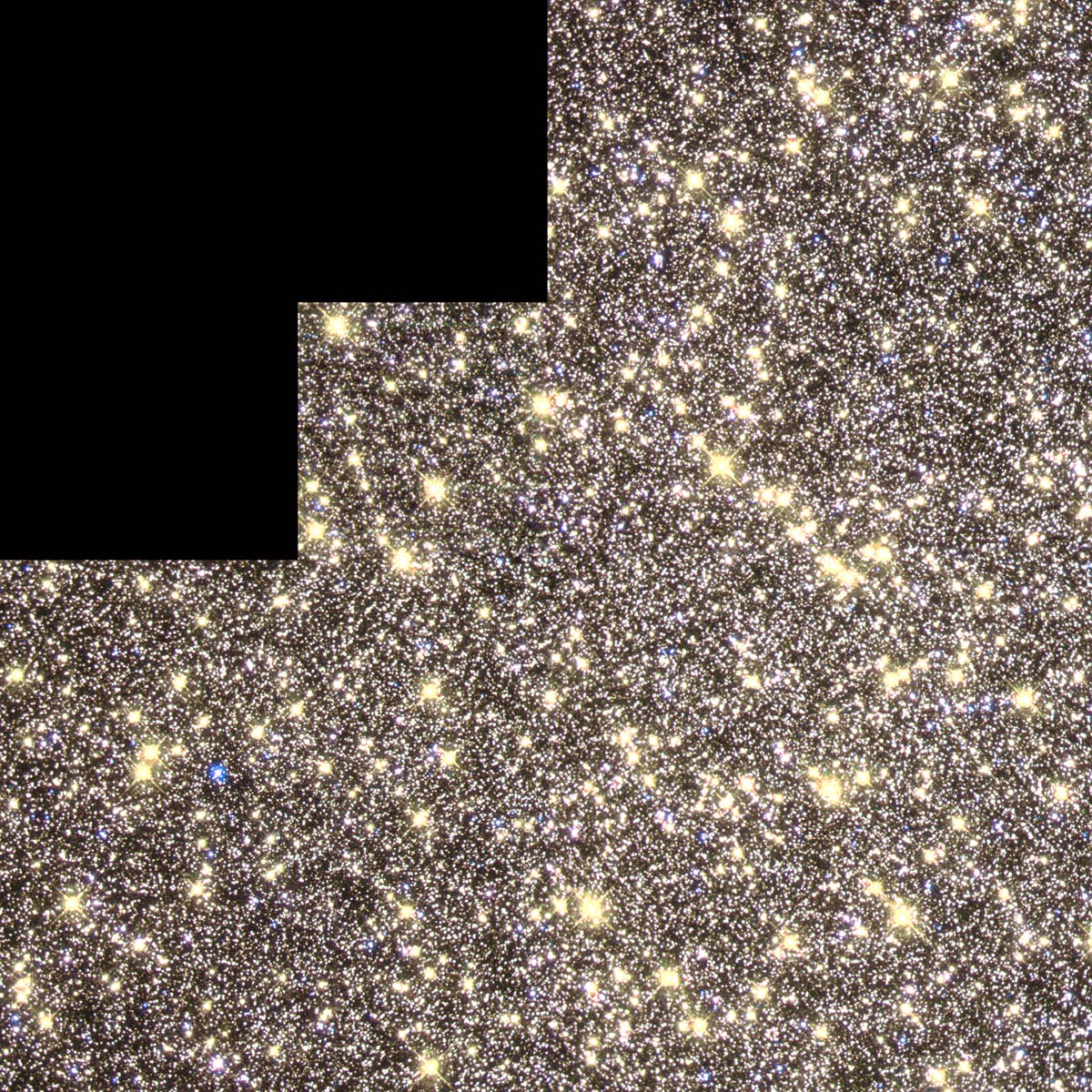
This breathtaking view reveals approximately 50,000 stars packed into the heart of Omega Centauri, the largest and most luminous globular star cluster in the Milky Way. Located about 15,800 light-years from Earth in the constellation Centaurus, Omega Centauri spans roughly 150 light-years in diameter and harbors an estimated 10 million stars bound together by mutual gravity. Unlike most globular clusters, which contain stars of a single age and chemical composition, Omega Centauri displays multiple stellar populations with varying ages and metallicities. This unusual diversity has led many astronomers to suspect that it is not a true globular cluster at all, but rather the stripped remnant core of a dwarf galaxy that was gravitationally captured and absorbed by the Milky Way billions of years ago. It is one of the few globular clusters visible to the unaided eye from Earth's Southern Hemisphere.
Scientific Significance
Omega Centauri stands as the most massive globular cluster in the Milky Way, with a total mass estimated at roughly 4 million solar masses, making it a uniquely important laboratory for stellar dynamics and galactic archaeology. Its multiple stellar populations, spanning a range of metallicities and ages, set it apart from all other Milky Way globular clusters and provide compelling evidence that it is the stripped nucleus of an ancient dwarf galaxy accreted by our galaxy. This interpretation is supported by the detection of a possible intermediate-mass black hole at its center, with an estimated mass of roughly 40,000 solar masses. Such an object would bridge the gap between stellar-mass and supermassive black holes, a population that remains largely theoretical. Studies of Omega Centauri's stellar dynamics, chemical abundances, and stellar populations provide direct constraints on the hierarchical assembly history of the Milky Way and the processes by which large galaxies grow through the accretion and disruption of smaller satellite systems over cosmic time.
Observation Details
This image was captured using Hubble's Advanced Camera for Surveys (ACS) in visible light wavelengths, resolving the dense stellar core of Omega Centauri into individual stars with extraordinary clarity. The field of view encompasses the innermost region of the cluster, where stellar densities are highest and ground-based telescopes struggle to separate individual stars due to atmospheric blurring. Hubble's sharp angular resolution was essential for producing accurate color-magnitude diagrams of the cluster's core, enabling astronomers to distinguish the multiple stellar populations that reveal its complex formation history. Multiple exposures through different filters were combined to create a natural-color composite image.
Location in the Universe
Constellation
Centaurus
Distance from Earth
15,800 light-years
Fun Facts
- 1
Omega Centauri contains roughly 10 million stars crammed into a sphere only about 150 light-years across, making it so luminous that ancient astronomers cataloged it as a star before telescopes revealed its true nature.
- 2
Unlike nearly all other globular clusters, Omega Centauri contains multiple generations of stars with different chemical compositions, strongly suggesting it is the remnant nucleus of a dwarf galaxy that the Milky Way consumed billions of years ago.
- 3
At the center of Omega Centauri, the average distance between stars is only about 0.1 light-years — roughly 100 times closer together than stars in our solar neighborhood — creating an incredibly dense stellar environment.
Image credit: NASA, ESA, Hubble Space Telescope