About This Image
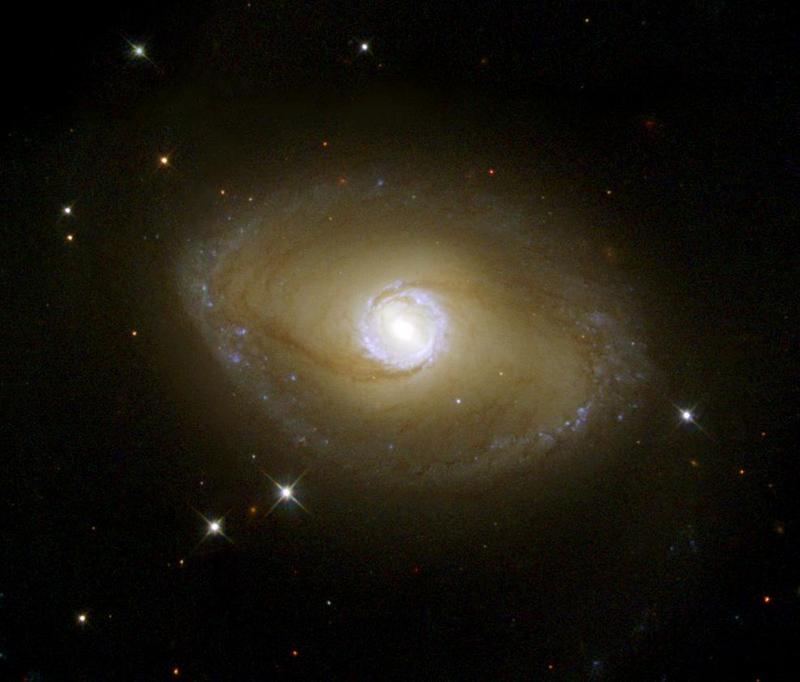
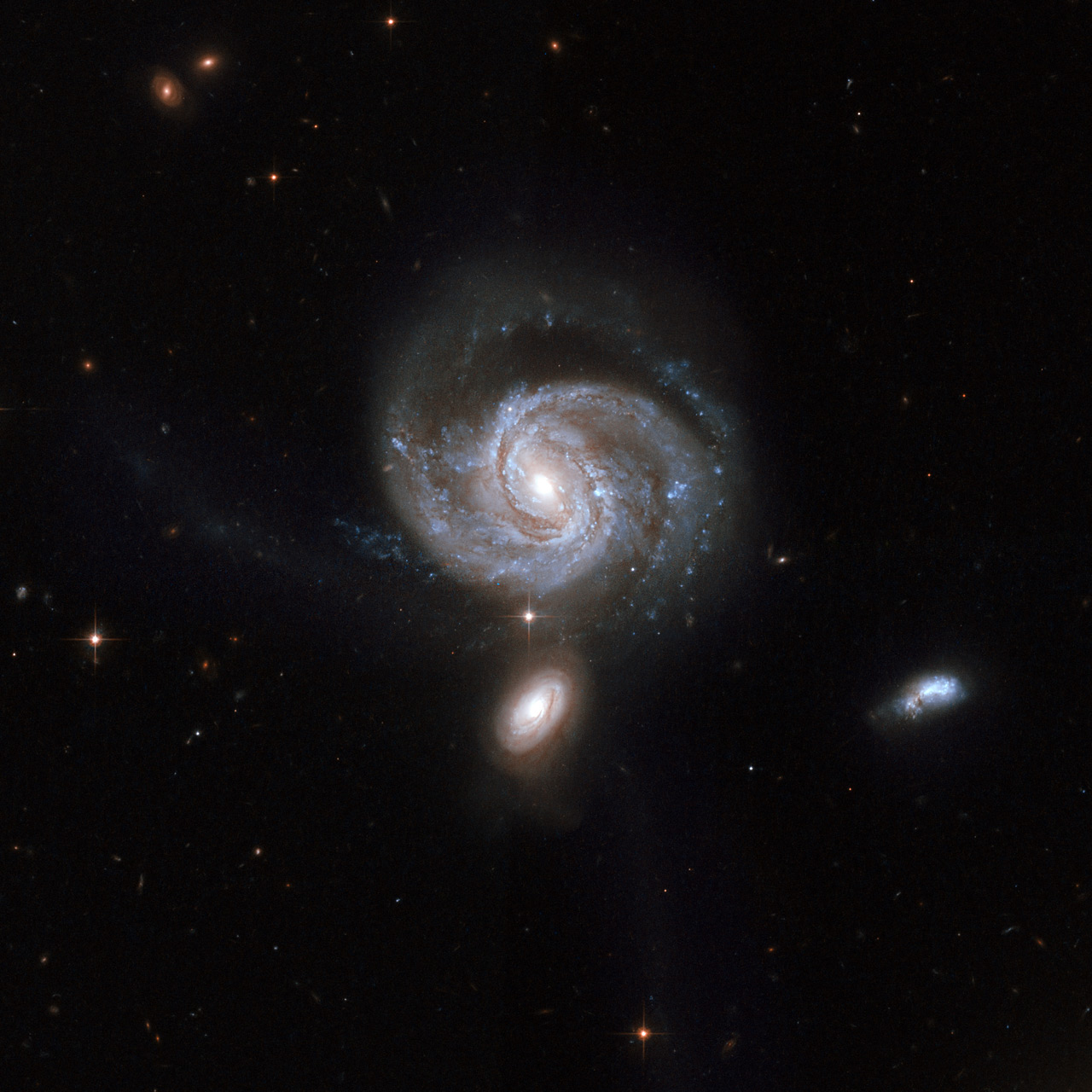
NGC 7674 is a spiral galaxy tilted nearly face-on to Earth, located approximately 400 million light-years away in the constellation Pegasus. Faint streamers below and to the left of the galaxy have been created by gravitational interactions with companion galaxies in its local group, known as the Hickson Compact Group 96. NGC 7674 is classified as a Seyfert 2 galaxy, meaning it harbors an active galactic nucleus powered by a supermassive black hole that is actively accreting material but is obscured from direct view by a thick torus of dust and gas surrounding the central engine. Despite this obscuration, the galaxy's nucleus radiates powerfully across the electromagnetic spectrum, from radio waves through X-rays, as energy from the hidden accretion disk escapes along paths above and below the dusty torus. The tidal streamers and disturbed morphology provide evidence that gravitational encounters with neighboring galaxies may have funneled gas toward the nucleus, fueling its current active phase.
Scientific Significance
NGC 7674 is an important object for studying the connection between galaxy interactions and the activation of supermassive black holes at galactic centers. The unified model of active galactic nuclei proposes that Seyfert 1 and Seyfert 2 galaxies are intrinsically the same type of object viewed from different angles, with the thick dusty torus surrounding the central engine blocking the direct view of the accretion disk and broad emission-line region in Seyfert 2 galaxies like NGC 7674. Hubble observations have provided supporting evidence for this model by resolving the narrow-line emission region extending above and below the galaxy's nucleus in a cone-shaped geometry consistent with collimation by an obscuring torus. NGC 7674's membership in a compact galaxy group provides a natural experiment for understanding how gravitational torques from tidal interactions funnel gas from galactic scales down to the sub-parsec feeding zone of the central black hole, a process that remains one of the major unsolved problems in active galaxy research.
Observation Details
Hubble observed NGC 7674 using the Advanced Camera for Surveys (ACS) in broadband visible filters that captured the galaxy's overall morphology, spiral arm structure, and faint tidal features extending toward companion galaxies. The high resolution of ACS was essential for resolving the galaxy's nuclear region and identifying the cone-shaped ionization structure emanating from the obscured active nucleus. Narrowband imaging targeting the [O III] emission line at 5007 angstroms revealed the extent and geometry of the ionized gas illuminated by the hidden central engine, tracing the opening angle of the ionization cone and providing constraints on the orientation of the obscuring torus relative to our line of sight.
Location in the Universe
Constellation
Pegasus
Distance from Earth
400 million light-years
Fun Facts
- 1
NGC 7674 is a member of Hickson Compact Group 96, a tight quartet of galaxies whose mutual gravitational interactions are slowly stripping gas and stars from each member — eventually, over billions of years, these galaxies will merge into a single larger galaxy.
- 2
Radio observations have revealed twin jets of relativistic plasma emanating from NGC 7674's active nucleus, extending several thousand light-years in opposite directions — these jets are powered by the magnetic field of the central supermassive black hole spinning at a significant fraction of the speed of light.
- 3
NGC 7674 is one of the nearest examples of a galaxy hosting a dual active nucleus, with some evidence suggesting its core may harbor two supermassive black holes separated by only about one light-year, spiraling toward an eventual merger.
Image credit: NASA, ESA, Hubble Space Telescope