About This Image
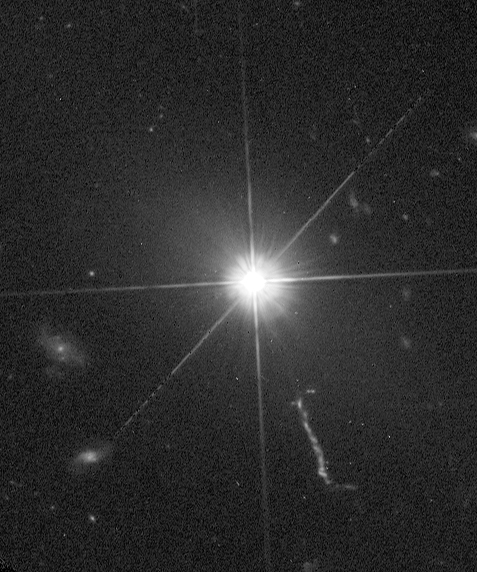
The quasar 3C 273 resides at the heart of a giant elliptical galaxy approximately 2.4 billion light-years away in the constellation Virgo. As the first quasar ever identified, 3C 273 holds an iconic place in the history of astronomy. In 1963, astronomer Maarten Schmidt recognized that the strange emission lines in its spectrum were ordinary hydrogen lines shifted enormously to longer wavelengths by the expansion of the universe, revealing 3C 273 to be extragalactic and extraordinarily luminous. This single discovery opened an entirely new field of astrophysics. The quasar shines with a luminosity roughly four trillion times that of the Sun, powered by a supermassive black hole consuming material at a prodigious rate. Hubble's sharp vision allowed astronomers to separate the blinding point-like quasar light from the much fainter glow of its host galaxy, revealing spiral structures and a remarkable jet of material streaming outward at nearly the speed of light.
Scientific Significance
As the first quasar ever identified, 3C 273 is arguably one of the most historically significant astronomical objects of the twentieth century. Its identification in 1963 by Maarten Schmidt at Caltech demonstrated that extremely compact sources of radio emission could be located at cosmological distances, implying energy outputs far exceeding those of entire galaxies. This discovery led directly to the theoretical framework of accretion onto supermassive black holes as the engine powering active galactic nuclei. Hubble observations of 3C 273 have been instrumental in characterizing the quasar's host galaxy, revealing a giant elliptical galaxy with faint spiral-like features that may indicate a past merger event. The quasar's prominent one-sided jet, resolved in exquisite detail by Hubble, provides a natural laboratory for studying relativistic plasma physics, particle acceleration, and magnetic field dynamics in extreme environments far beyond anything achievable in terrestrial experiments.
Observation Details
Hubble observed 3C 273 using the Wide Field Planetary Camera 2 (WFPC2) with coronagraphic techniques and specialized point-spread-function subtraction to suppress the overwhelming glare of the quasar nucleus and reveal the underlying host galaxy. This was one of the earliest successful attempts to image a quasar host galaxy, requiring careful calibration of Hubble's optical characteristics to remove the diffraction pattern of the brilliant central point source. Additional imaging with different filters revealed the relativistic jet extending from the nucleus, while spectroscopic observations with the Faint Object Spectrograph provided kinematic information about the gas surrounding the central black hole.
Location in the Universe
Constellation
Virgo
Distance from Earth
2.4 billion light-years
Fun Facts
- 1
3C 273 is so luminous that it can be detected with a modest amateur telescope despite being 2.4 billion light-years away — making it one of the most distant objects visible in small instruments and roughly 4 trillion times brighter than the Sun.
- 2
The relativistic jet extending from 3C 273 stretches over 200,000 light-years and consists of plasma traveling at roughly 99.5% the speed of light, emitting radiation across the entire electromagnetic spectrum from radio waves to gamma rays.
- 3
When Maarten Schmidt identified 3C 273 as extragalactic in 1963, it was so unexpected that it fundamentally changed our understanding of the universe, revealing that supermassive black holes could power objects visible across billions of light-years.
Image credit: NASA, ESA, Hubble Space Telescope