About This Image
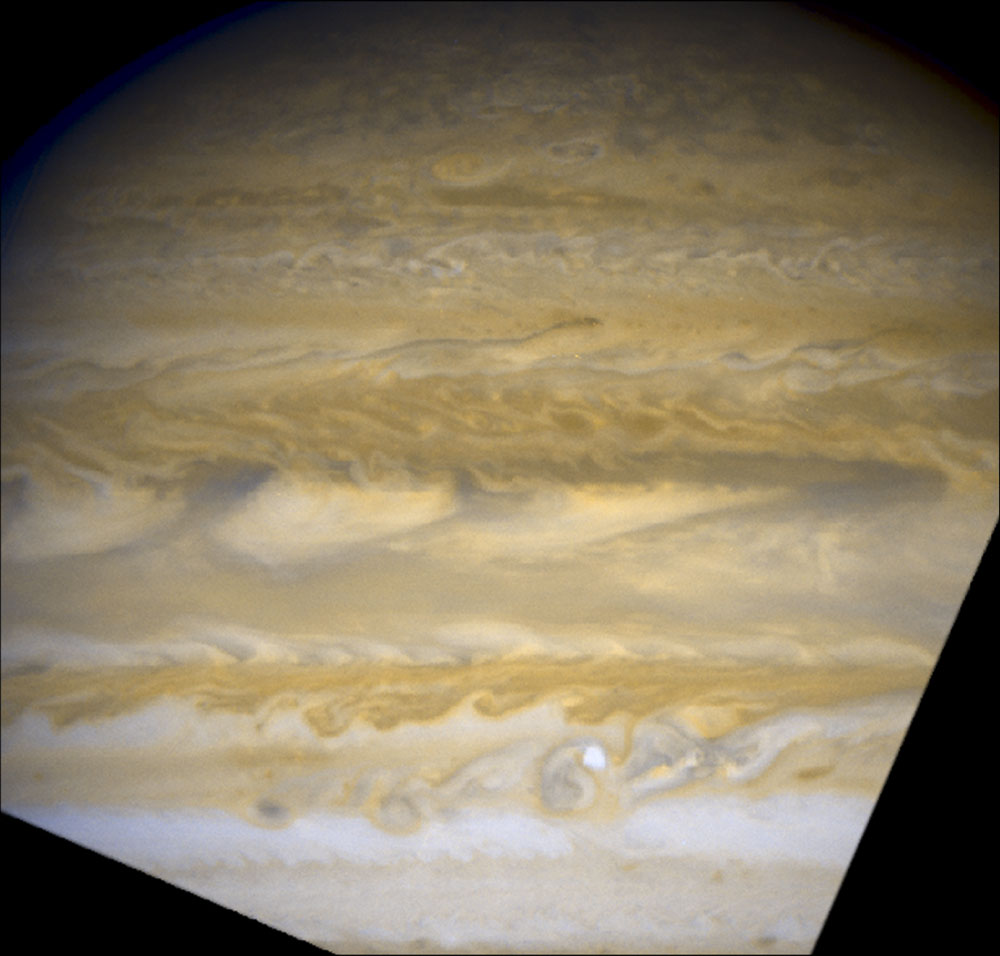
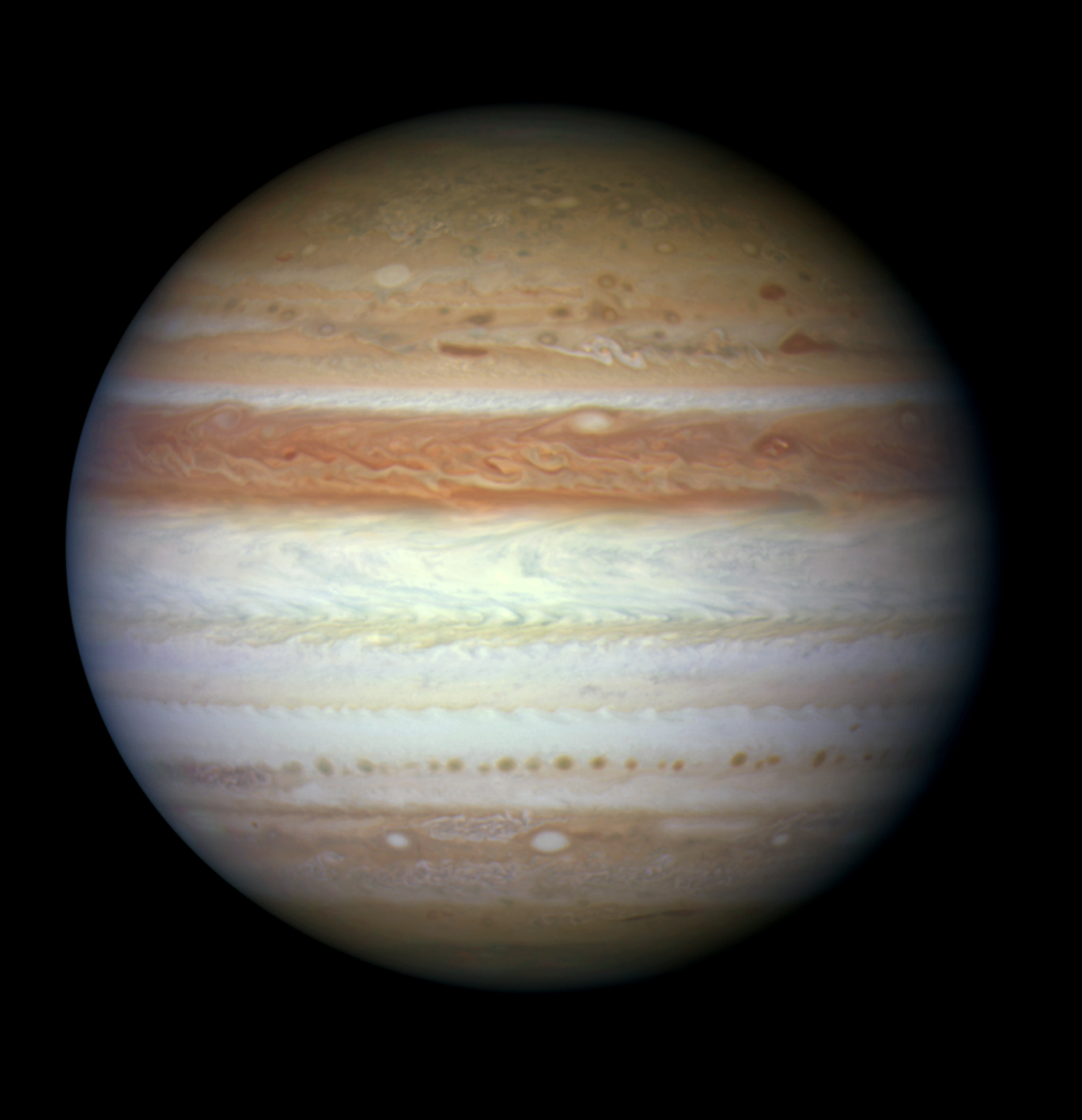
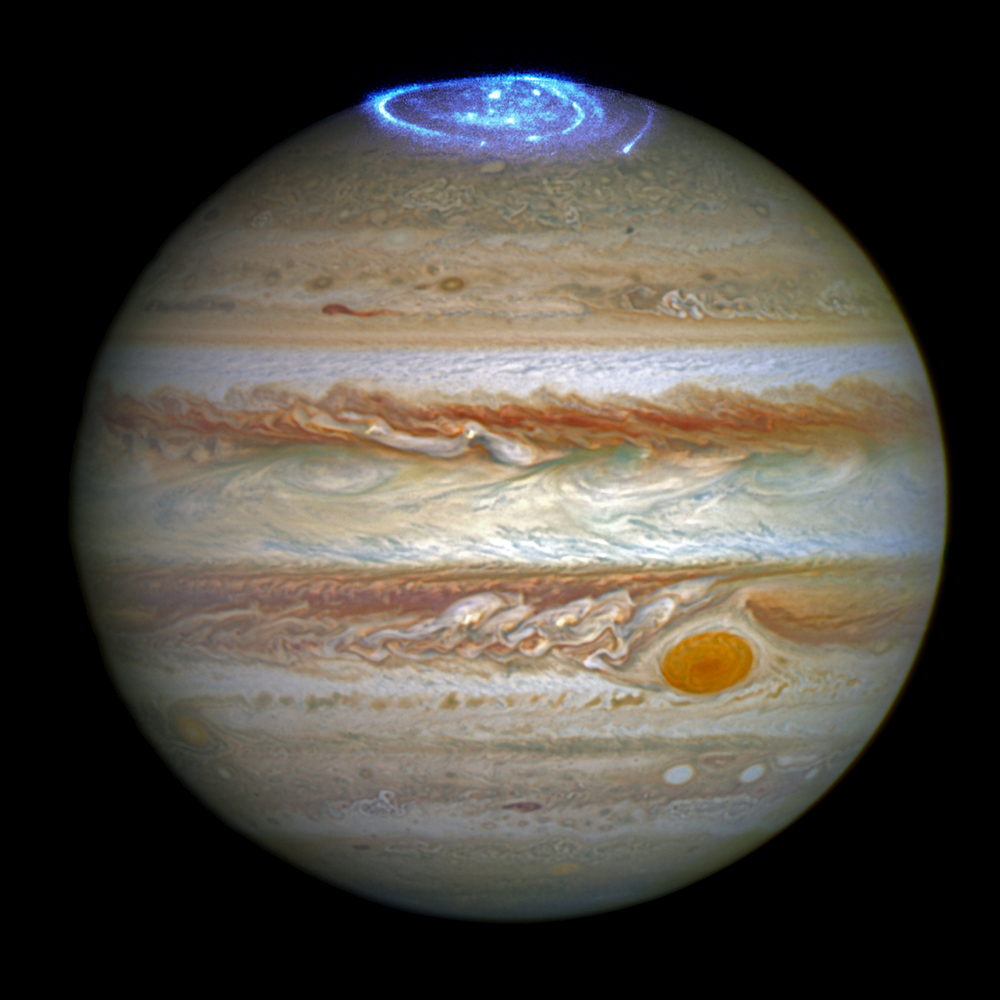
Hubble used its ultraviolet vision to observe auroras around Jupiter's north pole, revealing one of the most powerful light shows in the solar system. Auroras are formed when charged particles in the space around the planet are accelerated along the planet's magnetic field lines and interact with gases in the atmosphere, exciting atoms and molecules to produce brilliant ultraviolet emissions. Jupiter's auroras are hundreds of times more energetic than those on Earth, driven by the planet's enormously powerful magnetic field — the strongest of any planet in the solar system — and by material ejected from its volcanic moon Io. Unlike Earth's auroras, which are primarily triggered by the solar wind, Jupiter's auroral emissions are largely powered internally by the rapid rotation of its magnetosphere and the continuous injection of sulfur and oxygen ions from Io's volcanic plumes.
Scientific Significance
Hubble's ultraviolet observations of Jupiter's auroras have transformed our understanding of magnetospheric physics beyond Earth. The 2014 observations were part of a campaign coordinated with the approaching Juno spacecraft, designed to establish a baseline of auroral behavior before Juno began its close-up studies of Jupiter's polar regions. Jupiter's auroral system is fundamentally different from Earth's because it is powered primarily by internal magnetospheric processes rather than the solar wind. The rapid 10-hour rotation of Jupiter drives enormous electric currents through its magnetosphere, while Io continuously injects roughly one ton of volcanic material per second into the system. These sulfur and oxygen ions become trapped and energized, eventually spiraling along magnetic field lines into the polar atmosphere to produce auroral emissions. By mapping the morphology and temporal variability of the aurora in ultraviolet light, Hubble provided critical constraints on the structure of Jupiter's magnetic field and the dynamics of plasma transport within the magnetosphere.
Observation Details
These observations were captured using Hubble's Space Telescope Imaging Spectrograph (STIS) in far-ultraviolet imaging mode, operating at wavelengths between 115 and 170 nanometers that are completely absorbed by Earth's atmosphere and thus inaccessible to ground-based telescopes. The ultraviolet bandpass isolates emissions from molecular hydrogen and atomic hydrogen excited by precipitating charged particles, providing a clean view of the auroral morphology without contamination from reflected sunlight. Multiple exposures over several Jupiter rotations tracked changes in the auroral pattern, revealing the footprints of Io, Ganymede, and Europa as bright spots within the auroral oval.
Location in the Universe
Constellation
N/A (Solar System)
Distance from Earth
365 million to 601 million miles (varies)
Fun Facts
- 1
Jupiter's auroras are so powerful they emit hundreds of times more energy than Earth's Northern and Southern Lights, with the ultraviolet aurora alone radiating several terawatts of power — enough to supply all of human civilization's electricity needs.
- 2
Unlike Earth's auroras, which flicker mainly during solar storms, Jupiter's auroras never switch off — they blaze continuously, fueled by volcanic material from Io that gets trapped in Jupiter's immense magnetosphere.
- 3
Jupiter's magnetic field is approximately 20,000 times stronger than Earth's, creating a magnetosphere so vast that if it were visible to the naked eye from Earth, it would appear larger than the full Moon in our sky.
Image credit: NASA, ESA, Hubble Space Telescope