About This Image
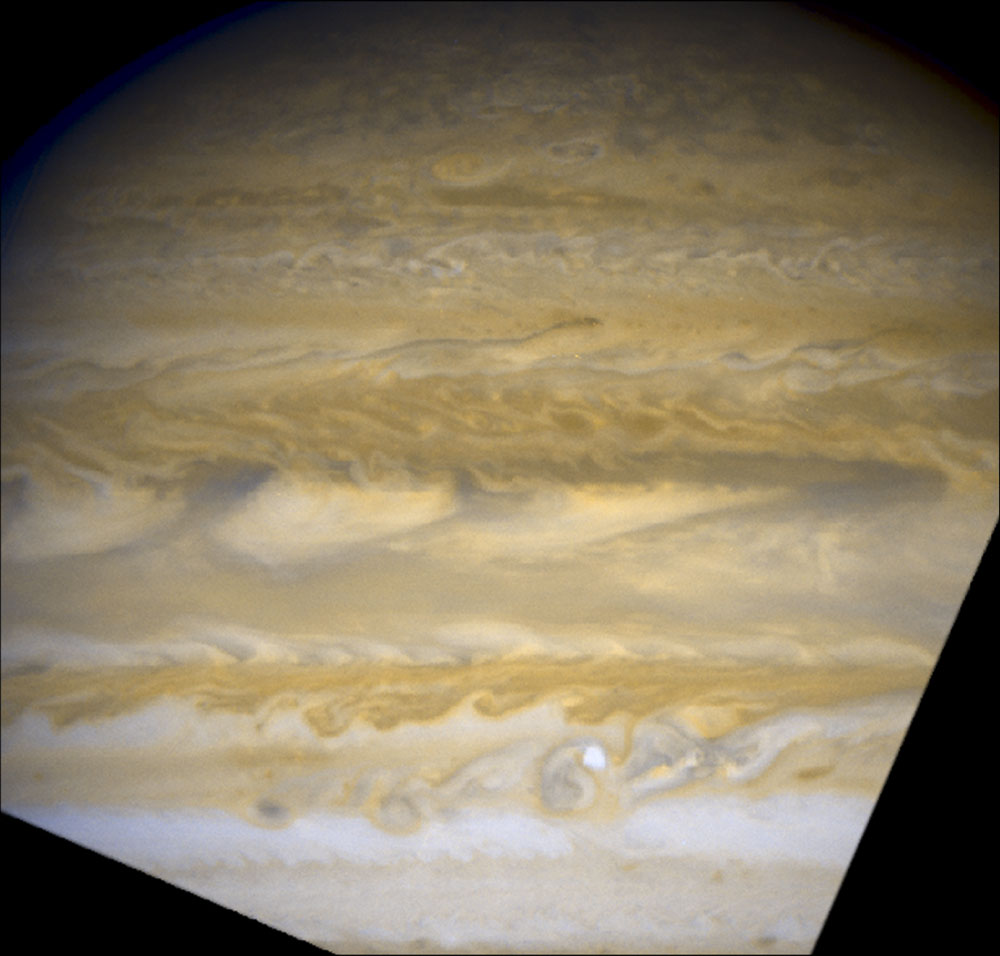
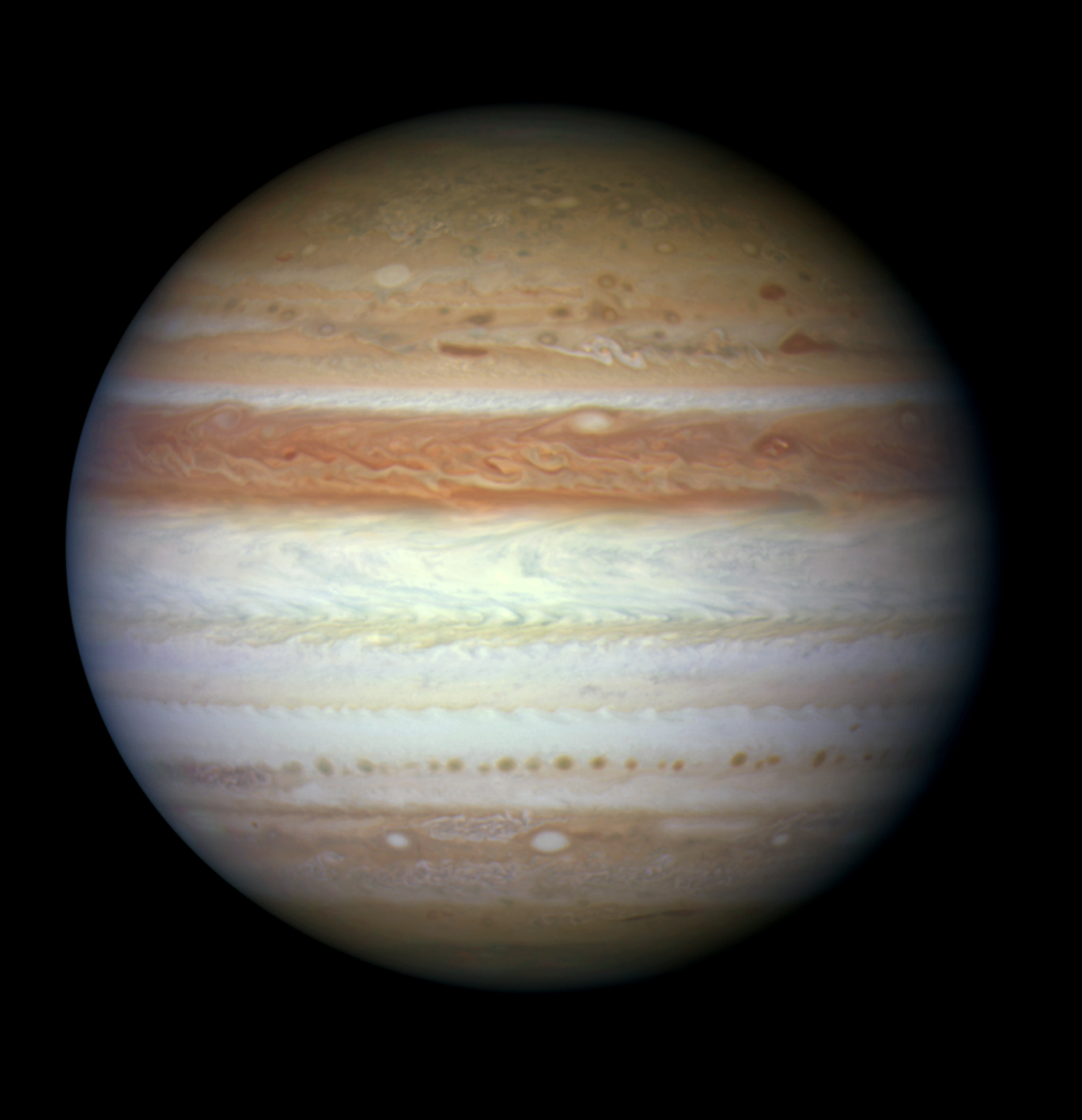
Hubble took this image of Jupiter four days after a giant meteor burned up in the planet's cloud tops in June 2010. Hubble found no sign of dark debris at the impact site, meaning the meteor did not plunge deep enough into the atmosphere to explode and leave behind any telltale marks. This stood in stark contrast to the dramatic dark scars left by the fragments of Comet Shoemaker-Levy 9 when they slammed into Jupiter in 1994, and the dark spot created by another impact in July 2009. The absence of visible debris provided astronomers with important constraints on the size and composition of the impacting body, suggesting it was likely a small, icy object that disintegrated entirely in the upper atmosphere before reaching the deeper cloud layers. Hubble's rapid-response observations demonstrated the telescope's unique ability to monitor transient events on solar system bodies.
Scientific Significance
Hubble's rapid-response observation of Jupiter following the June 2010 impact event contributed significantly to our understanding of the frequency and consequences of impacts on giant planets. By establishing that this particular impactor left no visible atmospheric scar, astronomers could constrain its size to approximately 8 to 13 meters in diameter — far smaller than the Shoemaker-Levy 9 fragments that ranged up to two kilometers. Combined with the 2009 impact that did leave a visible mark, these observations established that Jupiter experiences small impacts much more frequently than large ones, following a size-frequency distribution consistent with the known population of small solar system bodies. This information is crucial for understanding the impact hazard throughout the solar system, including the rate at which Earth-threatening objects are gravitationally scattered by Jupiter. The observations also provided tests of atmospheric entry models, constraining how deeply objects of different sizes and compositions penetrate before disintegrating.
Observation Details
Hubble observed Jupiter using the Wide Field Camera 3 (WFC3) in multiple visible and ultraviolet filters shortly after the reported impact flash. The observations were part of a Target of Opportunity program designed to respond rapidly to transient astronomical events. The WFC3's broad wavelength coverage allowed astronomers to search for impact debris at multiple atmospheric depths, since different wavelengths probe different altitudes in Jupiter's atmosphere. Ultraviolet imaging was particularly sensitive to high-altitude particulate debris that would scatter short-wavelength light. The absence of any detectable perturbation across all observed wavelengths confirmed that the impactor was too small to deposit significant energy or material in the visible cloud layers.
Location in the Universe
Constellation
N/A (Solar System)
Distance from Earth
365 million to 601 million miles (varies)
Fun Facts
- 1
The June 2010 meteor that struck Jupiter was first detected by amateur astronomers Anthony Wesley and Christopher Go, who independently captured a brief flash of light on the planet's disk — demonstrating how citizen scientists contribute to professional astronomy.
- 2
Jupiter's immense gravity acts as a cosmic vacuum cleaner, attracting comets and asteroids that might otherwise threaten the inner solar system — the planet experiences detectable impacts roughly once per year, far more frequently than any other planet.
- 3
The contrast between this invisible impact and the spectacular dark scars from Comet Shoemaker-Levy 9 in 1994 revealed that Jupiter is hit by a wide range of object sizes, from small meteors that burn up harmlessly to kilometer-sized bodies that leave marks visible for months.
Image credit: NASA, ESA, Hubble Space Telescope