About This Image
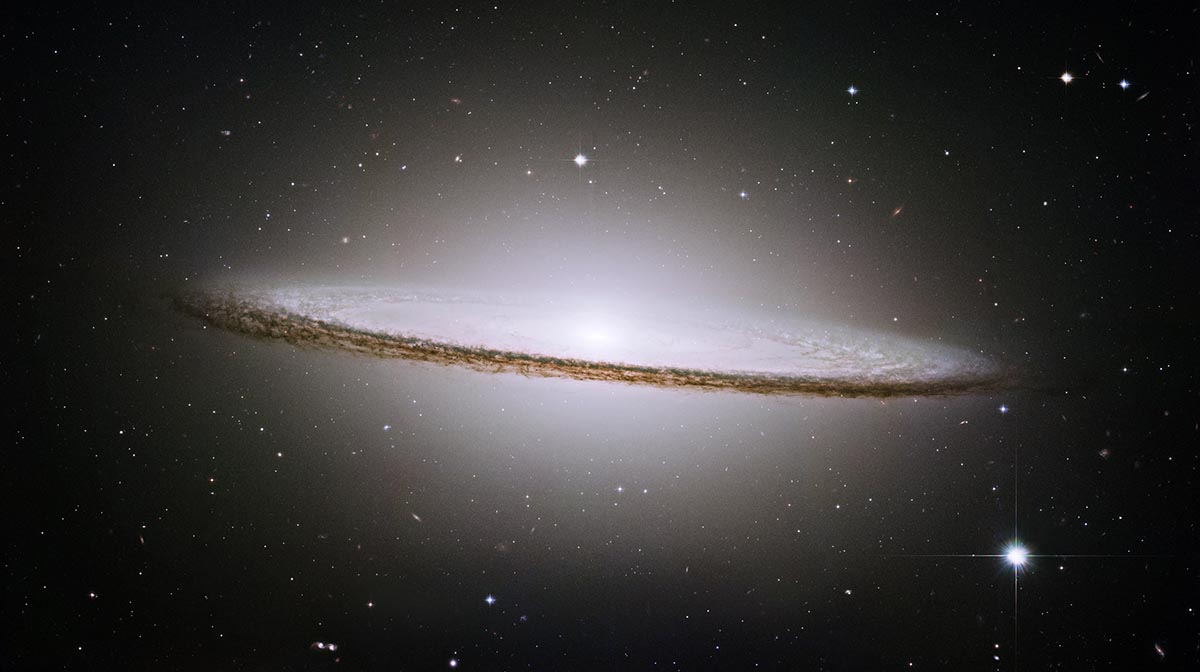
The Sombrero galaxy's hallmark is a brilliant white core encircled by thick lanes of dust, presenting one of the most visually striking sights in the sky. Officially cataloged as Messier 104 or NGC 4594, this galaxy is tilted nearly edge-on as seen from Earth, creating its distinctive hat-like silhouette that gives it its popular name. The Sombrero's bulge is unusually large and luminous, harboring a dense concentration of old stars and a supermassive black hole estimated at one billion solar masses — one of the most massive black holes found in any nearby galaxy. The prominent dust lane that encircles the galaxy is a ring of cold gas and dust that traces the galaxy's disk, where star formation continues at a modest rate. Beyond the visible disk, Hubble and other observatories have detected an extensive faint halo of globular clusters and diffuse starlight extending far beyond the galaxy's bright core.
Scientific Significance
The Sombrero Galaxy occupies an unusual niche in galaxy classification that has long puzzled astronomers. While it possesses a disk with spiral structure and a prominent dust ring characteristic of spiral galaxies, its enormous central bulge dominates the galaxy's total luminosity and stellar mass to a degree more typical of elliptical galaxies. This hybrid morphology has led to ongoing debate about whether the Sombrero is best understood as an unusually bulge-dominated spiral or as an elliptical galaxy that has acquired a disk component through a past merger. Hubble observations have shown that the globular cluster population around the Sombrero is remarkably rich and extends to large distances from the galaxy's center, more closely resembling the globular cluster systems of elliptical galaxies than spirals. The billion-solar-mass black hole at its center follows the well-established correlation between black hole mass and bulge luminosity, but sits at the extreme upper end of this relationship for its galaxy type.
Observation Details
This iconic image was produced by combining observations from Hubble's Advanced Camera for Surveys (ACS) taken through multiple broadband filters in visible light. The mosaic required six separate pointings of the ACS to cover the galaxy's full angular extent, which were then carefully stitched together to create a seamless panoramic view. The high dynamic range of the ACS detectors was essential for simultaneously capturing the brilliant nuclear region and the much fainter outer halo. Dust absorption features in the disk were enhanced by the choice of blue and green filters, where the contrast between the reddish starlight and the dark dust lane is most pronounced. The resulting image, released as one of Hubble's Heritage observations, quickly became one of the most recognized astronomical photographs ever taken.
Location in the Universe
Constellation
Virgo
Distance from Earth
29 million light-years
Fun Facts
- 1
The Sombrero Galaxy hosts a supermassive black hole with a mass of approximately one billion solar masses, making it roughly 250 times more massive than the black hole at the center of our own Milky Way and one of the largest known in any nearby galaxy.
- 2
Despite being classified as a spiral galaxy, the Sombrero has an abnormally large central bulge that contains nearly 2,000 globular clusters — roughly ten times more than the Milky Way's population, rivaling the numbers found in giant elliptical galaxies.
- 3
The Sombrero Galaxy can be observed with small amateur telescopes and was first recorded by Pierre Mechain in 1781, just six months before it was independently noted by Charles Messier, who later added it to his famous catalog as the 104th entry.
Image credit: NASA, ESA, Hubble Space Telescope