About This Image
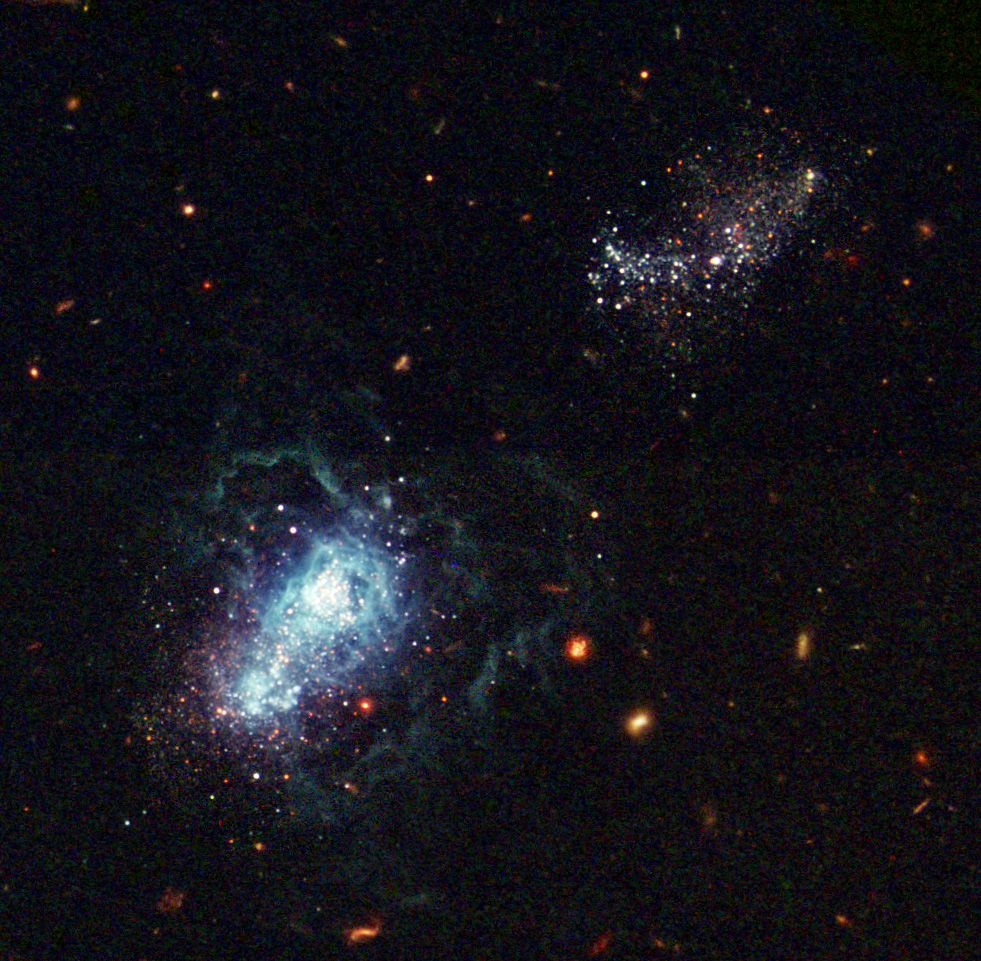
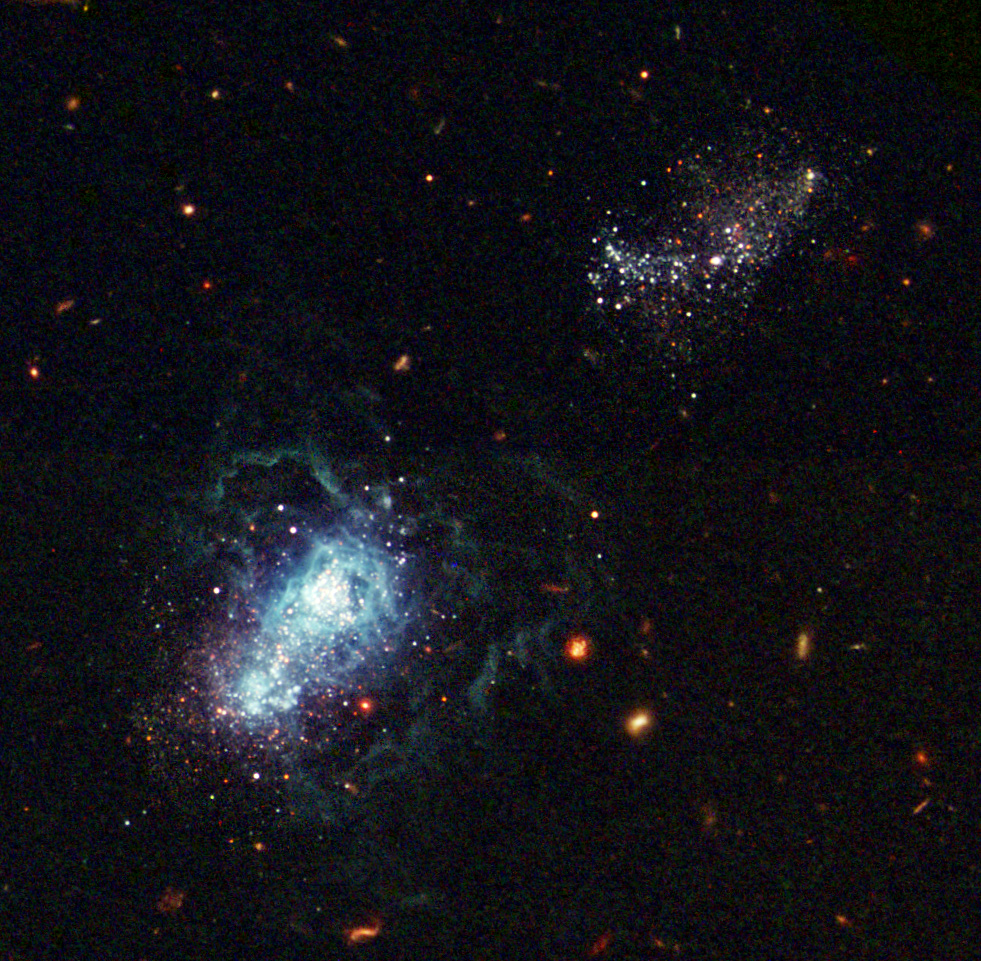
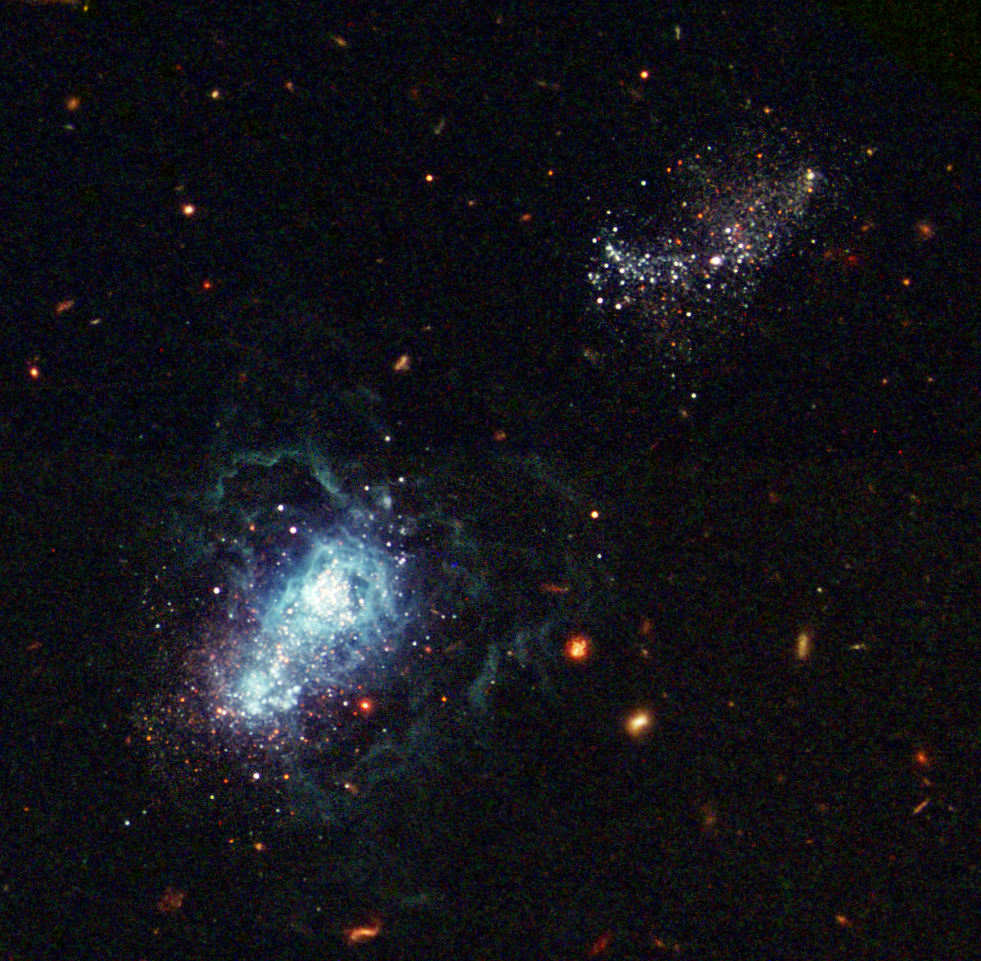
This image captures the irregular dwarf galaxy I Zwicky 18 and a companion galaxy to its upper right. For decades after its discovery by astronomer Fritz Zwicky in the 1930s, I Zwicky 18 was considered one of the youngest galaxies in the nearby universe, with its dominant stellar population appearing to be no more than 500 million years old. However, deep Hubble observations later revealed a faint population of older red giant stars, proving the galaxy had been forming stars for billions of years — it simply experienced a recent dramatic burst of activity that outshone its ancient stellar inhabitants. This age mystery makes I Zwicky 18 a unique laboratory for studying how dwarf galaxies can remain relatively dormant for eons before reigniting vigorous star formation, challenging simple models of galactic aging and evolution.
Scientific Significance
I Zwicky 18 occupies a pivotal role in our understanding of galaxy evolution because it challenges the assumption that galaxy age can be determined solely from the properties of its brightest stellar populations. When early observations showed only young blue stars, astronomers classified it as a genuinely young galaxy that had somehow delayed star formation for billions of years after the Big Bang. Hubble's deep imaging with the Advanced Camera for Surveys finally resolved faint red giant branch stars, establishing that I Zwicky 18 formed its first stars at least one billion years after the Big Bang, similar to most other galaxies. This discovery demonstrated that extreme starbursts can mask an older underlying stellar population, fundamentally changing how astronomers interpret the star formation histories of blue compact dwarf galaxies. The galaxy's extremely low metallicity also makes it an invaluable nearby analog for studying conditions in the early universe, where most galaxies had similarly pristine chemical compositions.
Observation Details
Hubble observed I Zwicky 18 using the Advanced Camera for Surveys (ACS) in multiple broadband filters spanning ultraviolet through near-infrared wavelengths. The deep exposures, totaling many orbits of integration time, were necessary to detect the extremely faint red giant branch stars lurking beneath the glare of the galaxy's brilliant young stellar population. Color-magnitude diagrams constructed from these observations allowed astronomers to identify distinct stellar populations of different ages. The ultraviolet filters highlighted the youngest, most massive stars in the starburst regions, while the red and near-infrared filters were essential for revealing the ancient low-mass stars that proved the galaxy's true age.
Location in the Universe
Constellation
Ursa Major
Distance from Earth
59 million light-years
Fun Facts
- 1
I Zwicky 18 was long considered the youngest galaxy known, with its brightest stars appearing only 500 million years old — but Hubble revealed hidden ancient stars proving it had been quietly forming stars for over 10 billion years.
- 2
The galaxy contains some of the lowest concentrations of elements heavier than hydrogen and helium ever measured, with oxygen abundances roughly 50 times lower than the Sun's, making it chemically similar to primordial galaxies in the early universe.
- 3
Despite being only about 3,000 light-years across — roughly 50 times smaller than the Milky Way — I Zwicky 18 produces stars at an intense rate relative to its size, driven by gravitational interactions with its nearby companion galaxy.
Image credit: NASA, ESA, Hubble Space Telescope