About This Image
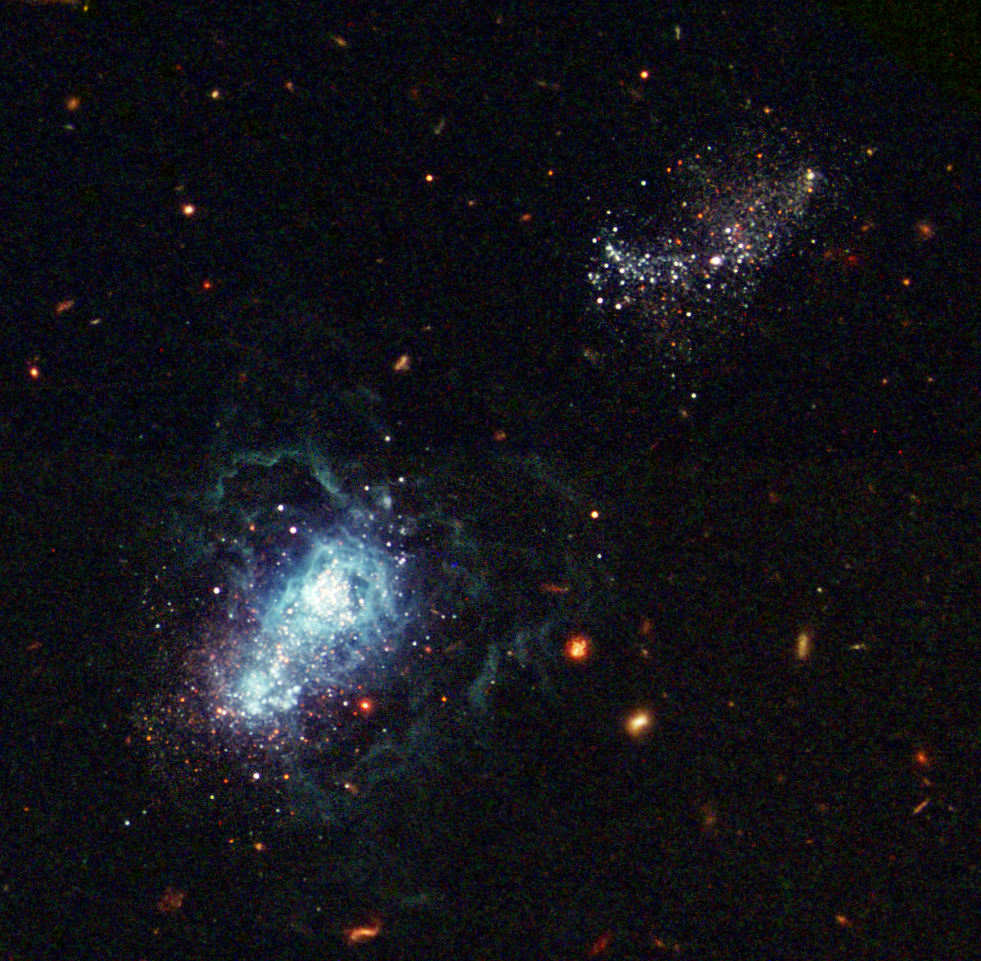
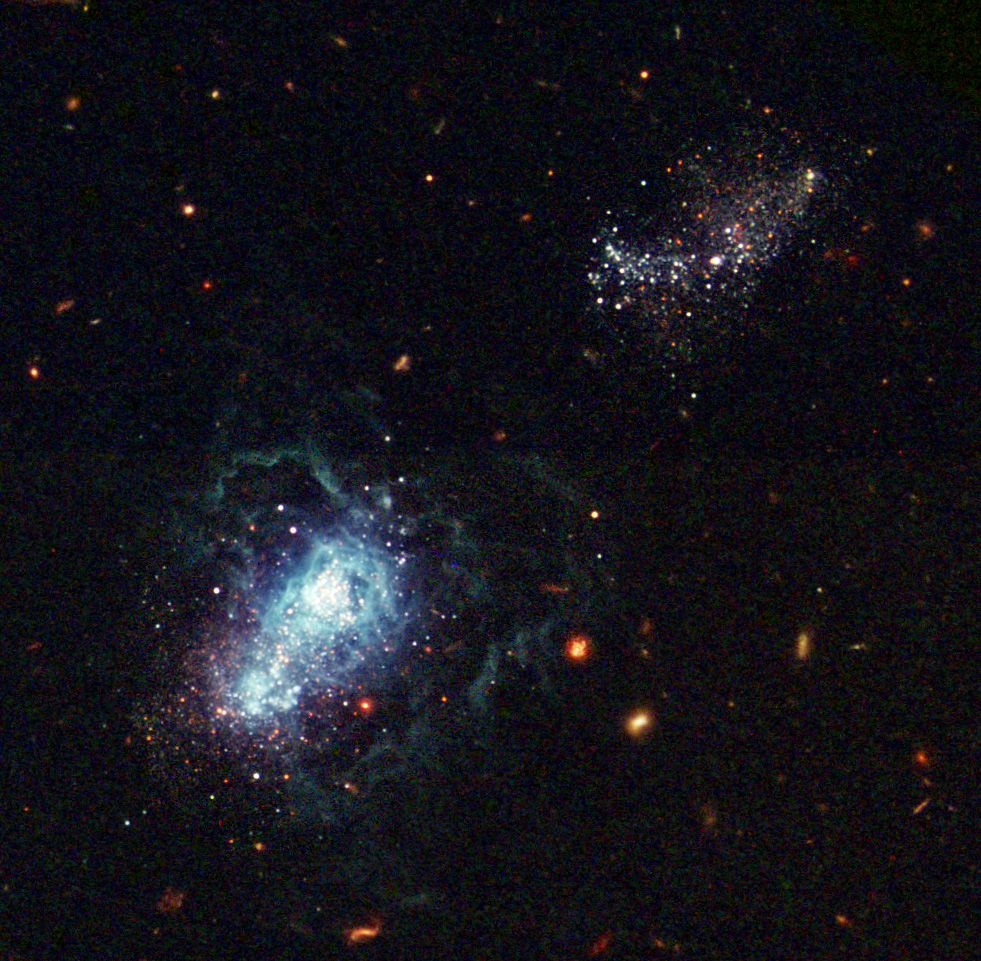
This image of the irregular dwarf galaxy I Zwicky 18 highlights the gravitational interaction between the main body of the galaxy and a smaller companion galaxy visible to its upper right. The two systems are engaged in a cosmic dance that has profoundly influenced the star formation history of both objects. Streams of gas bridge the gap between them, channeling material that fuels bursts of new star formation in I Zwicky 18's central regions. The companion itself shows signs of disruption, with its outer regions being tidally stretched by the gravitational pull of the larger galaxy. This interaction likely triggered the current intense episode of star formation that makes I Zwicky 18 blaze with young, hot blue stars, demonstrating how galaxy interactions can awaken dormant systems and dramatically alter their evolutionary trajectories.
Scientific Significance
The I Zwicky 18 system provides a compelling case study for understanding how gravitational interactions drive star formation in dwarf galaxies. Isolated dwarf galaxies in the nearby universe tend to form stars at relatively low rates, but encounters with companion galaxies can compress interstellar gas, trigger gravitational instabilities, and ignite intense starbursts. The interaction between I Zwicky 18 and its companion demonstrates this process in a relatively pristine chemical environment, where the low metallicity of the gas means that cooling processes and dust formation differ substantially from those in more chemically enriched galaxies like the Milky Way. By studying how star formation proceeds under these metal-poor conditions, astronomers gain insights into the physics that governed star formation in the early universe, when most galaxies had similarly low heavy-element abundances. The tidal interaction also tests models of dynamical friction and orbital decay in low-mass galaxy pairs.
Observation Details
Hubble's Advanced Camera for Surveys (ACS) captured this image using a combination of broadband and narrowband filters. The broadband filters in visible wavelengths revealed the overall stellar distribution and the morphology of both galaxies, while narrowband filters targeting hydrogen-alpha emission highlighted regions of active star formation where ultraviolet radiation from young massive stars ionizes surrounding hydrogen gas. The high angular resolution of ACS was critical for resolving individual star-forming clusters within I Zwicky 18 and for distinguishing the faint tidal features connecting the main galaxy to its companion from unrelated background sources.
Location in the Universe
Constellation
Ursa Major
Distance from Earth
59 million light-years
Fun Facts
- 1
The companion galaxy interacting with I Zwicky 18 is itself a dwarf system only a few thousand light-years across, yet its gravitational influence has been sufficient to trigger one of the most intense star-forming episodes observed in any nearby dwarf galaxy.
- 2
Gas bridges connecting I Zwicky 18 to its companion have been detected in radio observations of neutral hydrogen, revealing that the two galaxies are exchanging material through tidal streams that span tens of thousands of light-years.
- 3
Computer simulations suggest the companion has made multiple close passes around I Zwicky 18 over hundreds of millions of years, with each encounter compressing gas clouds and igniting successive waves of star formation.
Image credit: NASA, ESA, Hubble Space Telescope