About This Image
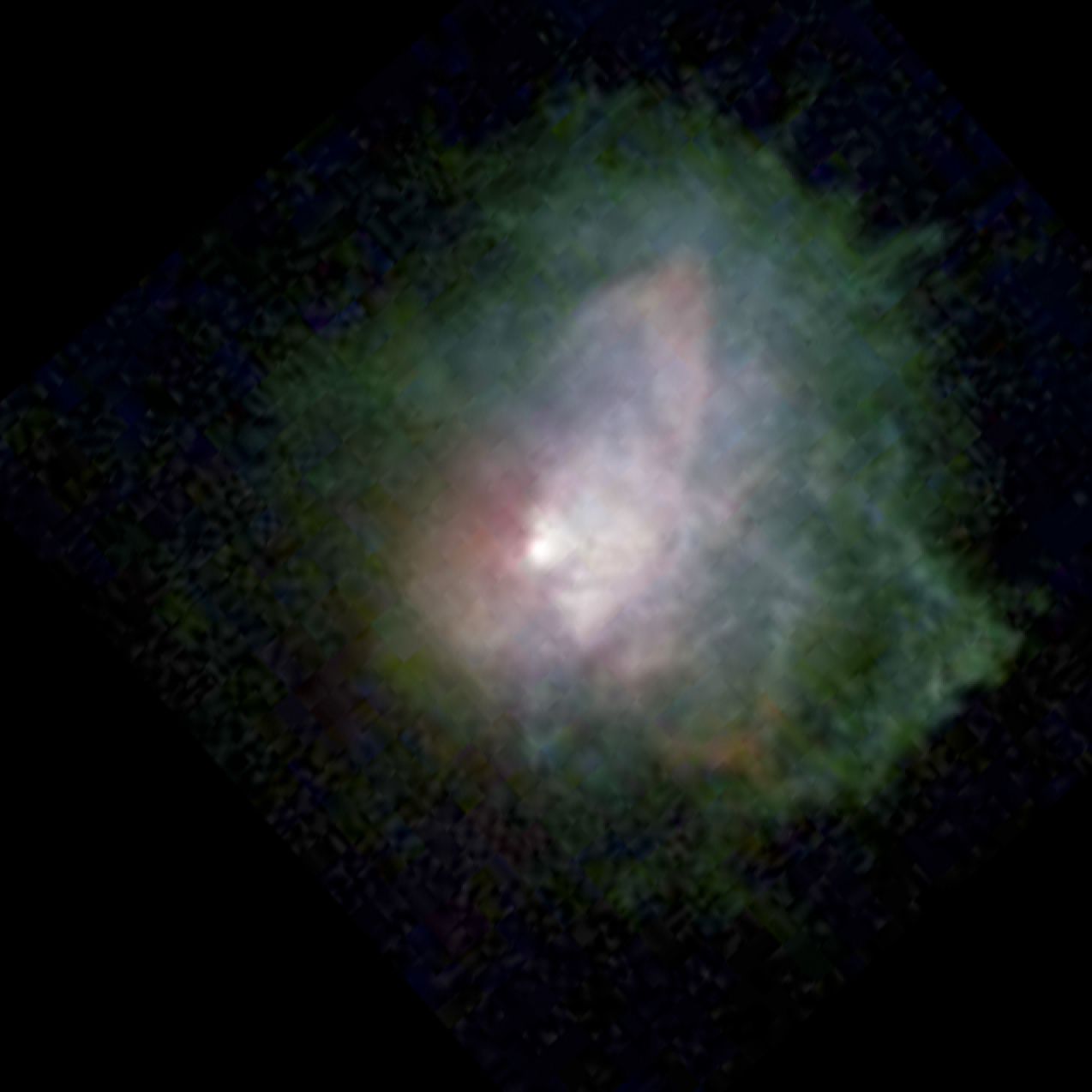
The red hypergiant star VY Canis Majoris is surrounded by a complex, turbulent nebula of gas and dust that the star has violently ejected over thousands of years through a series of massive outbursts. Located approximately 3,900 light-years from Earth in the constellation Canis Major, VY Canis Majoris is one of the largest known stars in the universe, with an estimated radius of roughly 1,400 times that of our Sun. If placed at the center of our solar system, its surface would extend beyond the orbit of Jupiter. The ejected material visible in this image forms an intricate pattern of loops, arcs, filaments, and dense knots, each moving at different velocities and in various directions, tracing the star's episodic mass-loss history. These dramatic eruptions are stripping the star of its outer layers as it approaches the final stages of its life, destined to end in a spectacular supernova explosion.
Scientific Significance
VY Canis Majoris provides astronomers with a rare and invaluable opportunity to study the extreme mass-loss processes that govern the final evolutionary stages of the most massive stars in the universe. As a red hypergiant nearing the end of its life, the star is shedding its outer envelope through mechanisms that remain poorly understood — its mass loss cannot be explained by steady stellar wind models alone, requiring episodic, convection-driven eruptions of enormous energy. The complex circumstellar nebula preserved around the star records thousands of years of mass-loss history in its multiple arcs, knots, and filaments, each corresponding to a distinct outburst event. By analyzing the chemical composition, velocities, and spatial distribution of this ejected material, researchers can reconstruct the star's eruptive history and constrain theoretical models of massive stellar evolution. VY Canis Majoris is expected to end its life as a core-collapse supernova, and understanding its pre-supernova mass loss is essential for predicting the properties of such explosions and the compact remnants they leave behind.
Observation Details
This image was captured using Hubble's Advanced Camera for Surveys (ACS) in visible light, resolving the intricate structure of the circumstellar nebula surrounding VY Canis Majoris with extraordinary detail. The observations employed polarimetric imaging to distinguish light scattered by dust grains from direct starlight, enabling astronomers to map the three-dimensional geometry of the ejected material. Multiple epochs of Hubble observation have allowed researchers to measure the proper motions of individual knots and arcs within the nebula, directly tracing their expansion velocities and linking them to specific mass-loss events in the star's recent history.
Location in the Universe
Constellation
Canis Major
Distance from Earth
3,900 light-years
Fun Facts
- 1
VY Canis Majoris is so enormous that light itself takes over eight hours to travel around its circumference — by comparison, light circles our Sun in just 14.5 seconds.
- 2
The star is losing mass at a phenomenal rate of roughly 100 times the mass of Earth every year through its powerful stellar winds and episodic eruptions, gradually shedding its outer layers into space.
- 3
Despite being one of the most luminous stars in the Milky Way — shining with approximately 300,000 times the luminosity of the Sun — VY Canis Majoris is invisible to the naked eye because much of its light is absorbed and re-radiated by the surrounding dust at infrared wavelengths.
Image credit: NASA, ESA, Hubble Space Telescope