About This Image
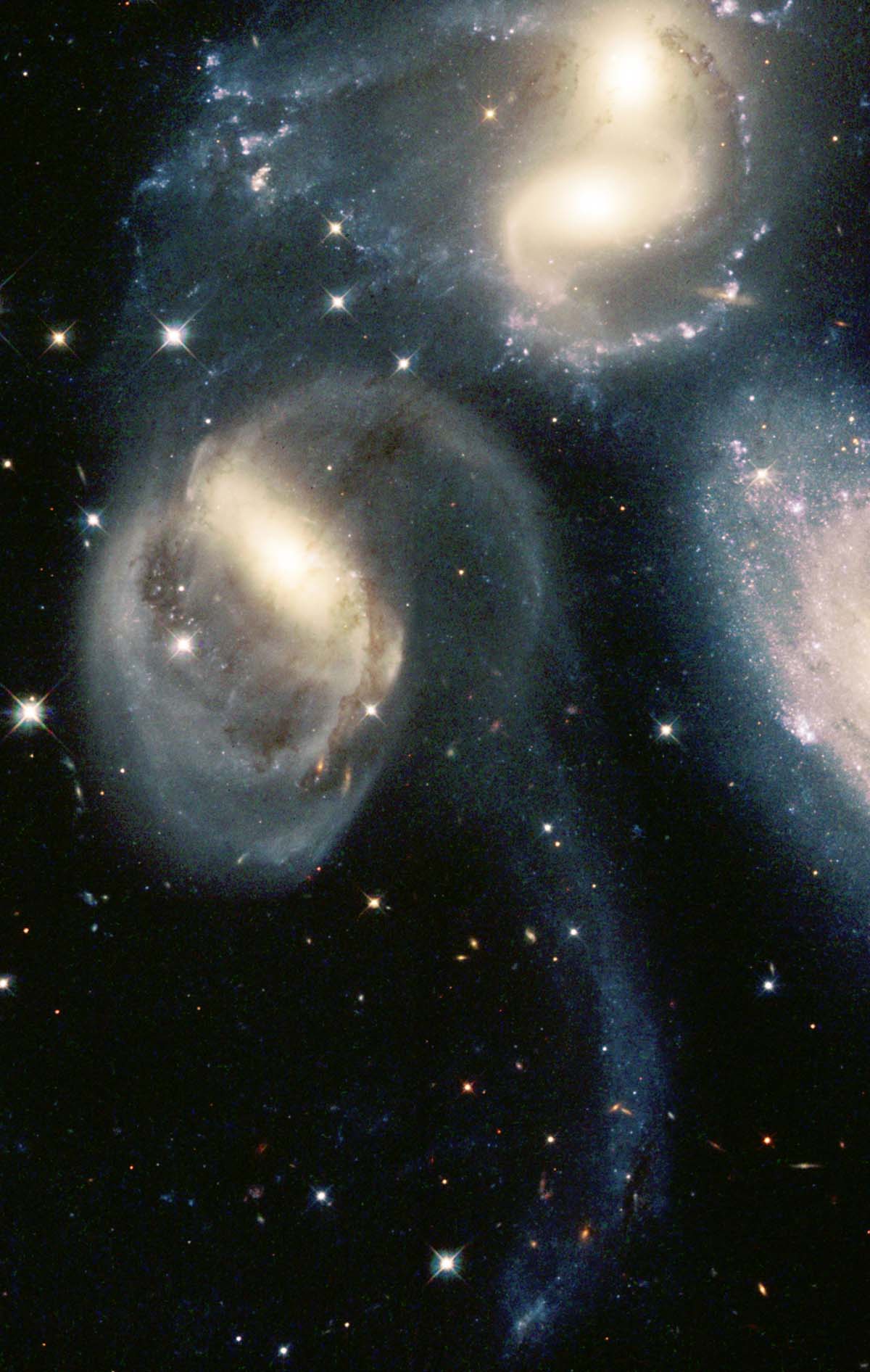
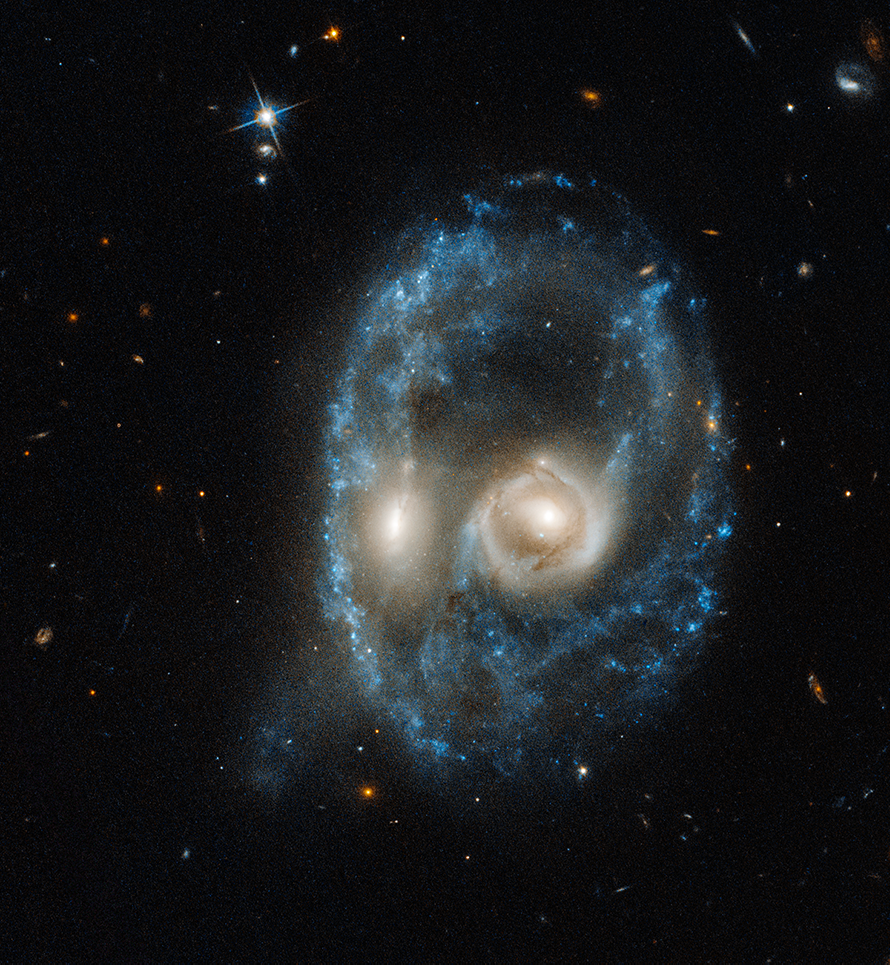
The colliding galaxies AM 2026-424 present one of the most visually arresting images in the Hubble archive — a cosmic face staring back across 704 million light-years of space from the constellation Aquila. Each luminous "eye" is the bright central core of a galaxy, their nuclei drawn close together as one galaxy plunged through the disk of the other in a cataclysmic encounter. The ghostly outline of the face is formed by a vast ring of young blue stars approximately 109,000 light-years in diameter, ignited into existence by the expanding density wave generated during the collision. Additional clumps of newly formed blue stars create the appearance of a nose and mouth, completing the uncanny facial resemblance. This ring galaxy system is a transient cosmic phenomenon — the face-like structure will persist for only about 100 million years before the gravitational interaction completely disrupts both galaxies and they eventually merge into a single, larger system.
Scientific Significance
AM 2026-424 belongs to the rare class of ring galaxies, systems formed when a compact galaxy passes directly through the disk of a larger companion, triggering an expanding wave of star formation. This collision geometry produces a clean, symmetric ring only when the impact occurs nearly head-on and perpendicular to the disk plane, making ring galaxies intrinsically uncommon and scientifically valuable. The expanding blue ring in AM 2026-424 allows astronomers to study triggered star formation in a controlled, well-defined geometry, providing direct measurements of how the star-formation wave propagates through the interstellar medium and how the resulting stellar populations age as the ring expands outward. The presence of two clearly visible galactic nuclei indicates that the collision is still in a relatively early phase, offering a snapshot of the merger process that complements observations of more advanced mergers. Studying systems like AM 2026-424 helps refine numerical simulations of galaxy collisions and improve our understanding of how mergers transform galaxy morphology and drive stellar mass growth over cosmic time.
Observation Details
This image was captured using Hubble's Wide Field Camera 3 (WFC3) in visible-light filters as part of a program to image unusual interacting galaxy systems. The observations resolved the ring structure into individual star-forming complexes and revealed the dual nuclear cores of the merging galaxies with sharp clarity. The blue color of the ring reflects the predominance of massive, short-lived O and B-type stars born in the density wave, while the redder galactic nuclei contain older stellar populations. The image was processed to enhance the contrast between the blue ring and the underlying older stellar components, revealing fine-scale structure in the star-forming regions distributed along the ring.
Location in the Universe
Constellation
Aquila
Distance from Earth
704 million light-years
Fun Facts
- 1
The face-like appearance of AM 2026-424 is entirely coincidental and temporary — the ring of blue stars forming the 'face' will disperse within roughly 100 million years as the two galaxies continue their gravitational dance toward an eventual merger.
- 2
This image was released by NASA on October 28, 2019, just in time for Halloween, earning AM 2026-424 the informal nickname 'the Ghost Face Galaxy' — a perfect example of pareidolia, the human tendency to see faces in random patterns.
- 3
The ring of blue stars spanning 109,000 light-years in diameter was formed by a density wave rippling outward through the gas disk of one galaxy after the other galaxy punched through it — much like the expanding ring of ripples created when a stone is dropped into a pond.
Image credit: NASA, ESA, Hubble Space Telescope