About This Image
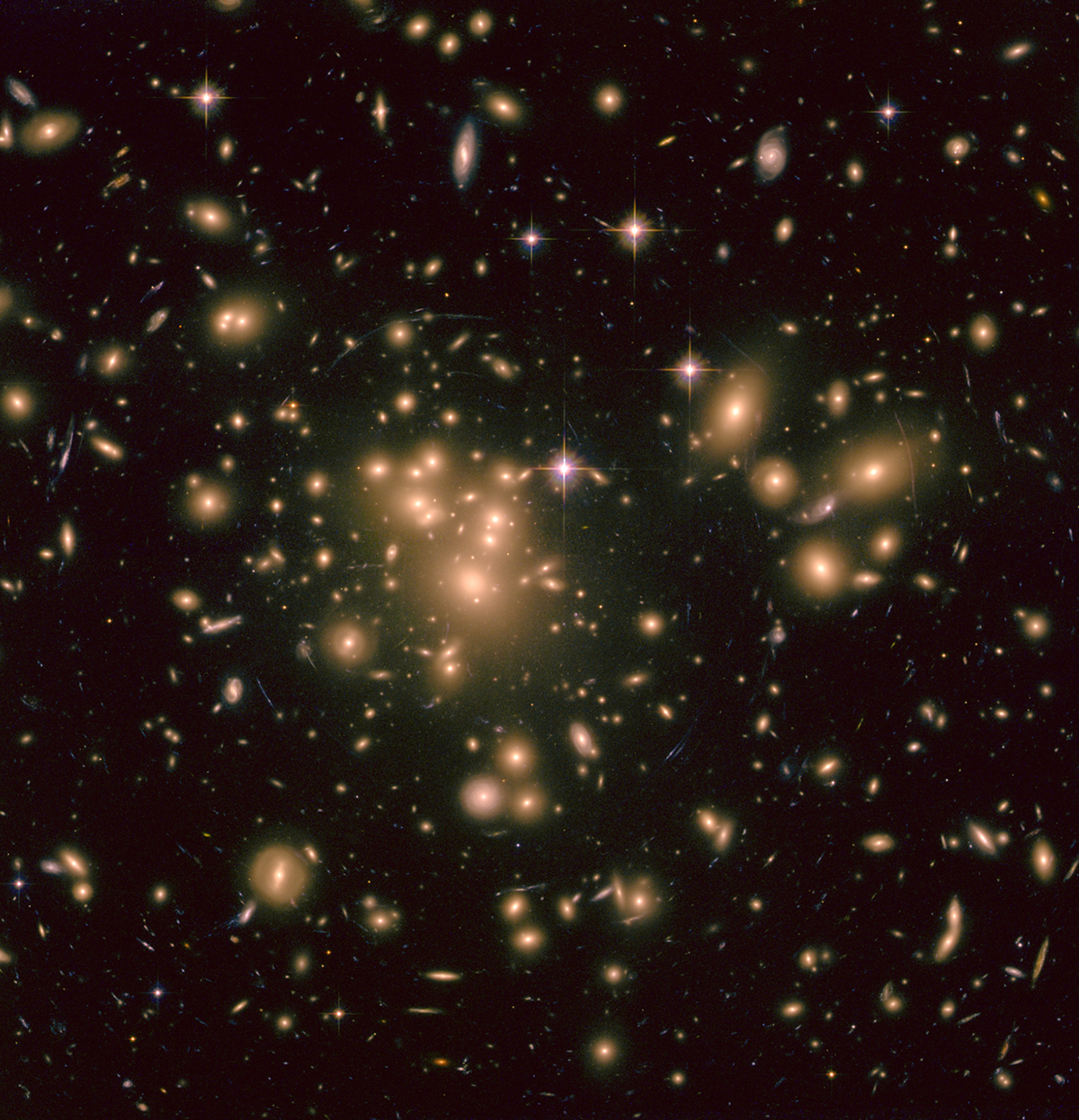
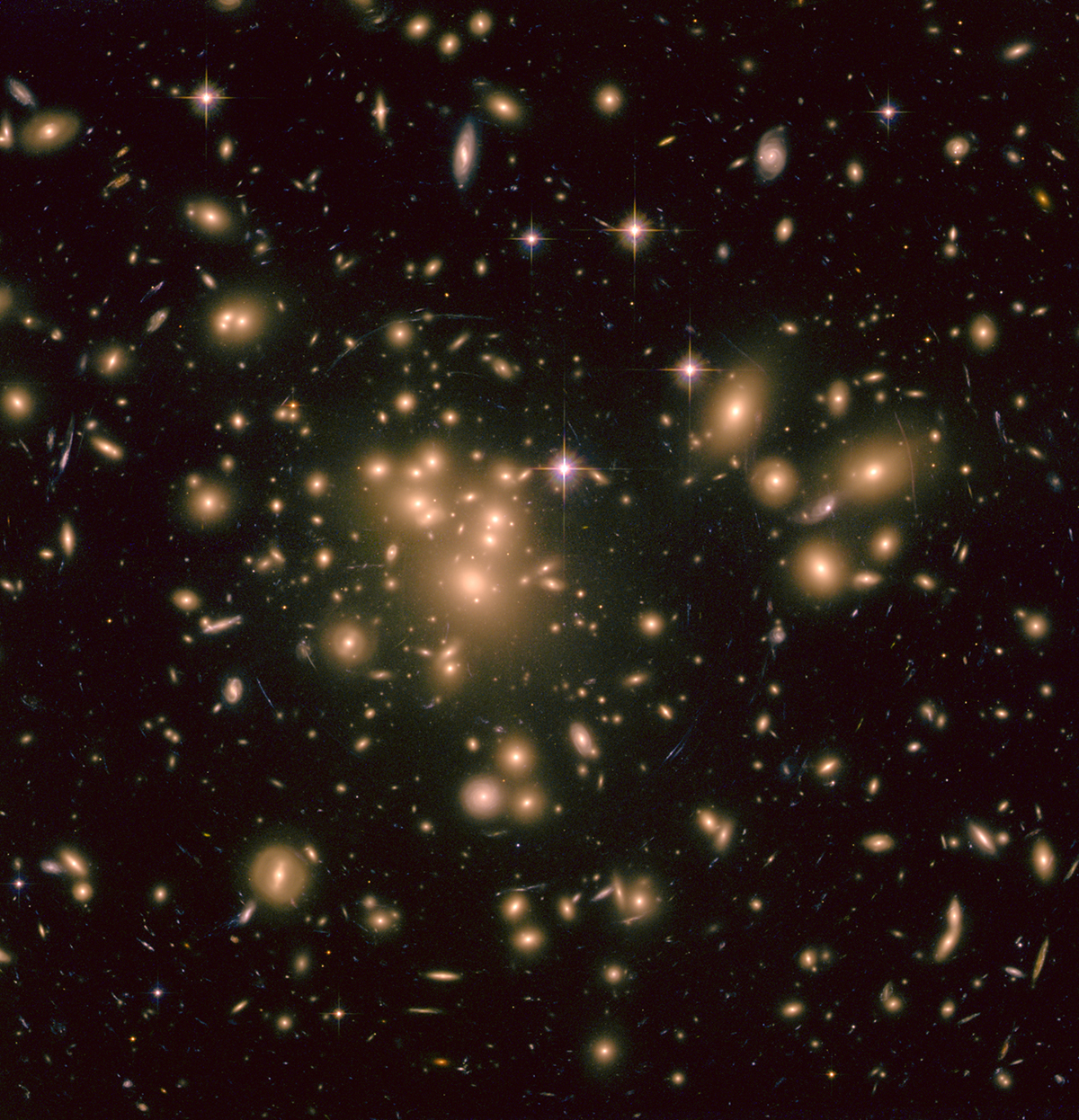
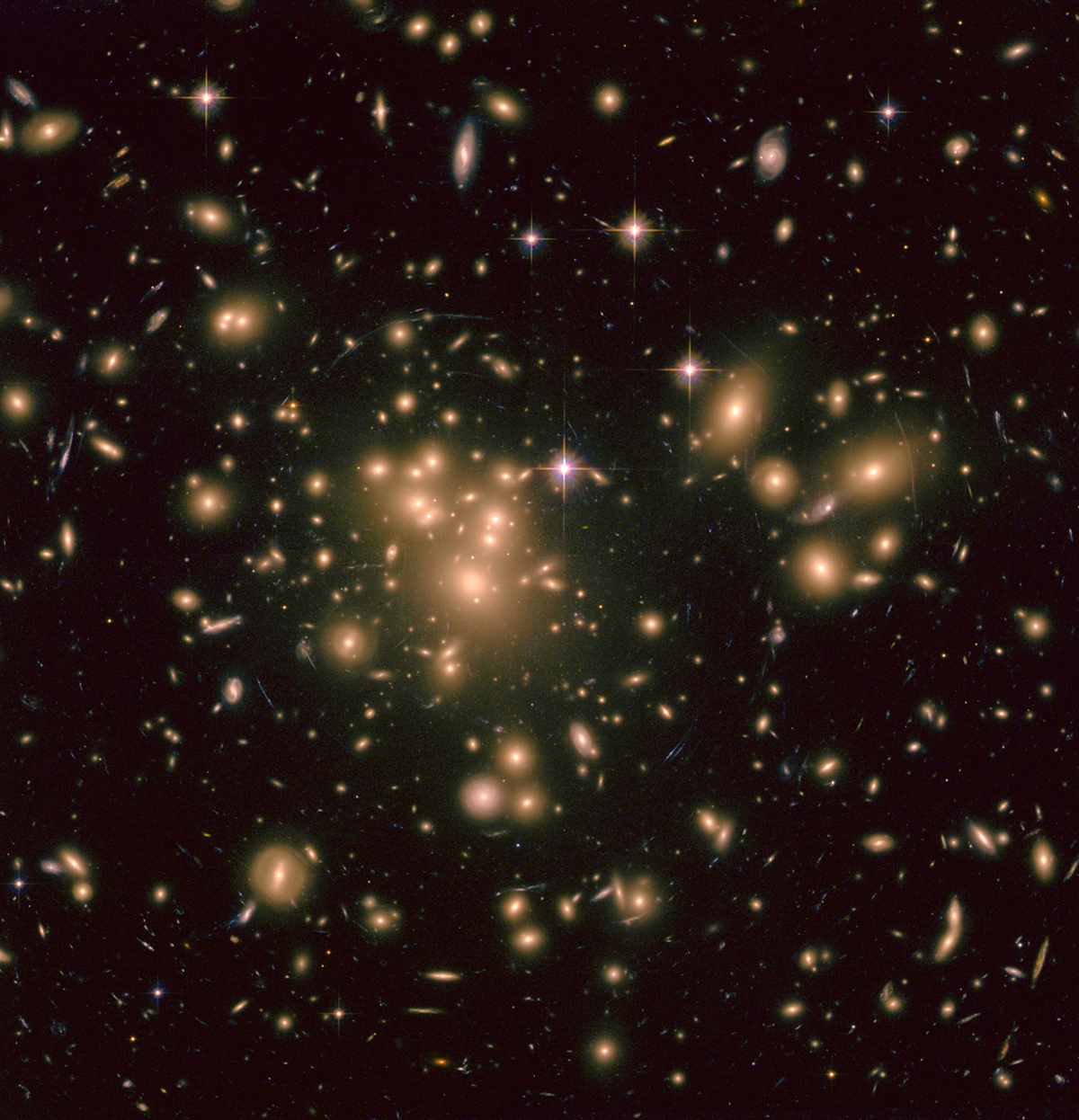
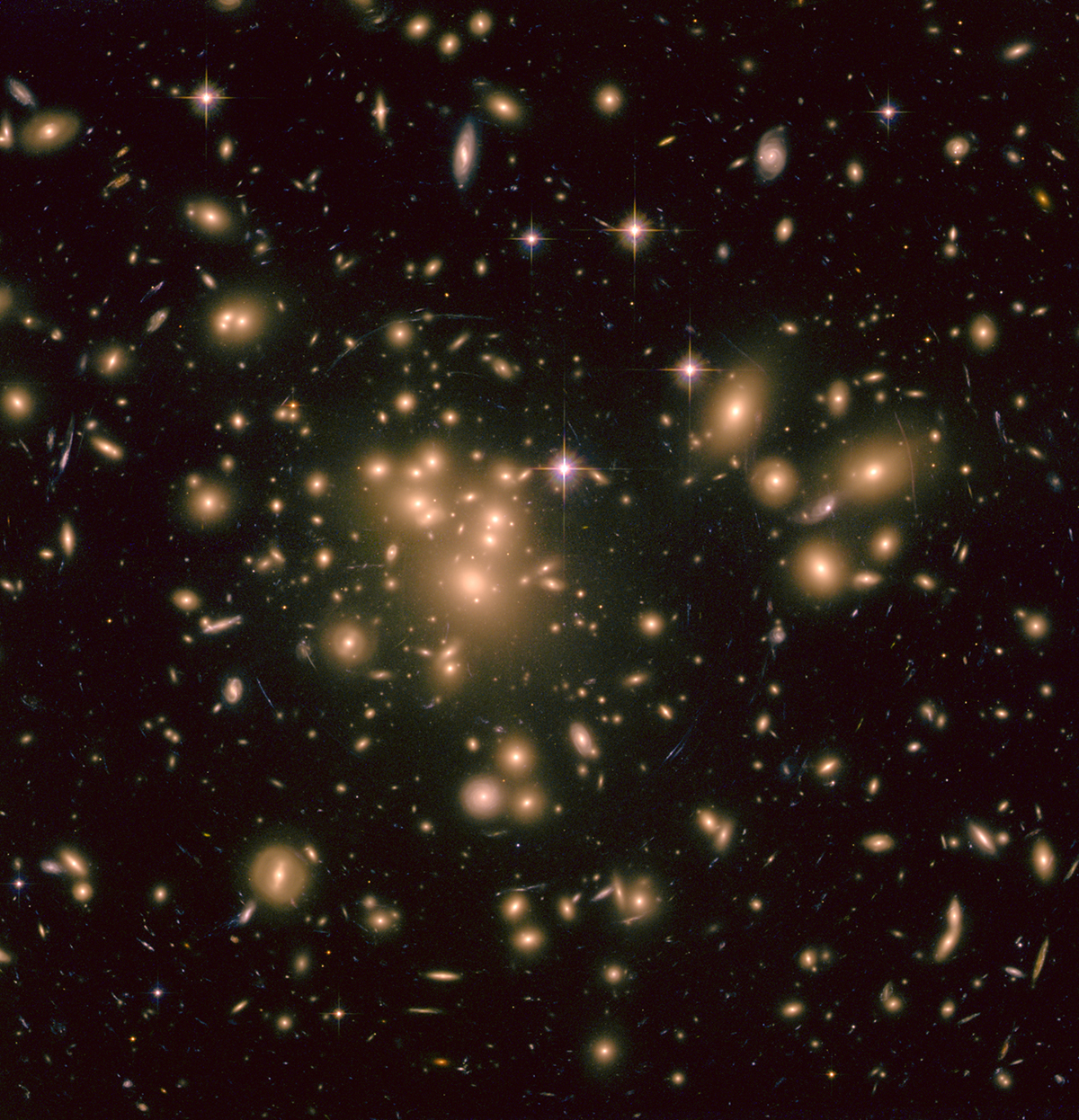
This Hubble image of the galaxy cluster Abell 1689 reveals a treasure trove of magnified background galaxies that would otherwise lie far beyond the reach of even the most powerful telescopes. Located 2.2 billion light-years from Earth in the constellation Virgo, the cluster's colossal mass acts as a cosmic magnifying glass, bending and amplifying light from galaxies situated billions of light-years behind it. Among the most remarkable discoveries made through Abell 1689's gravitational lens are some of the most distant galaxies ever observed, whose light originated when the universe was less than one billion years old. These faint, magnified images appear as tiny, distorted arcs and streaks scattered throughout the cluster field, each one a window into the earliest epoch of galaxy formation. By studying these gravitationally amplified views of the infant universe, astronomers gain invaluable insights into how the first galaxies assembled, how quickly they formed stars, and how they contributed to the reionization of the universe's hydrogen gas during the cosmic dawn.
Scientific Significance
Abell 1689's exceptional gravitational lensing power has made it one of the most important tools in observational cosmology for probing the distant universe. By magnifying galaxies that existed during the epoch of reionization — the period roughly 200 million to one billion years after the Big Bang when the first stars and galaxies flooded the universe with ultraviolet radiation, transforming the neutral hydrogen gas that filled intergalactic space into the ionized plasma that pervades it today — Abell 1689 has enabled the detection and characterization of some of the earliest known galaxies. These observations have provided crucial constraints on the ultraviolet luminosity function of early galaxies, directly bearing on the question of whether early galaxies produced sufficient ionizing radiation to drive reionization. The cluster has also been used to test cosmological parameters, including the equation of state of dark energy, by comparing the observed lensing geometry with theoretical predictions for different cosmological models. The combination of strong and weak lensing data from Abell 1689 has yielded some of the tightest constraints on the mass-concentration relation of galaxy clusters, a fundamental prediction of the cold dark matter framework.
Observation Details
These observations were obtained with Hubble's Advanced Camera for Surveys (ACS) in deep optical exposures and supplemented with near-infrared imaging from the Wide Field Camera 3 (WFC3). The near-infrared data were essential for detecting the most distant lensed galaxies, whose light has been redshifted by the expansion of the universe from ultraviolet and visible wavelengths into the infrared. The combined optical and infrared dataset enabled photometric redshift estimates for hundreds of lensed background sources, mapping the three-dimensional distribution of distant galaxies behind the cluster. The exceptional depth of the observations, combined with the cluster's magnification, probed galaxy populations several times fainter than the Hubble Ultra Deep Field at comparable redshifts.
Location in the Universe
Constellation
Virgo
Distance from Earth
2.2 billion light-years
Fun Facts
- 1
Using Abell 1689 as a gravitational telescope, astronomers discovered a galaxy at a redshift of 7.6, meaning its light was emitted when the universe was only about 700 million years old — one of the most distant galaxies known at the time of its discovery.
- 2
The magnification provided by Abell 1689 can boost the brightness of background galaxies by factors of 10 to 100, effectively giving Hubble the light-gathering power of a telescope with a mirror many times its actual size.
- 3
Some background galaxies behind Abell 1689 appear as multiple images — the same galaxy visible in two, three, or even five separate locations in the image — because light takes different paths around the cluster's warped spacetime, each arriving from a slightly different direction.
Image credit: NASA, ESA, Hubble Space Telescope