About This Image
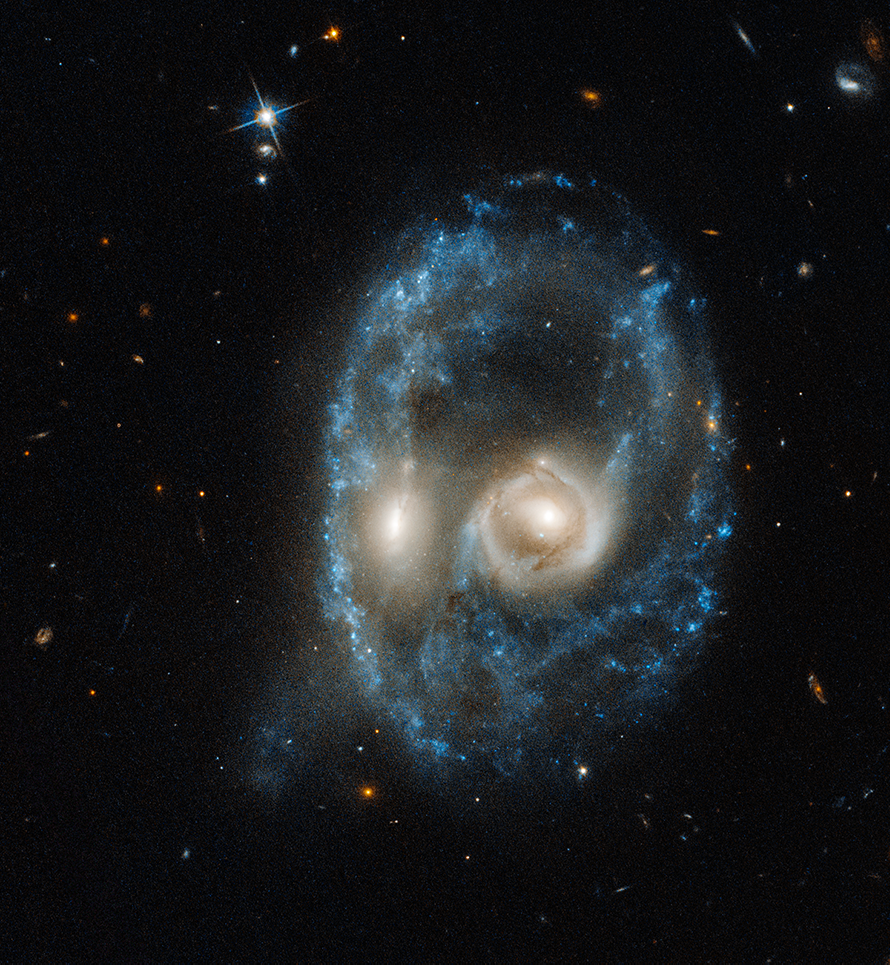
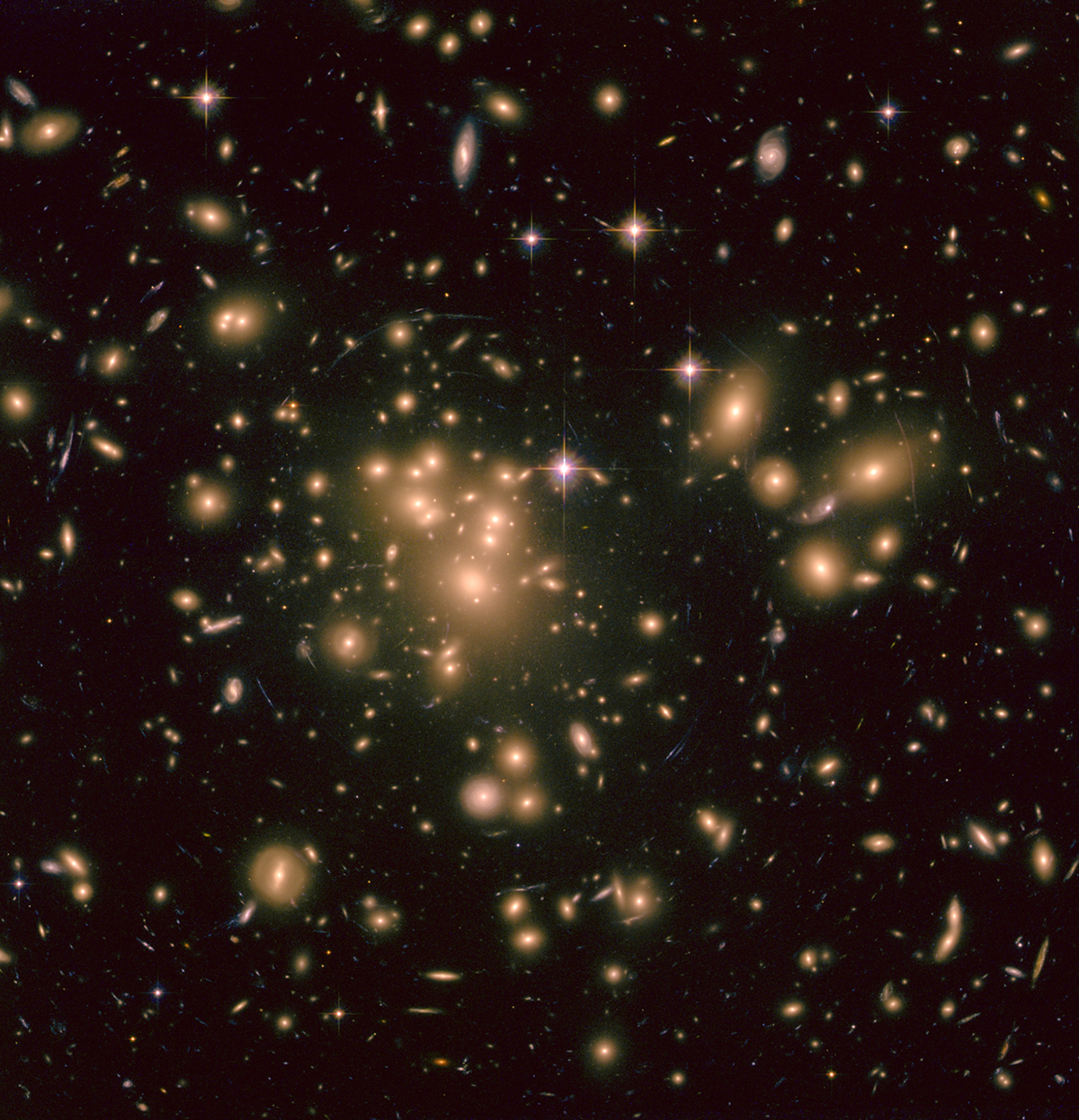
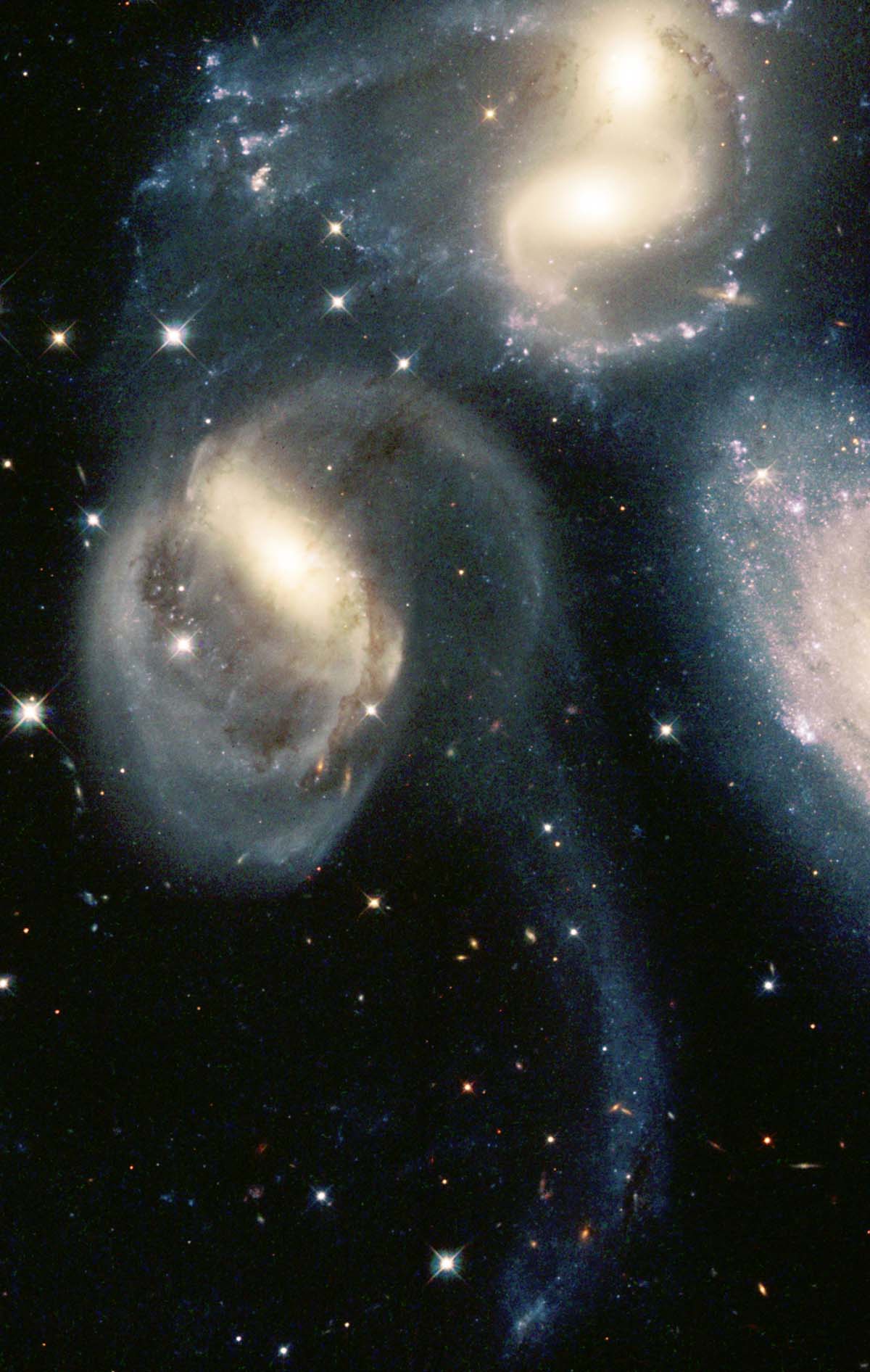
This striking close-up image reveals four of the five galaxies that compose Stephan's Quintet, the first compact galaxy group ever discovered, identified by the French astronomer Edouard Stephan in 1877. Located approximately 290 million light-years away in the constellation Pegasus, this remarkable galactic ensemble showcases the dramatic consequences of gravitational interaction between closely spaced galaxies. The image reveals brilliant blue clusters of newly formed stars, ignited by the violent tidal forces generated as the galaxies gravitationally tug and distort one another. Long streamers and tails of gas and stars have been ripped from the galaxies and flung into intergalactic space, creating a complex web of debris that records the history of their interactions. Shock waves produced by one galaxy plunging through the group at nearly 900 kilometers per second have heated intergalactic gas to millions of degrees, generating a vast ridge of X-ray emission visible in complementary observations.
Scientific Significance
Stephan's Quintet serves as one of the most important nearby laboratories for studying galaxy interactions, mergers, and the complex interplay between galaxies and their surrounding intergalactic medium. The group provides a snapshot of processes that were far more common in the early universe, when galaxies were closer together and interactions more frequent. The ongoing collision between NGC 7318b and the intragroup medium has produced one of the largest known shock fronts in the universe, spanning approximately 60,000 light-years, which has been studied extensively across the electromagnetic spectrum from radio to X-ray wavelengths. These observations have revealed how galaxy collisions can simultaneously quench star formation in some regions by heating gas to extreme temperatures while triggering vigorous starbursts in others through shock compression. The multiple tidal tails and debris fields provide direct evidence for the hierarchical assembly of galaxies through mergers, a fundamental prediction of modern cosmological models.
Observation Details
This image was captured using Hubble's Wide Field and Planetary Camera 2 (WFPC2) in multiple visible-light filters, resolving individual star-forming regions, tidal features, and compact stellar clusters within the interacting galaxy group. The observations revealed the detailed morphology of tidal tails and bridges connecting the member galaxies, features that trace the gravitational dynamics of the system over hundreds of millions of years. Complementary observations at X-ray wavelengths by the Chandra X-ray Observatory and at infrared wavelengths by the Spitzer Space Telescope provided critical multi-wavelength context for understanding the physical conditions in the shock-heated gas and dust-obscured star-forming regions within the group.
Location in the Universe
Constellation
Pegasus
Distance from Earth
290 million light-years
Fun Facts
- 1
Stephan's Quintet was the first compact galaxy group ever identified, discovered in 1877, but one of the five galaxies (NGC 7320) is actually a foreground interloper at only 40 million light-years away — nearly seven times closer than the other four members.
- 2
One of the group's galaxies, NGC 7318b, is plunging through the group at roughly 900 kilometers per second, generating a massive shock wave larger than the Milky Way that heats intergalactic gas to millions of degrees and triggers bursts of star formation.
- 3
The tidal tails and debris streams created by the galaxies' interactions contain enough raw material to build entirely new dwarf galaxies, and astronomers have observed 'tidal dwarf galaxies' forming within these structures — essentially new galaxies born from the wreckage of old ones.
Image credit: NASA, ESA, Hubble Space Telescope