About This Image
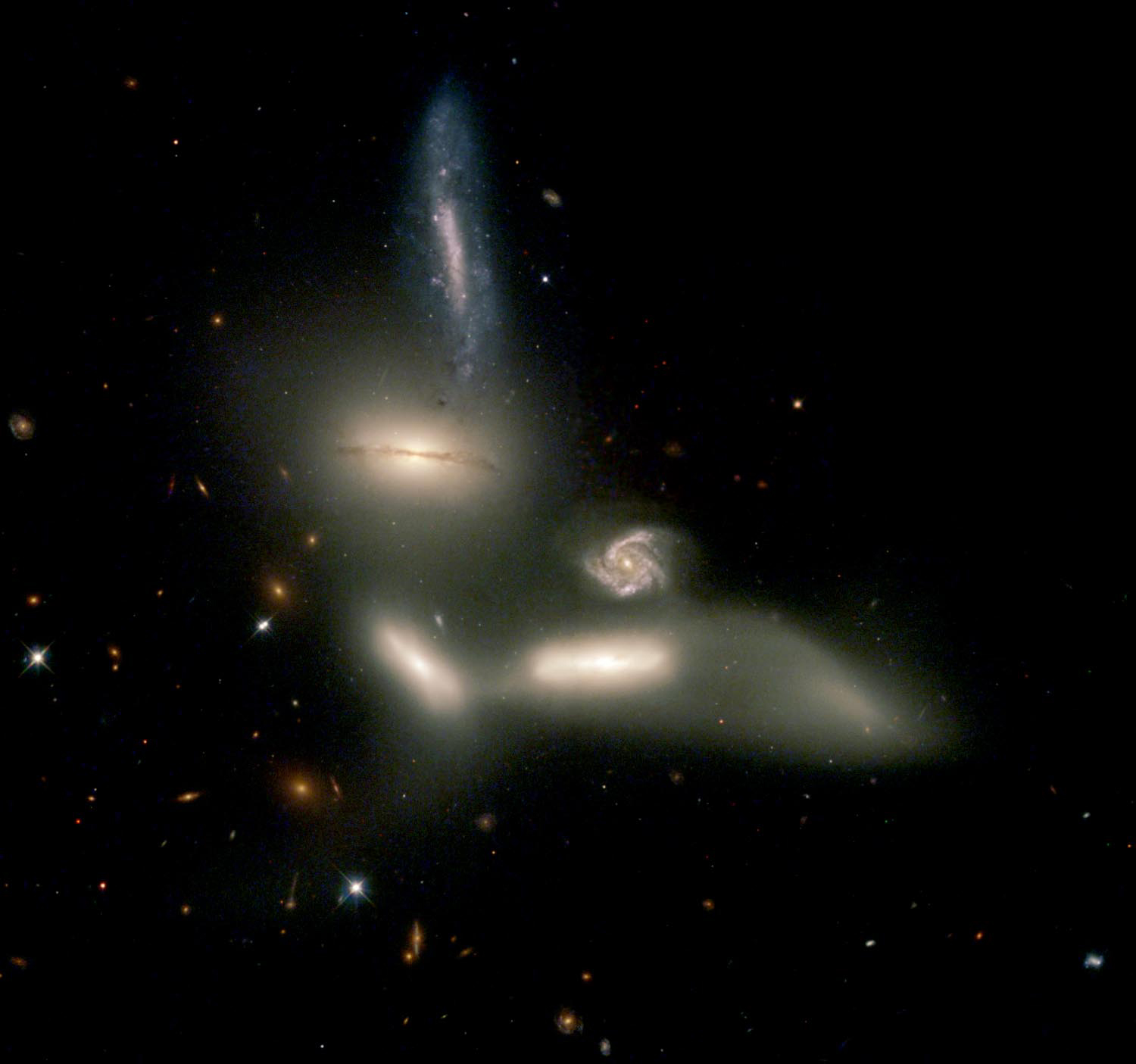
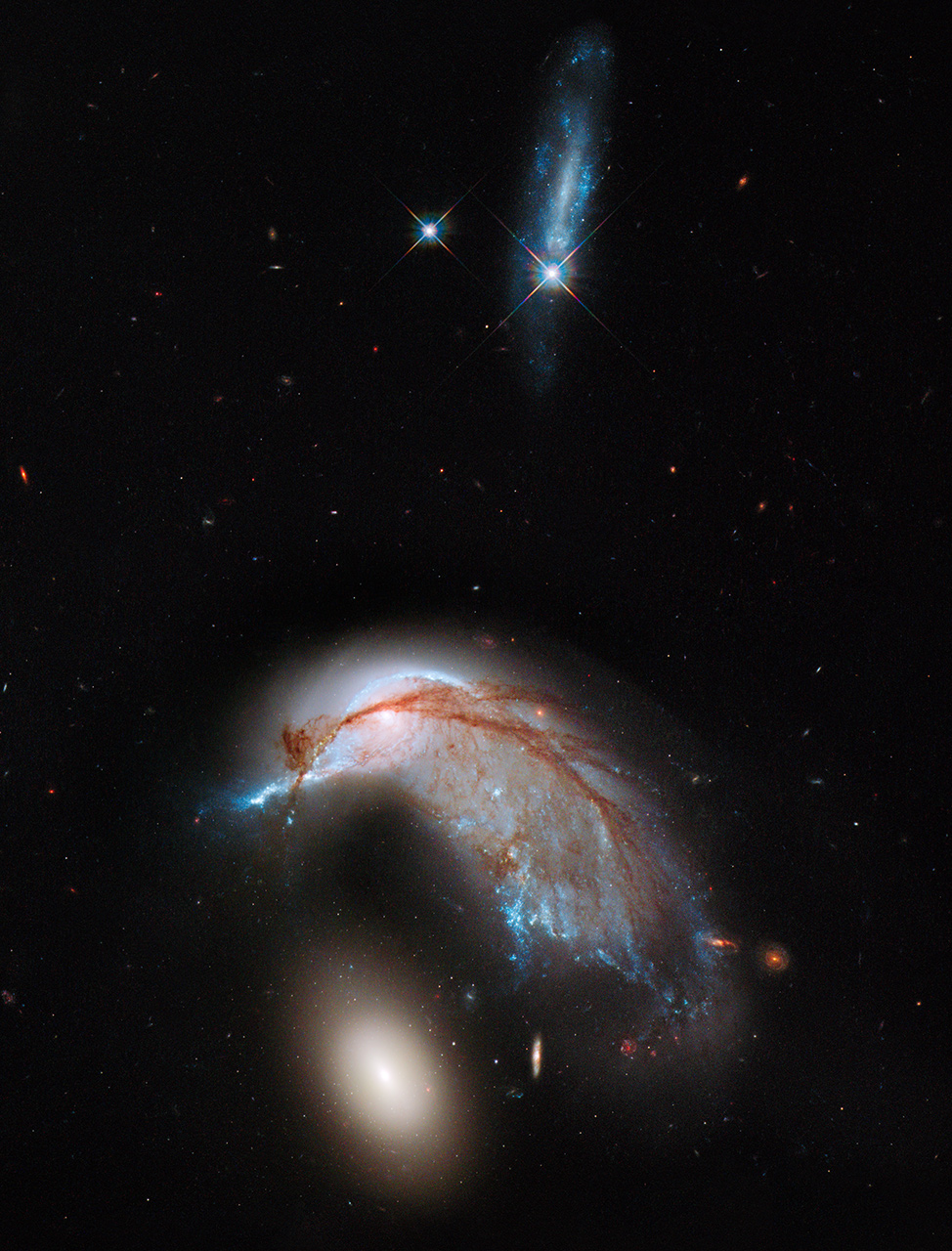
This striking image captures the interacting galaxy pair known as Arp 142, nicknamed the 'Penguin and the Egg' for their unmistakable resemblance to a penguin guarding its egg. The 'Penguin,' NGC 2936, was once an ordinary spiral galaxy until it ventured too close to the compact elliptical galaxy NGC 2937, the 'Egg,' whose powerful gravitational pull has dramatically warped and distorted NGC 2936's spiral arms into a chaotic, elongated shape. Bright blue knots of newly formed stars trace the disrupted arms, ignited by the gravitational compression of gas clouds during the interaction. The smooth, featureless NGC 2937 sits calmly below, its old stellar population largely unaffected by the encounter. Located approximately 326 million light-years away in the constellation Hydra, this pair illustrates the dramatic transformations galaxies undergo during close gravitational encounters.
Scientific Significance
Arp 142 provides astronomers with an exceptional case study of galaxy interactions at an intermediate stage of merging. The system demonstrates how tidal forces from a massive companion can completely reshape a spiral galaxy's morphology while simultaneously triggering bursts of new star formation. The contrast between the actively star-forming, disrupted NGC 2936 and the quiescent, undisturbed elliptical NGC 2937 offers direct insight into how different galaxy types respond to gravitational encounters. Numerical simulations of this system have helped refine models of tidal interaction dynamics, revealing that the current configuration represents a stage roughly 50 to 100 million years after the closest approach. Arp 142 also illustrates the process by which spiral galaxies are gradually transformed into elliptical galaxies through mergers, a mechanism believed to be one of the primary drivers of galaxy evolution across cosmic time. The pair is included in Halton Arp's famous Atlas of Peculiar Galaxies, a catalog that has been instrumental in studying non-standard galaxy morphologies.
Observation Details
Hubble captured this image of Arp 142 using the Wide Field Camera 3 (WFC3) in both visible and infrared wavelengths. The visible-light observations highlight the blue star-forming regions and the warped dust lanes of NGC 2936, while infrared data penetrates the dust to reveal the underlying stellar distribution. The image also includes an unrelated background galaxy, UGC 5130, visible as a blue object above the interacting pair. Hubble's resolution allowed astronomers to identify individual star-forming complexes within the tidal debris and measure the color gradients that trace the progression of gravitationally induced star formation across the disrupted spiral.
Location in the Universe
Constellation
Hydra
Distance from Earth
326 million light-years
Fun Facts
- 1
NGC 2936 was a perfectly normal spiral galaxy before the gravitational encounter with NGC 2937 stretched and distorted its shape into what now resembles a penguin, earning the pair the nickname 'Penguin and the Egg.'
- 2
The bright blue clumps visible along NGC 2936's distorted arms are regions of intense star formation triggered by the gravitational interaction, as gas clouds are compressed and collapse into new stars at an accelerated rate.
- 3
Despite appearing calm and unaffected, NGC 2937 (the 'Egg') is actually responsible for the gravitational chaos — its dense, compact mass is steadily pulling NGC 2936 apart, and the two galaxies will eventually merge into a single larger galaxy over hundreds of millions of years.
Image credit: NASA, ESA, Hubble Space Telescope