About This Image
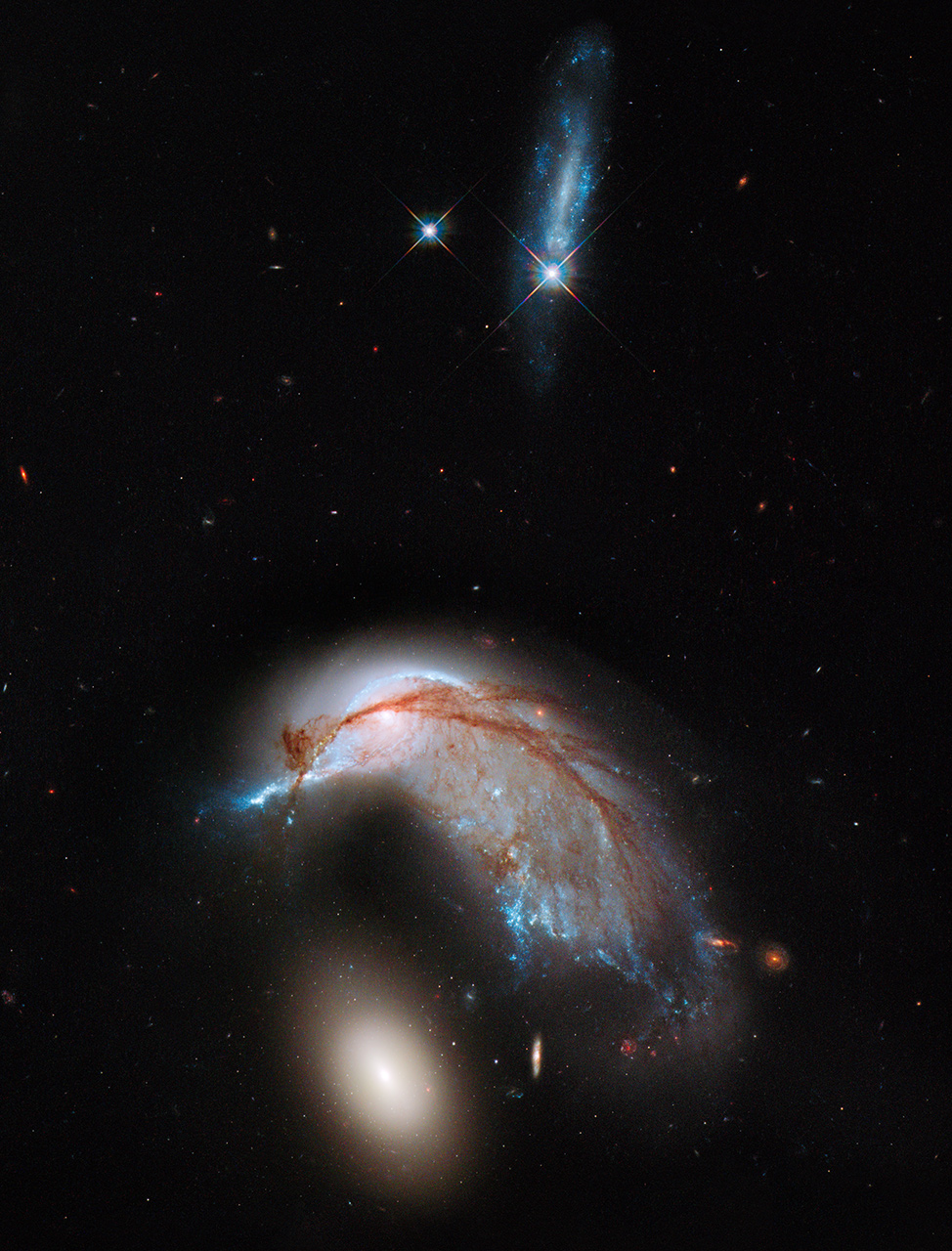
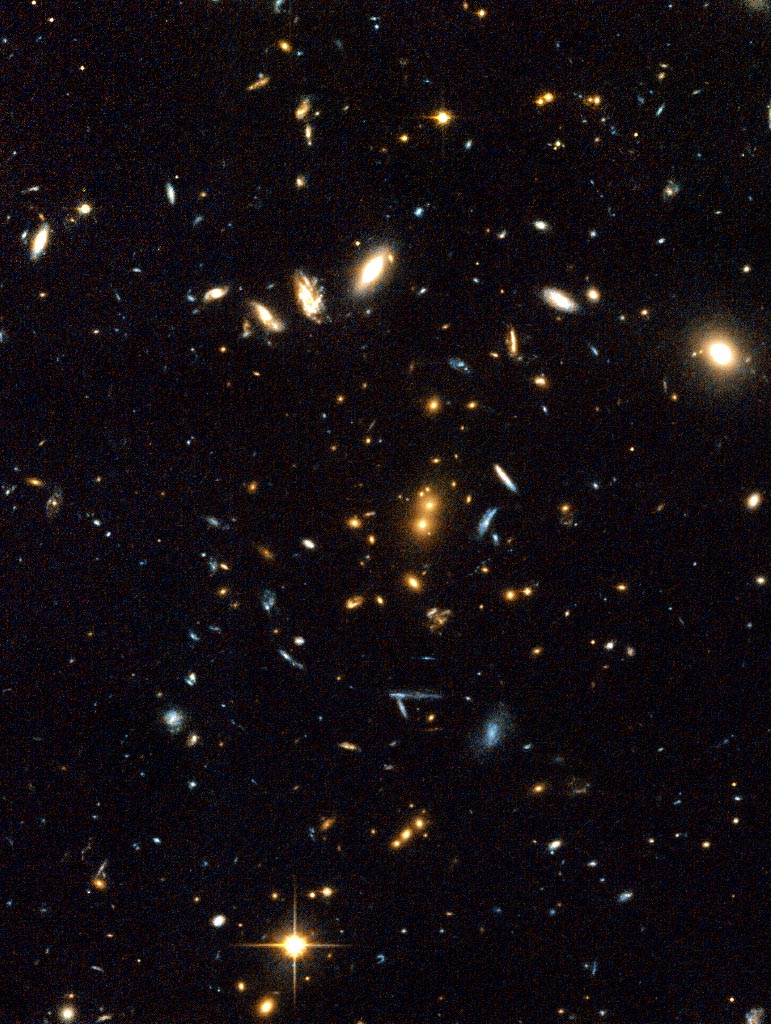
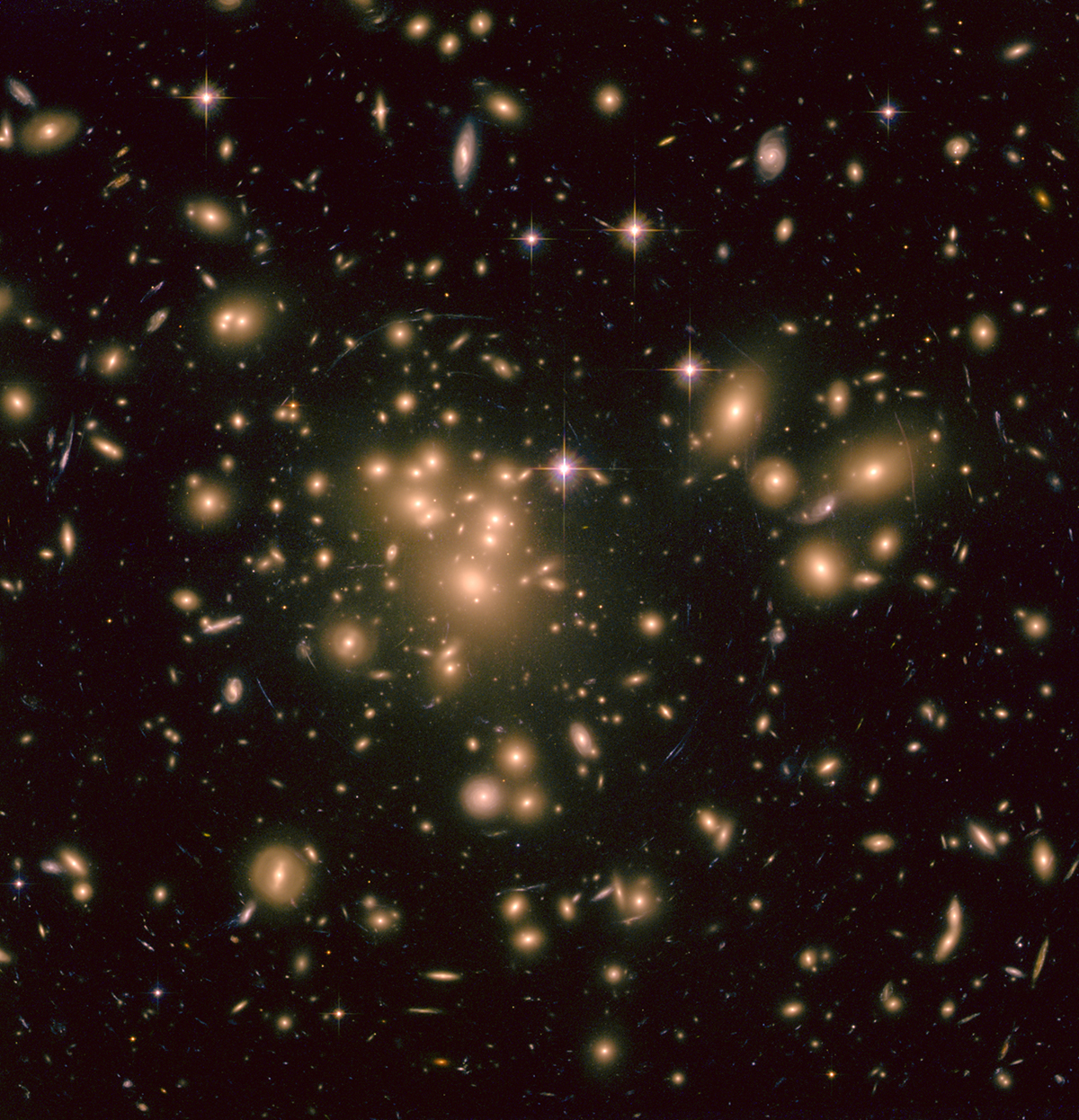
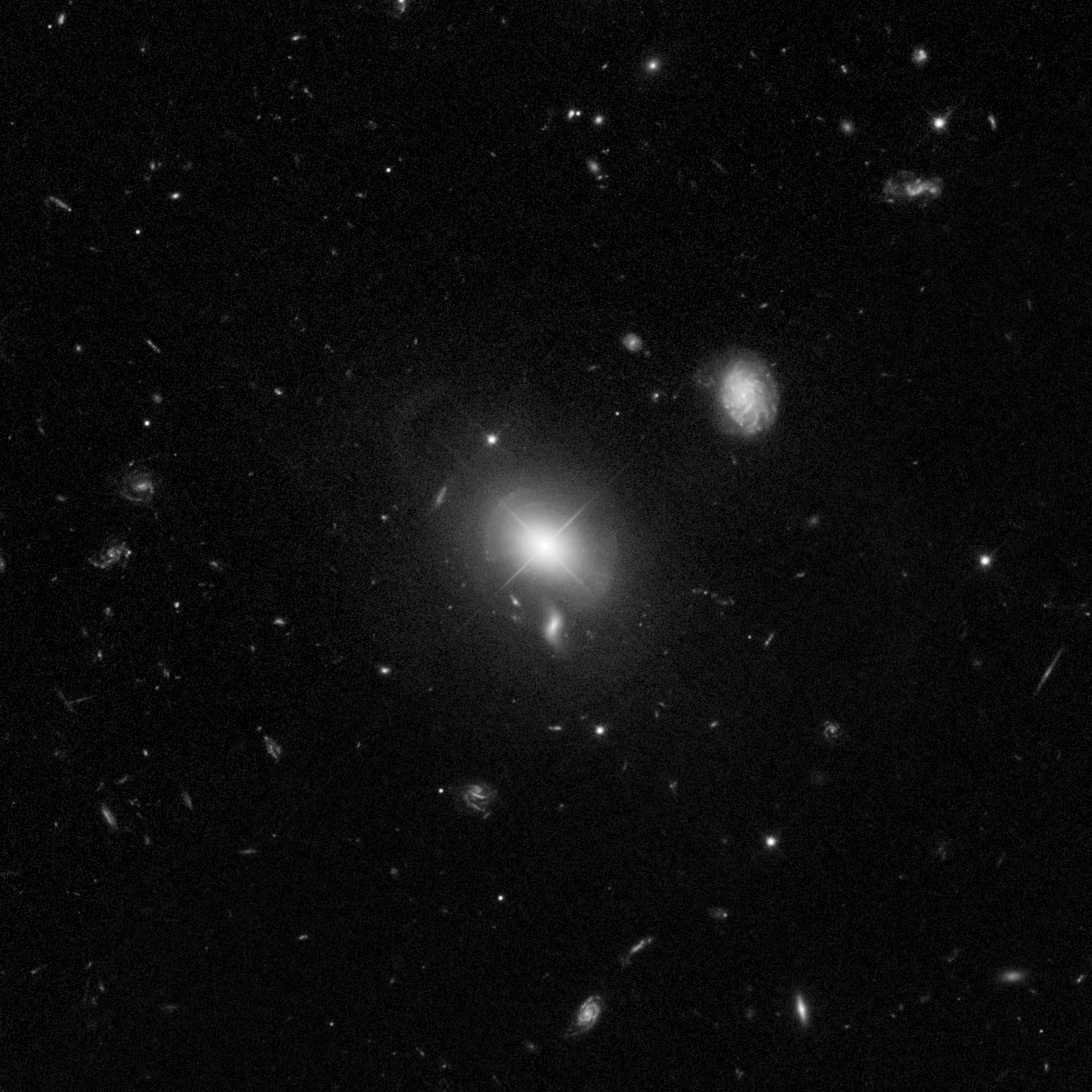
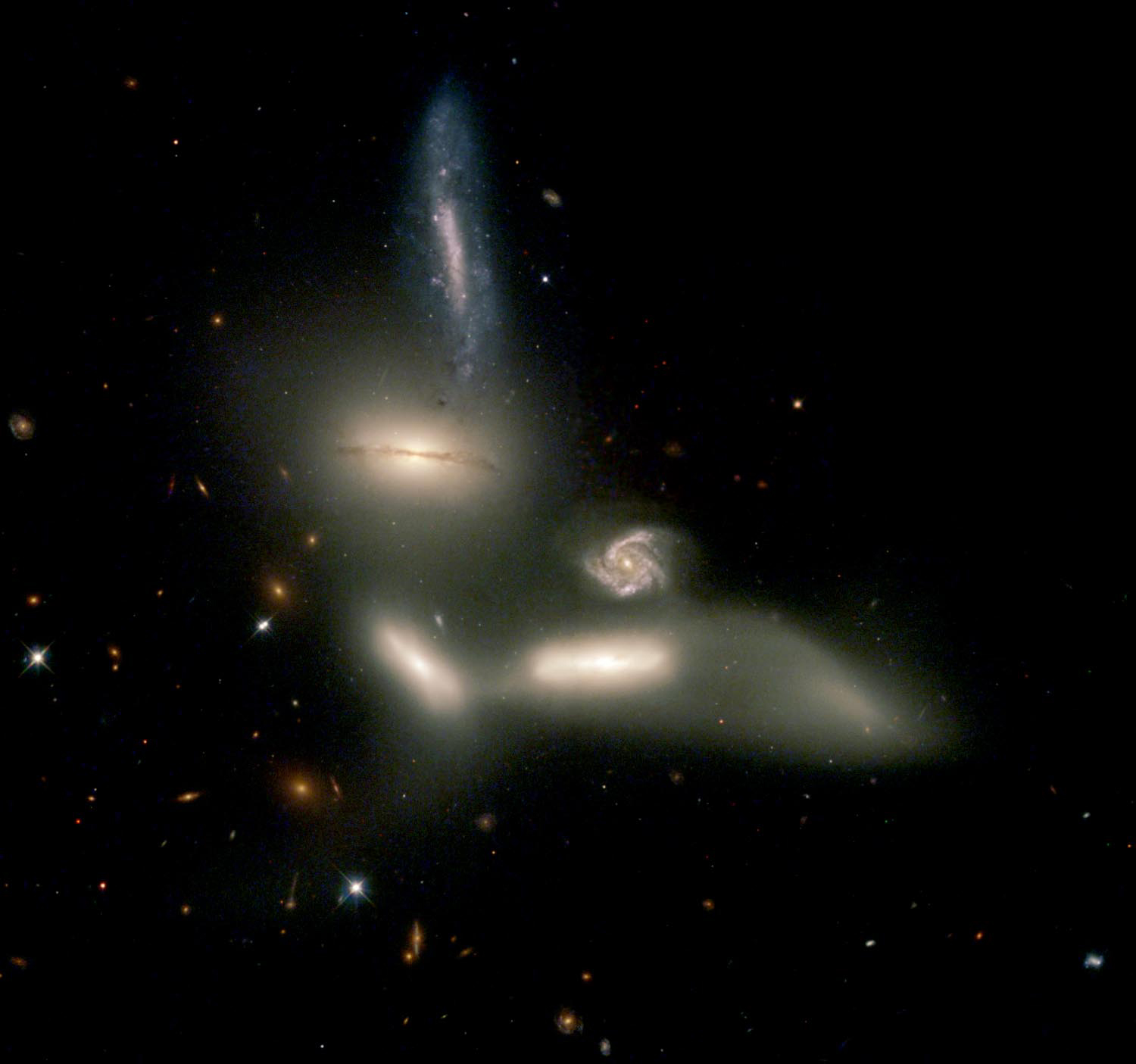
Seyfert's Sextet presents one of the most intriguing optical illusions in the extragalactic sky. At first glance, this appears to be a group of six galaxies crammed into an impossibly small region of space, making it one of the densest galaxy concentrations visible from Earth. However, closer examination reveals that the grouping is not entirely what it seems. Only four of the six objects are actually galaxies at the same distance, approximately 190 million light-years away in the constellation Serpens. The small face-on spiral galaxy with prominent blue arms lies far in the background, and a diffuse plume of stars to the lower right is not a separate galaxy at all but rather a tidal tail of material ripped from one of the interacting members. The four true members are locked in a complex gravitational dance that will ultimately result in their merging into a single large elliptical galaxy.
Scientific Significance
Seyfert's Sextet is among the most compact galaxy groups in the nearby universe and serves as a premier laboratory for studying the physics of galaxy interactions in extremely confined environments. The four member galaxies are separated by distances comparable to the size of the individual galaxies themselves, resulting in intense and continuous gravitational interactions that are visibly stripping stars and gas from the member galaxies. The prominent tidal debris features reveal the ongoing redistribution of material within the group. Compact groups like this are thought to represent a critical transitional stage in the hierarchical assembly of galaxies — their members will merge over the next few hundred million years to form a single, massive elliptical galaxy surrounded by a diffuse halo of tidally stripped material. Studying these groups helps astronomers understand the timescales and physical mechanisms of galaxy merging, the triggering and quenching of star formation during interactions, and how the intragroup medium is enriched with heavy elements expelled from disrupted galaxies.
Observation Details
Hubble captured this image using the Wide Field and Planetary Camera 2 (WFPC2) in multiple visible-light filters. The high angular resolution was critical for disentangling the overlapping light from galaxies packed so closely together on the sky. The color composite reveals the contrasting stellar populations among the group members — bluer regions indicate younger stars and active star formation, while redder areas correspond to older stellar populations. The observations clearly resolved the tidal tails and bridges of material connecting the interacting galaxies, features that would appear blurred and ambiguous in ground-based images. Complementary spectroscopic data confirmed the redshifts of each component, establishing which objects are true group members and which are foreground or background interlopers.
Location in the Universe
Constellation
Serpens
Distance from Earth
190 million light-years
Fun Facts
- 1
Despite its name suggesting six galaxies, Seyfert's Sextet actually contains only four galaxies at the same distance — the small spiral is a much more distant background galaxy, and the diffuse patch is a tidal debris plume torn from one of the group members.
- 2
The four true members of the group are separated by only about 100,000 light-years — roughly the diameter of our own Milky Way — making this one of the most compact galaxy groups known and ensuring that they will eventually merge.
- 3
Seyfert's Sextet was first cataloged by astronomer Carl Seyfert in 1951, the same scientist famous for identifying Seyfert galaxies, a class of active galaxies with unusually bright nuclei powered by supermassive black holes.
Image credit: NASA, ESA, Hubble Space Telescope