About This Image
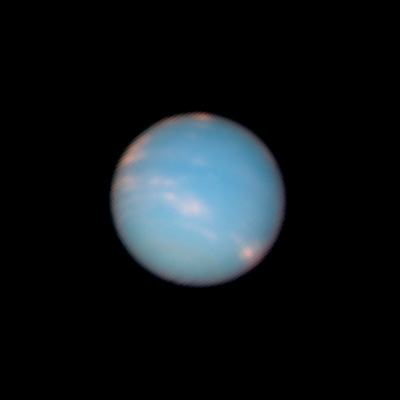
This vivid portrait of Neptune, the most distant major planet in our solar system, reveals striking atmospheric features driven by the planet's extreme and dynamic weather. Located approximately 2.7 billion miles from the Sun, Neptune appears as a brilliant blue sphere, its color produced by methane in the upper atmosphere absorbing red wavelengths of sunlight and reflecting blue light back to the observer. High-altitude clouds composed of methane ice crystals are visible as bright white streaks and patches in both the northern and southern hemispheres, rising above the main cloud deck. Neptune harbors the fastest winds measured on any planet in the solar system, with jet streams reaching speeds of approximately 1,200 miles per hour. Despite receiving only a fraction of the sunlight that reaches Earth, Neptune generates more than twice the energy it absorbs, powered by an internal heat source that drives its remarkably violent atmospheric dynamics.
Scientific Significance
Hubble's ongoing monitoring of Neptune has been essential for understanding atmospheric dynamics on ice giant planets, a class of world that may be among the most common planet types in our galaxy. Since Voyager 2's brief flyby in 1989 provided the only close-up views, Hubble has served as the primary instrument for tracking long-term changes in Neptune's atmosphere over decades. These observations have revealed that Neptune's weather patterns are surprisingly variable — enormous storm systems comparable in size to Earth appear, intensify, and dissipate over timescales of years. The bright methane ice clouds captured in this image trace high-altitude convective features analogous to thunderstorms on Earth but operating on a vastly larger and more energetic scale. Hubble's observations have shown that Neptune's atmospheric activity follows seasonal patterns driven by its 164-year orbit, despite the extremely weak solar forcing at its distance. Understanding Neptune's atmospheric processes provides critical context for interpreting observations of exoplanetary atmospheres around other stars.
Observation Details
This image was captured using Hubble's Wide Field Camera 3 (WFC3) in visible-light filters optimized for detecting atmospheric features on giant planets. The observations employed multiple narrowband and broadband filters to isolate light reflected from different altitude levels in Neptune's atmosphere, with methane absorption bands revealing cloud structures at various depths. Hubble's angular resolution can distinguish features as small as a few hundred miles across on Neptune's disk. The observations were part of the Outer Planet Atmospheres Legacy (OPAL) program, a long-term Hubble initiative dedicated to annual monitoring of the giant planets to track weather patterns, storm evolution, and seasonal atmospheric changes over time.
Location in the Universe
Distance from Earth
2.7 billion miles
Fun Facts
- 1
Neptune's winds are the fastest in the solar system, reaching speeds of approximately 1,200 miles per hour — nearly five times faster than the strongest tornadoes ever recorded on Earth.
- 2
Neptune's blue color comes from methane gas in its atmosphere, which absorbs red light from the Sun and reflects the blue wavelengths back into space, giving the planet its distinctive vivid azure appearance.
- 3
Despite being the farthest major planet from the Sun and receiving 900 times less sunlight than Earth, Neptune radiates more than twice as much energy as it receives, indicating a powerful internal heat source whose exact mechanism remains a subject of scientific investigation.
Image credit: NASA, ESA, Hubble Space Telescope