About This Image
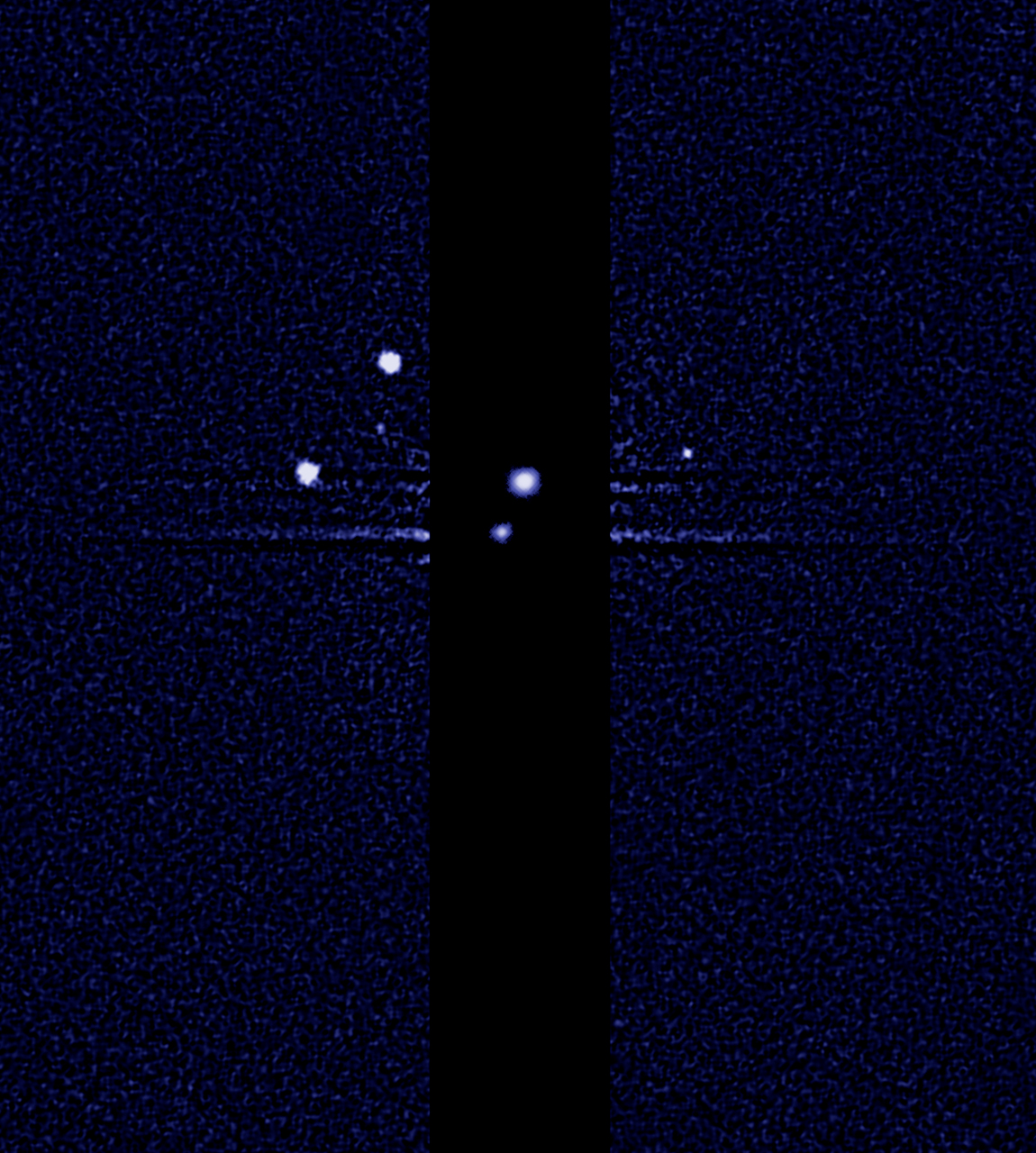
This image captures the dwarf planet Pluto and its remarkable system of five known moons, representing the most complete portrait of this distant world obtainable from the inner solar system. Pluto appears as the bright central object, with its largest moon Charon visible as a distinct companion nearby. The four smaller moons — Nix, Hydra, Kerberos, and Styx — appear as faint points of light orbiting at greater distances. Located at an average distance of approximately 3.67 billion miles from the Sun, the Pluto system is so remote and its smaller moons so faint that only Hubble possessed the sensitivity and resolution to detect them prior to the New Horizons flyby. The discovery of this unexpectedly complex satellite system around a dwarf planet transformed our understanding of the outer solar system and provided critical navigation data for the New Horizons spacecraft's historic 2015 encounter.
Scientific Significance
Hubble's systematic observations of the Pluto system were transformative for both planetary science and mission planning. The discovery of Nix and Hydra in 2005, followed by Kerberos in 2011 and Styx in 2012, revealed that Pluto possesses a complex satellite system far richer than expected for a small, distant body. This discovery supported the giant impact hypothesis for the system's origin, in which an early collision between Pluto and another Kuiper Belt object created Charon and ejected debris that coalesced into the smaller moons. The orbital dynamics of this five-body system provided a natural laboratory for testing models of satellite formation and gravitational interaction. Critically, Hubble's discovery of the additional moons raised concerns about potential debris hazards for the New Horizons mission, prompting detailed dynamical analyses to ensure a safe flyby trajectory. The Hubble observations also established baseline measurements of the moons' brightnesses and orbits that were later refined by New Horizons' close encounter, enabling direct comparisons between remote and in-situ observations of an outer solar system body.
Observation Details
Hubble observed the Pluto system using the Wide Field Camera 3 (WFC3) in visible-light filters, employing long exposure times to detect the extremely faint small moons against the scattered light from the much brighter Pluto and Charon. Special image processing techniques were applied to subtract the glare from Pluto and Charon, which would otherwise overwhelm the tiny signals from the smaller satellites. Multiple observations at different orbital phases allowed astronomers to confirm the moons' orbital paths and distinguish them from background stars. The observations required precise pointing and tracking of Pluto's motion across the sky at its slow apparent rate among the background stars.
Location in the Universe
Distance from Earth
3.67 billion miles
Fun Facts
- 1
Pluto's four smallest moons — Nix, Hydra, Kerberos, and Styx — were all discovered using Hubble between 2005 and 2012, demonstrating that even a world known since 1930 still held major surprises awaiting the right telescope.
- 2
The entire Pluto-Charon system is thought to have formed from a giant impact early in solar system history, similar to the collision that created Earth's Moon, with the four small moons coalescing from the debris of this ancient cataclysm.
- 3
Pluto's small moons tumble chaotically rather than rotating smoothly because the combined gravitational influence of Pluto and Charon creates a constantly shifting gravitational environment that prevents the tiny moons from settling into stable rotation states.
Image credit: NASA, ESA, Hubble Space Telescope