About This Image
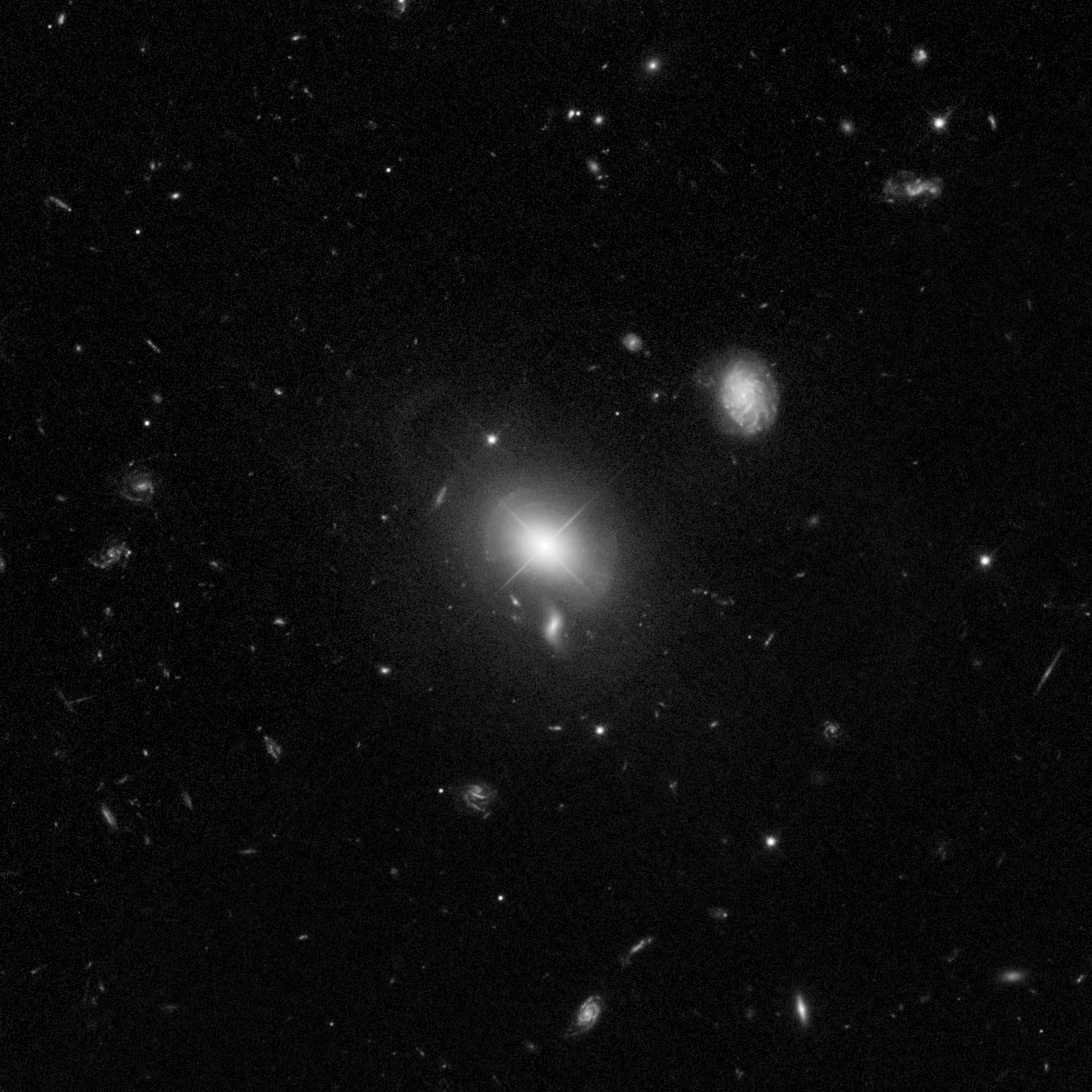
This remarkable image reveals concentric shells of stars surrounding the quasar MC2 1635+119, located approximately 2 billion light-years from Earth. Quasars are among the most luminous objects in the universe, powered by supermassive black holes actively consuming gas and dust at the centers of galaxies. The delicate stellar shells visible in this image are telltale signatures of a past galaxy merger — when two galaxies collide, their stars can be flung into nested, arc-like structures that persist for hundreds of millions of years before gradually dispersing. The presence of these shells around MC2 1635+119 provides compelling evidence that the quasar activity was triggered by a galactic collision, which funneled fresh gas toward the central black hole and ignited its brilliant emission. This connection between galaxy mergers and quasar ignition is a key prediction of theoretical models of active galactic nucleus evolution.
Scientific Significance
MC2 1635+119 is an important piece of evidence in establishing the causal relationship between galaxy mergers and the activation of supermassive black holes as quasars. Theoretical models have long predicted that galaxy collisions channel gas toward galactic centers, providing the fuel needed to power quasar-level luminosities. However, directly observing the merger signatures around active quasars is exceptionally challenging because the quasar's blinding glare overwhelms the faint stellar features of its host galaxy. Hubble's sharp resolution and careful image processing techniques allowed astronomers to subtract the quasar's point-like emission and reveal the underlying shell structure of the host galaxy. MC2 1635+119 was included in a systematic Hubble survey of quasar host galaxies that found a strong statistical correlation between quasar activity and merger morphology, particularly shells, tidal tails, and disturbed isophotes. These findings have profoundly influenced our understanding of the co-evolution of galaxies and their central black holes across cosmic history.
Observation Details
Hubble observed MC2 1635+119 using the Advanced Camera for Surveys (ACS) in broad visible-light filters. Detecting the faint stellar shells required careful subtraction of the quasar's intense point-source emission using a model of the telescope's point spread function (PSF). This technique, known as PSF subtraction, removes the glare of the central source to expose the underlying host galaxy structure. The resulting images revealed multiple concentric shell features consistent with the remnants of a major galaxy merger. The observations were part of a larger program studying the morphologies of quasar host galaxies at intermediate redshifts to quantify the connection between nuclear activity and galaxy interactions.
Location in the Universe
Distance from Earth
2 billion light-years
Fun Facts
- 1
The stellar shells around MC2 1635+119 are fossil evidence of an ancient galactic collision — when galaxies merge, stars are ejected into graceful arc-like patterns that can persist for hundreds of millions of years.
- 2
Quasars like MC2 1635+119 can outshine their entire host galaxy by a factor of 100 or more, all from a region no larger than our solar system at the galaxy's center where a supermassive black hole is devouring surrounding matter.
- 3
The discovery of merger shells around this quasar was part of a broader Hubble survey that found most luminous quasars reside in galaxies showing signs of recent collisions, strongly supporting the theory that galaxy mergers are a primary trigger for quasar activity.
Image credit: NASA, ESA, Hubble Space Telescope