About This Image
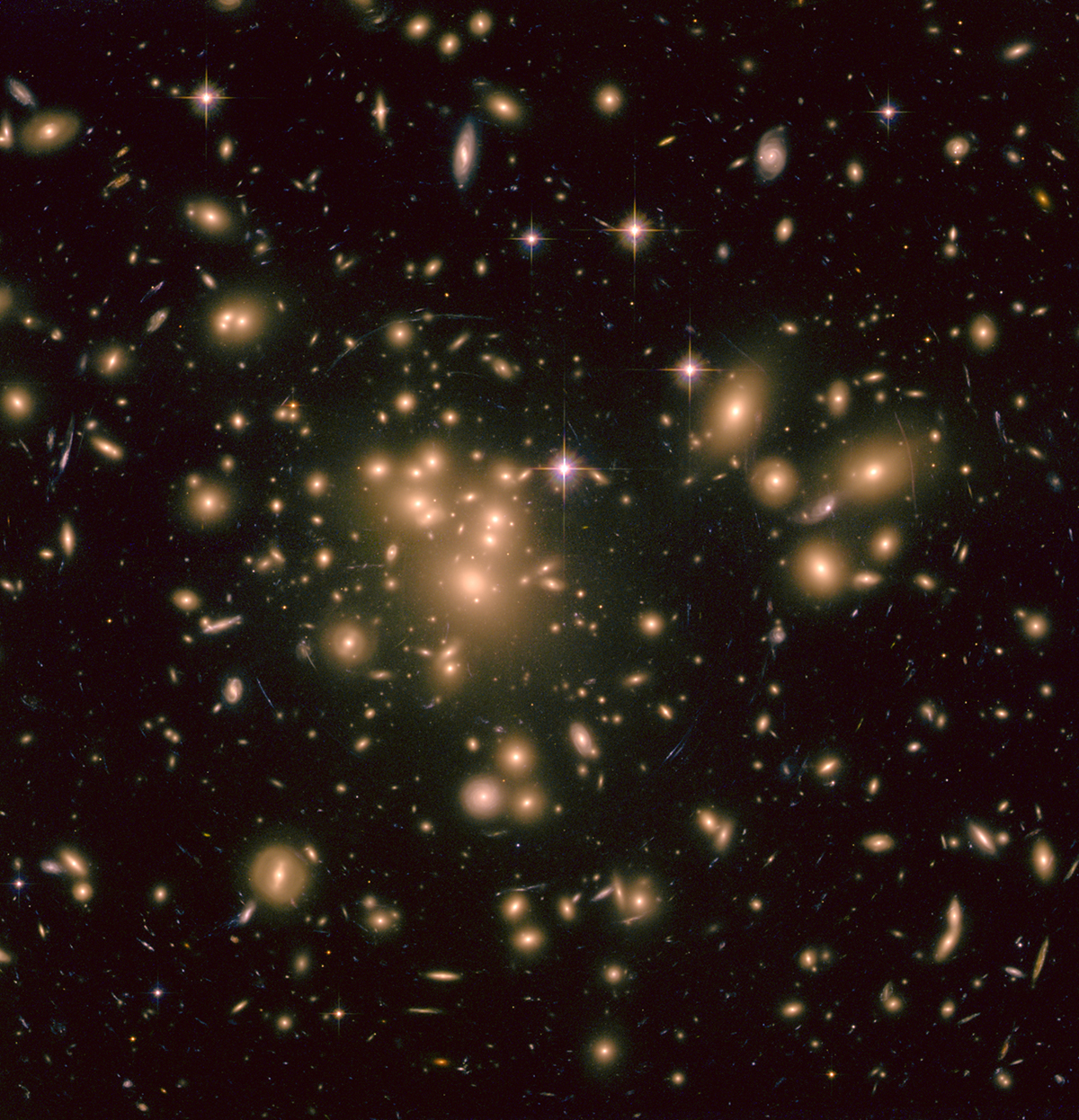
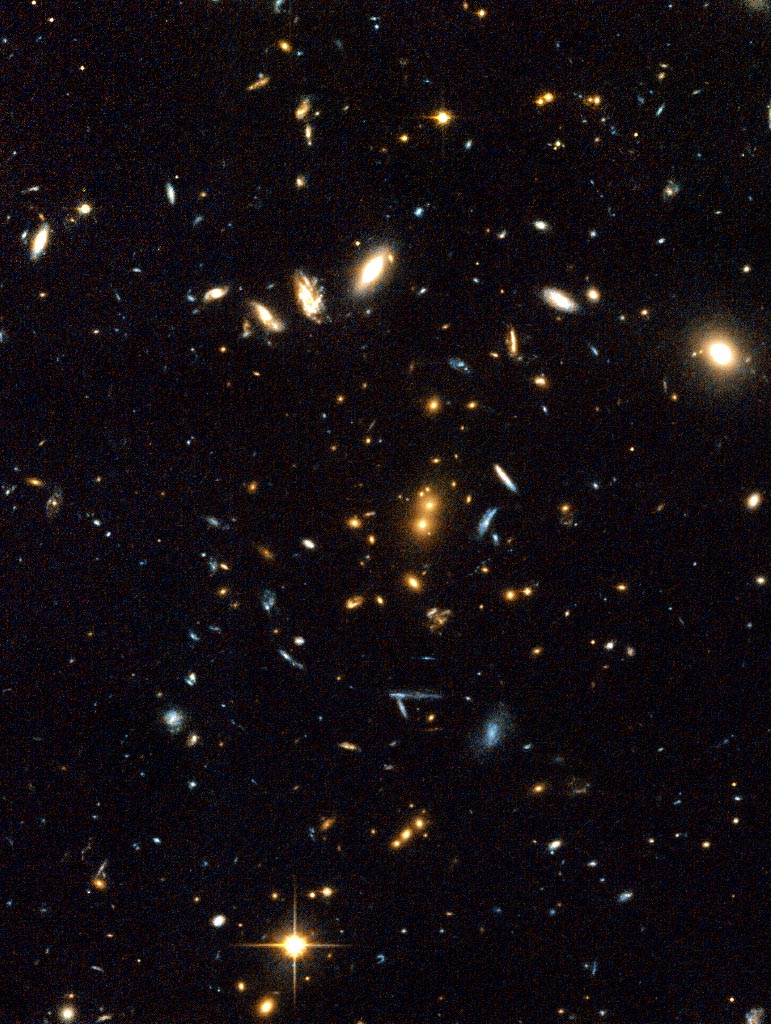
This image reveals the massive galaxy cluster RDCS 1252.9-2927, one of the most distant and most massive galaxy clusters known at the time of its observation. Located approximately 8.5 billion light-years away in the constellation Centaurus, the cluster's light has traveled for more than 60 percent of the age of the universe to reach us. The galaxies visible in this image already existed when the universe was only about 5 billion years old, or roughly 35 percent of its current age. Remarkably, despite the cluster's extreme youth in cosmic terms, its member galaxies are predominantly red ellipticals with old stellar populations, suggesting that massive galaxies in dense environments formed the bulk of their stars very early in cosmic history. This challenges simple models of galaxy formation that predicted a more gradual buildup of stellar mass in the early universe.
Scientific Significance
RDCS 1252.9-2927 has been fundamentally important for understanding how the most massive cosmic structures formed and evolved in the early universe. The existence of such a massive, virialized cluster at a lookback time of 8.5 billion years places stringent constraints on cosmological models, because the formation of galaxy clusters through gravitational collapse is a slow process that depends sensitively on the density and composition of the universe. Finding massive clusters at high redshift requires that structure formation began early and proceeded efficiently, which in turn constrains the amount of dark matter and dark energy. The predominantly red colors of the cluster's member galaxies were surprising, indicating that massive elliptical galaxies in dense environments had already completed the majority of their star formation by this epoch. This 'downsizing' phenomenon — where the most massive galaxies form their stars earliest and fastest — contradicts the simplest hierarchical models and has driven significant revisions to theories of galaxy formation, particularly regarding the role of feedback from supermassive black holes in shutting down star formation.
Observation Details
Hubble observed RDCS 1252.9-2927 using the Advanced Camera for Surveys (ACS) in visible and near-infrared filters. The near-infrared observations were particularly important because at the cluster's redshift, the light emitted by old stellar populations in the optical rest frame is shifted into the infrared as observed from Earth. Deep multi-band photometry enabled measurement of photometric redshifts and stellar population ages for individual cluster members. The observations were combined with X-ray data from Chandra, which detected the hot intracluster medium and confirmed the cluster's large gravitational mass. Ground-based spectroscopy from the Very Large Telescope provided precise redshifts for the brightest cluster galaxies.
Location in the Universe
Constellation
Centaurus
Distance from Earth
8.5 billion light-years
Fun Facts
- 1
RDCS 1252.9-2927 was one of the most distant massive galaxy clusters ever confirmed at the time of its discovery, existing when the universe was barely one-third of its present age.
- 2
Despite its extreme distance and youth, the cluster's galaxies are already predominantly old and red, meaning their stars formed even earlier — within the first 2 to 3 billion years after the Big Bang.
- 3
The cluster was originally detected as a faint X-ray source by the ROSAT satellite, and only Hubble could resolve the individual member galaxies to confirm its nature and study their properties.
Image credit: NASA, ESA, Hubble Space Telescope