About This Image
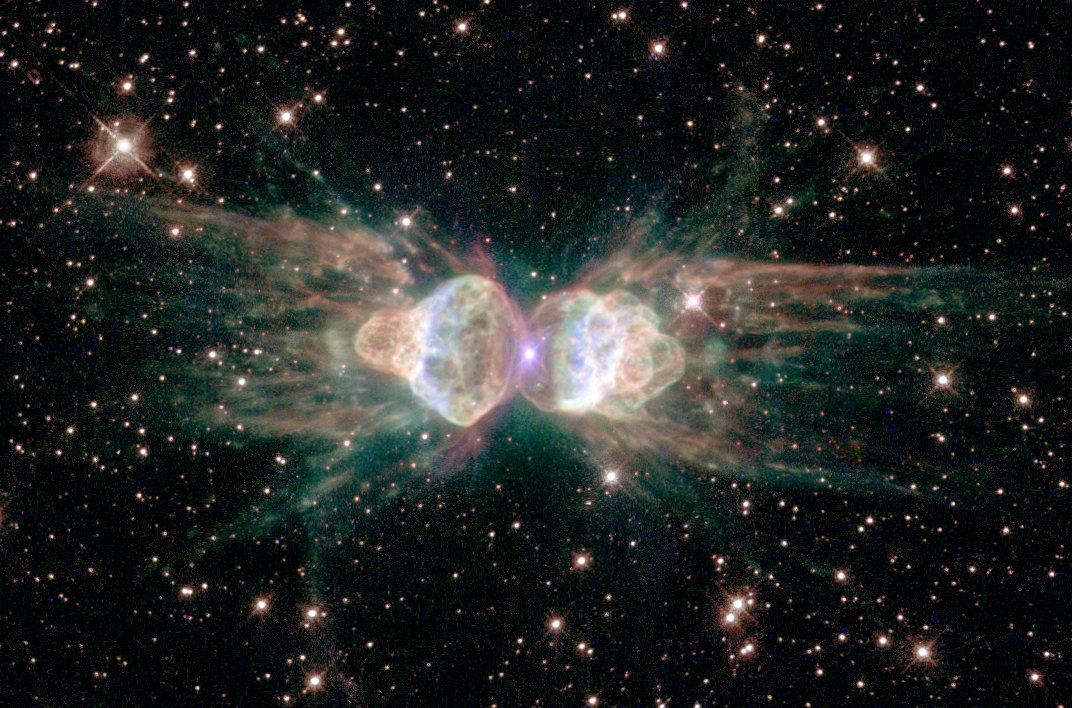
The Ant Nebula, formally designated Menzel 3 (Mz 3), displays one of the most striking and puzzling symmetrical structures found among planetary nebulae. Located approximately 8,000 light-years away in the constellation Norma, this dying Sun-like star has ejected its outer layers into space in a pattern that bears a remarkable resemblance to the head and thorax of an ant. The twin lobes of glowing gas extend in opposite directions from the central star, each lobe exhibiting intricate internal structure including nested shells, filaments, and shock-heated regions. The extraordinary symmetry of the ejection is difficult to explain with standard models of stellar death for single stars, leading astronomers to hypothesize that the central star may have a close binary companion whose gravitational influence shapes the outflows, or that powerful magnetic fields channel the gas into these highly collimated bipolar jets.
Scientific Significance
The Ant Nebula is one of the most important objects for understanding the poorly explained shaping mechanisms of bipolar planetary nebulae. While standard models predict that single asymptotic giant branch stars should eject roughly spherical envelopes, Mz 3's extreme bipolarity demands additional physical processes. Leading hypotheses include the presence of a close binary companion that creates an accretion disk and collimates the outflow into jets, or the operation of strong toroidal magnetic fields generated during the star's final evolutionary stages. Detailed spectroscopic analysis of the nebula has revealed multiple distinct velocity components within the lobes, suggesting that several separate ejection events occurred over time, each producing a nested shell within the bipolar structure. The central star itself is heavily obscured by a dense equatorial torus of dust, consistent with the binary interaction scenario. Mz 3 has become a benchmark object for computational models of magnetohydrodynamic jet launching and collimation, with direct relevance to understanding jet formation in other astrophysical contexts including young stellar objects and active galactic nuclei.
Observation Details
Hubble observed the Ant Nebula using the Space Telescope Imaging Spectrograph (STIS) and the Wide Field and Planetary Camera 2 (WFPC2) in multiple narrowband filters targeting emission lines of ionized nitrogen, hydrogen-alpha, and doubly ionized oxygen. These emission-line filters isolate gas at different temperatures and ionization states, revealing the internal structure and excitation conditions within the nebular lobes. The resulting color composite maps the distribution of different chemical elements and physical conditions across the nebula. Hubble's angular resolution was essential for resolving the fine filamentary structures and nested shells within each lobe that ground-based telescopes could not distinguish.
Location in the Universe
Constellation
Norma
Distance from Earth
8,000 light-years
Fun Facts
- 1
The Ant Nebula's twin lobes display a level of symmetry so precise that astronomers suspect a hidden binary companion star or strong magnetic fields must be sculpting the outflows, as a single dying star alone cannot easily produce such perfectly opposed jets.
- 2
Despite its name, a planetary nebula has nothing to do with planets — the term was coined in the 18th century because these round, glowing shells of gas reminded early telescopic observers of the disks of distant planets.
- 3
The gas in the Ant Nebula's lobes is expanding at speeds exceeding 600 miles per second, and the entire visible structure will disperse into the interstellar medium over the next 10,000 to 20,000 years, enriching surrounding space with elements forged inside the star.
Image credit: NASA, ESA, Hubble Space Telescope