About This Image
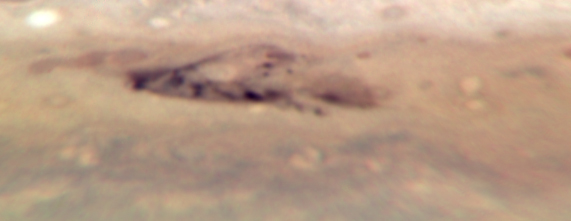
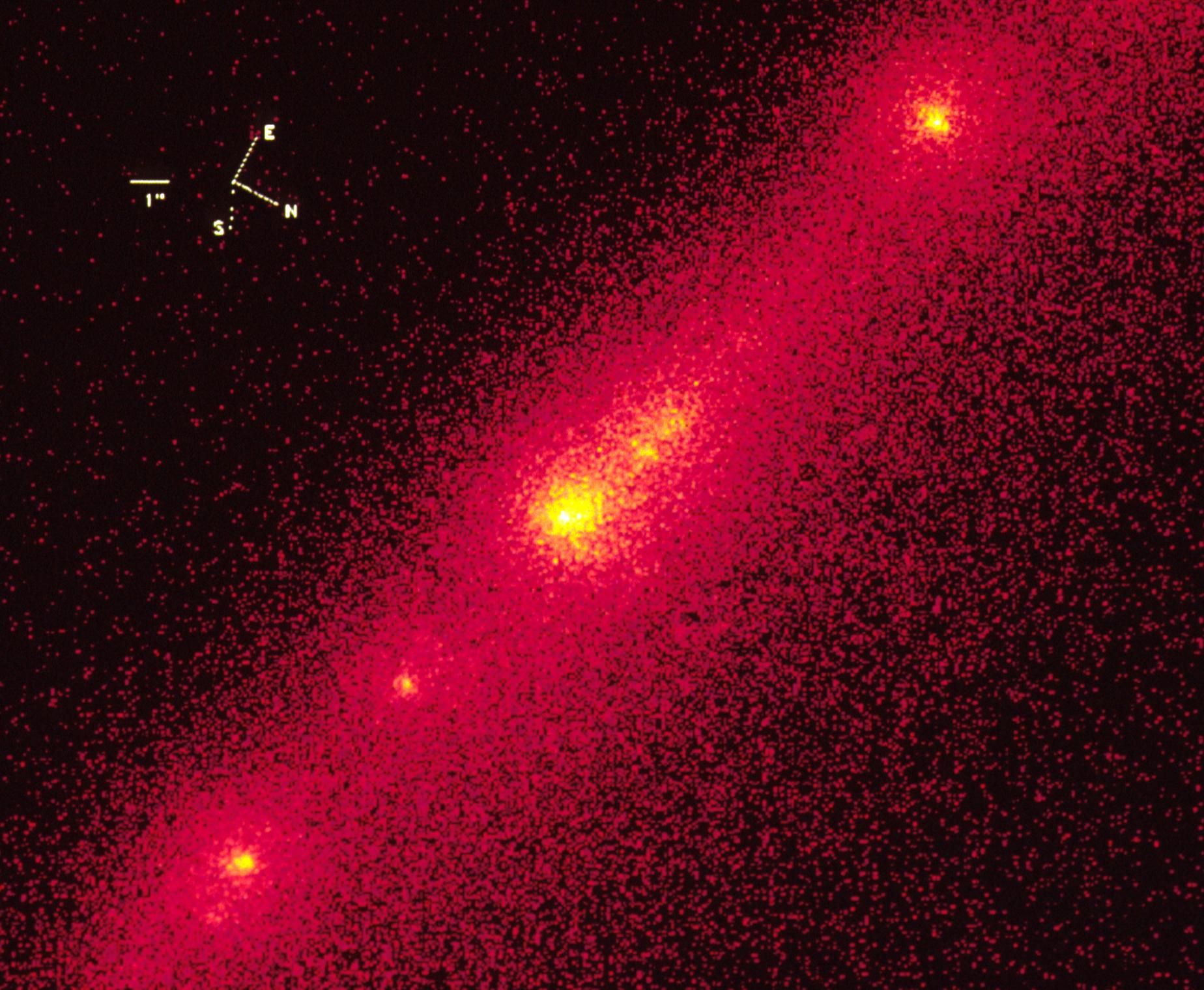
This image captures the brightest "nucleus" in a string of approximately 20 that comprised the broken-up comet Shoemaker-Levy 9. The image reveals that the bright segment is actually a group of at least four separate pieces.
Scientific Significance
Shoemaker-Levy 9 gave astronomers a rare chance to study tidal disruption and planetary impacts in real time. The fragment chain confirmed how a giant planet's gravity can shred weak comets during close passes. Follow-up observations of the later impacts helped quantify impact energy, atmospheric response, and impact frequency in the outer solar system, all of which inform modern planetary defense models.
Observation Details
Hubble observed the fragment train with high-resolution visible-light imaging before the 1994 impacts. The data resolved multiple nuclei within brighter condensations and measured their spacing and evolution along the comet's orbit. These measurements were combined with ground-based monitoring to predict impact timing and map fragment trajectories.
Location in the Universe
Constellation
N/A (Solar System)
Distance from Earth
Approximately 4.5 AU from Earth (1993)
Fun Facts
- 1
Shoemaker-Levy 9 was torn apart by Jupiter's gravity before impact, creating a chain of fragments often called a cosmic pearl necklace.
- 2
Different fragments struck Jupiter in July 1994 and left dark scars larger than Earth in the planet's cloud tops.
- 3
These observations became one of the most dramatic real-time impact events ever recorded in planetary astronomy.
Image credit: NASA, ESA, Hubble Space Telescope