About This Image
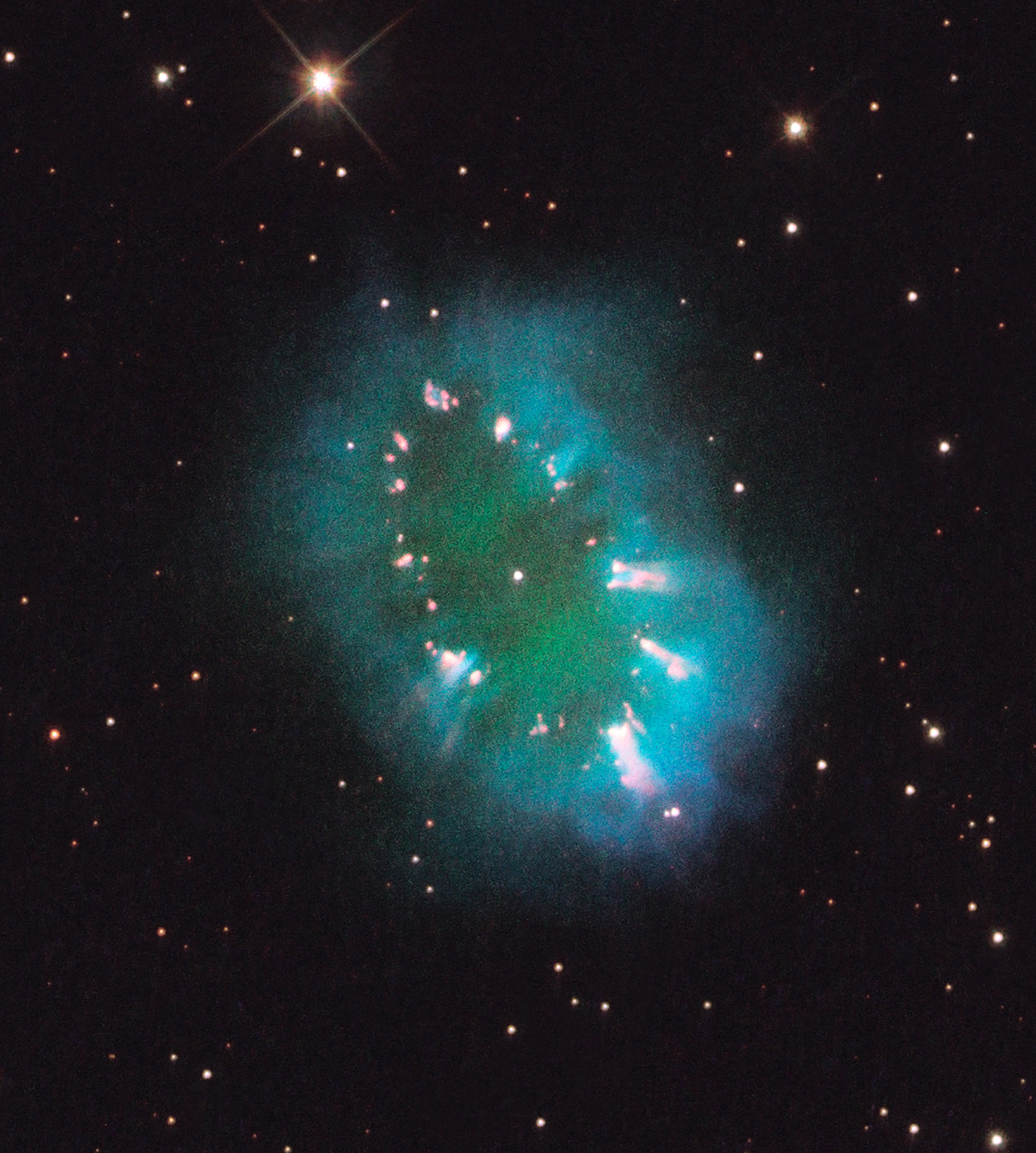
The Necklace Nebula contains the glowing remains of an ordinary, Sun-like star shedding material at the end of its life. The nebula consists of a bright ring, measuring 12 trillion miles across, dotted with dense, bright knots of gas that resemble diamonds in a necklace.
Scientific Significance
The Necklace Nebula is a key target for understanding how binary interactions shape planetary nebulae. Its morphology supports the idea that common-envelope evolution can eject material into rings, jets, and clumps rather than smooth shells. Studying this object helps constrain how Sun-like stars lose mass near the end of their lives and how angular momentum from a companion changes nebular geometry.
Observation Details
Hubble used narrowband filters that isolate emission from ionized hydrogen, oxygen, and nitrogen to map temperature and ionization structure across the ring. The sharp imaging resolves compact knots and faint outflow features that are difficult to detect from the ground. Combining color channels reveals where the gas is densest and where shocks may be active.
Location in the Universe
Constellation
Sagitta
Distance from Earth
Approximately 15,000 light-years
Fun Facts
- 1
The bright knots in the ring are dense clumps of gas ionized by radiation from the central stellar remnant.
- 2
The nebula likely formed through a common-envelope interaction between two stars in a close binary system.
- 3
Its ring-and-knot appearance inspired the nickname Necklace Nebula because it resembles bright gems on a circular chain.
Image credit: NASA, ESA, Hubble Space Telescope