About This Image
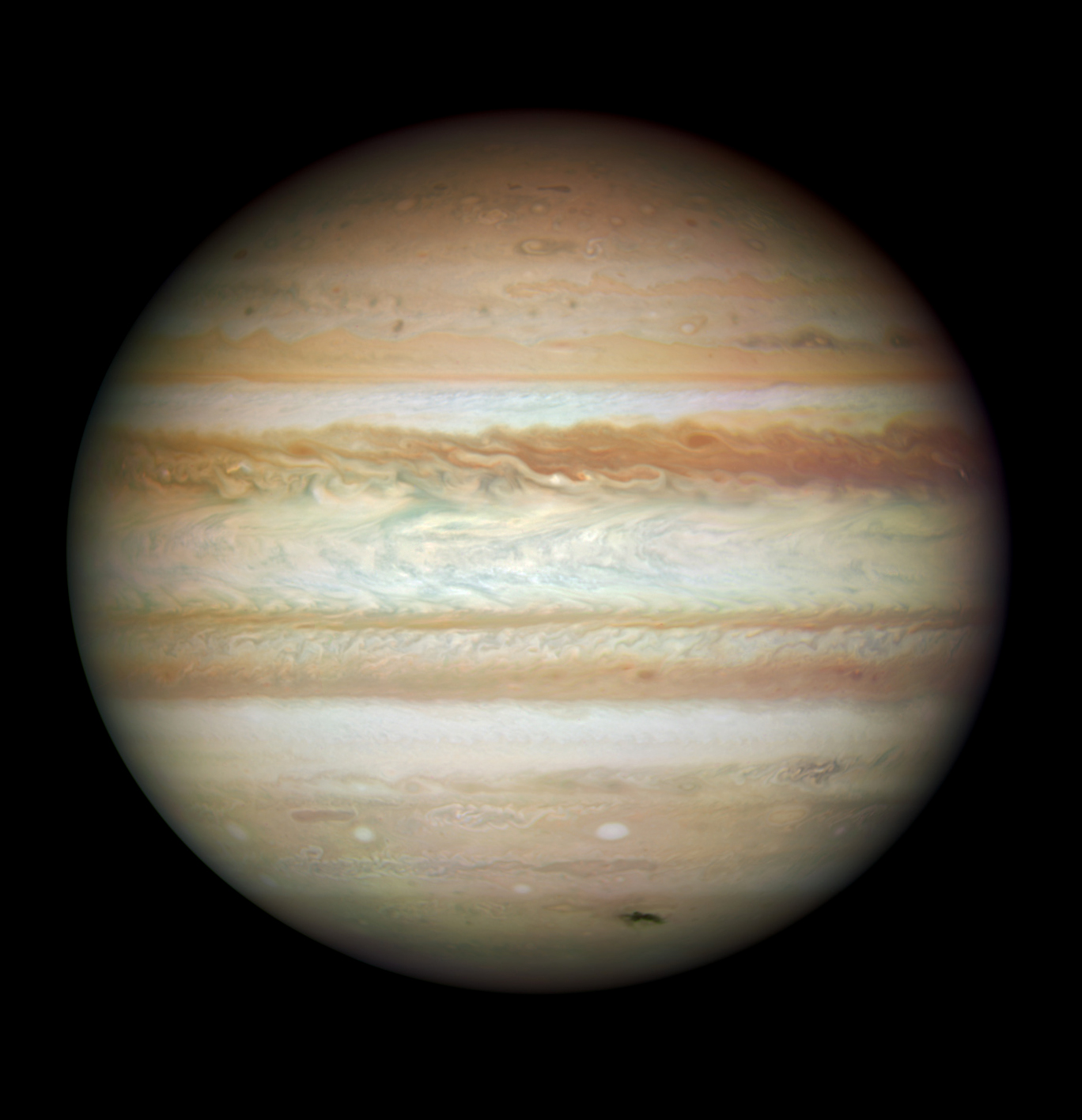
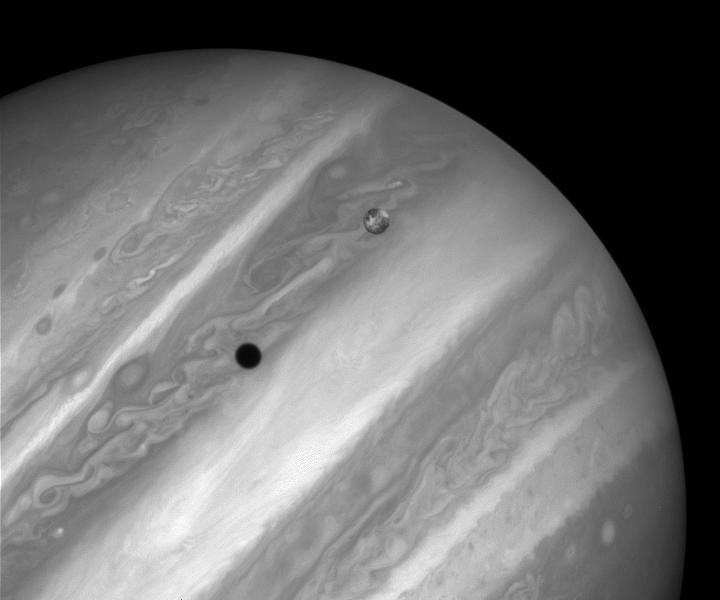
This image shows Jupiter's volcanic moon Io passing above the turbulent clouds of the giant planet. The conspicuous black spot on Jupiter is Io's shadow. The shadow sweeps across the face of Jupiter at 17 kilometers per second.
Scientific Significance
Jupiter-Io transit observations connect atmospheric science and orbital dynamics in one dataset. The moving shadow provides a high-contrast marker for studying Jupiter's cloud motion and rotation, while repeated transit timing refines orbital models of the Galilean moons. These measurements support long-term studies of tidal interactions and interior heating in Io.
Observation Details
Hubble imaged the system during transit with optical filters that capture both Jupiter's cloud texture and Io's silhouette and shadow. Sequential frames track the shadow path and local atmospheric features it crosses. The data are useful for comparing zonal wind behavior across latitudes.
Location in the Universe
Constellation
N/A (Solar System)
Distance from Earth
365 to 600 million miles (varies)
Fun Facts
- 1
Io is the most volcanically active moon in the solar system.
- 2
Its shadow can be seen crossing Jupiter's cloud tops at high apparent speed.
- 3
Transit geometry provides precise timing constraints for orbital mechanics.
Image credit: NASA, ESA, Hubble Space Telescope