About This Image
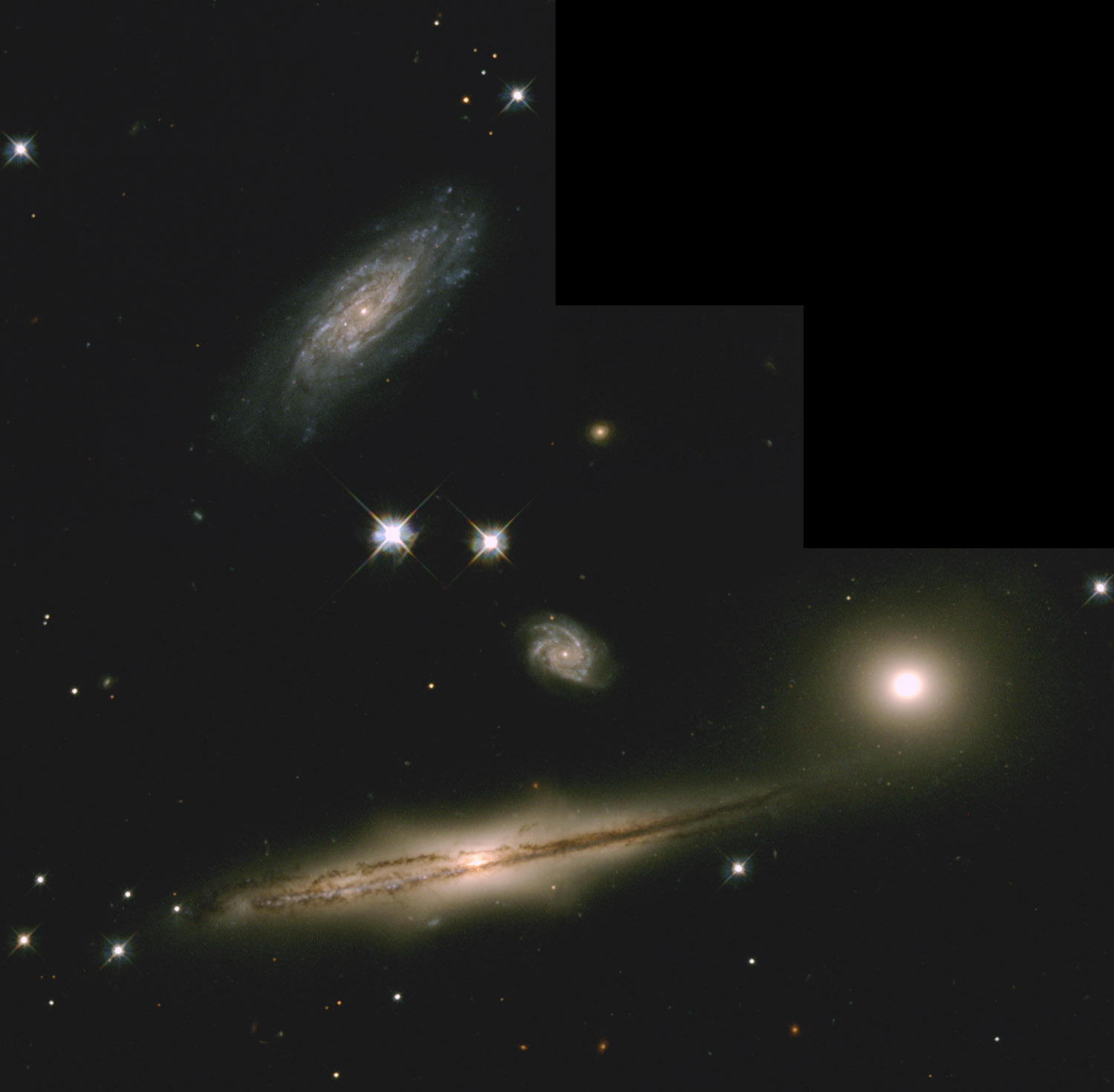
This troupe of galaxies, known as Hickson Compact Group 87, is performing an intricate dance orchestrated by the mutual gravitational forces acting between them. The small spiral near the center could either be a member or an unrelated background object.
Scientific Significance
HCG 87 is an important environment for studying how repeated weak interactions alter galaxies over time. In compact groups, close separations accelerate tidal heating, gas redistribution, and morphological change. These systems help bridge isolated mergers and dense cluster processes, clarifying how environment drives galaxy transformation.
Observation Details
Hubble's resolution cleanly separates overlapping galaxy components and reveals subtle tidal structures. Multi-band imaging helps distinguish old stellar envelopes from younger star-forming knots and dust lanes. The morphology can be compared with redshift data to refine membership and interaction history.
Location in the Universe
Constellation
Capricornus
Distance from Earth
Approximately 400 million light-years
Fun Facts
- 1
Hickson Compact Group 87 contains galaxies packed closely enough for strong mutual interactions.
- 2
At least one small spiral near the center may be either a member or a chance background object.
- 3
Compact groups are efficient environments for tidal stripping and eventual merging.
Image credit: NASA, ESA, Hubble Space Telescope