About This Image
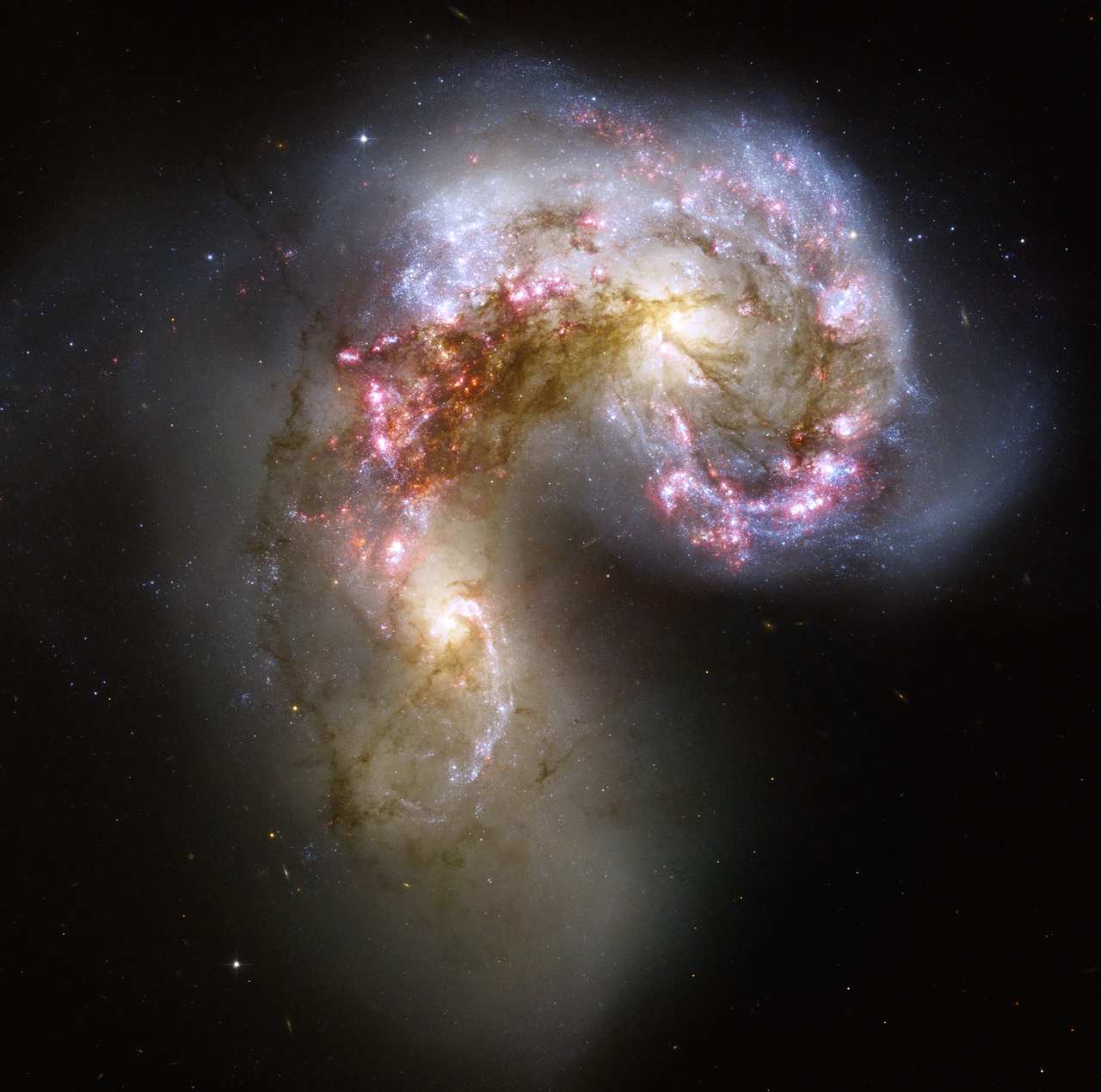
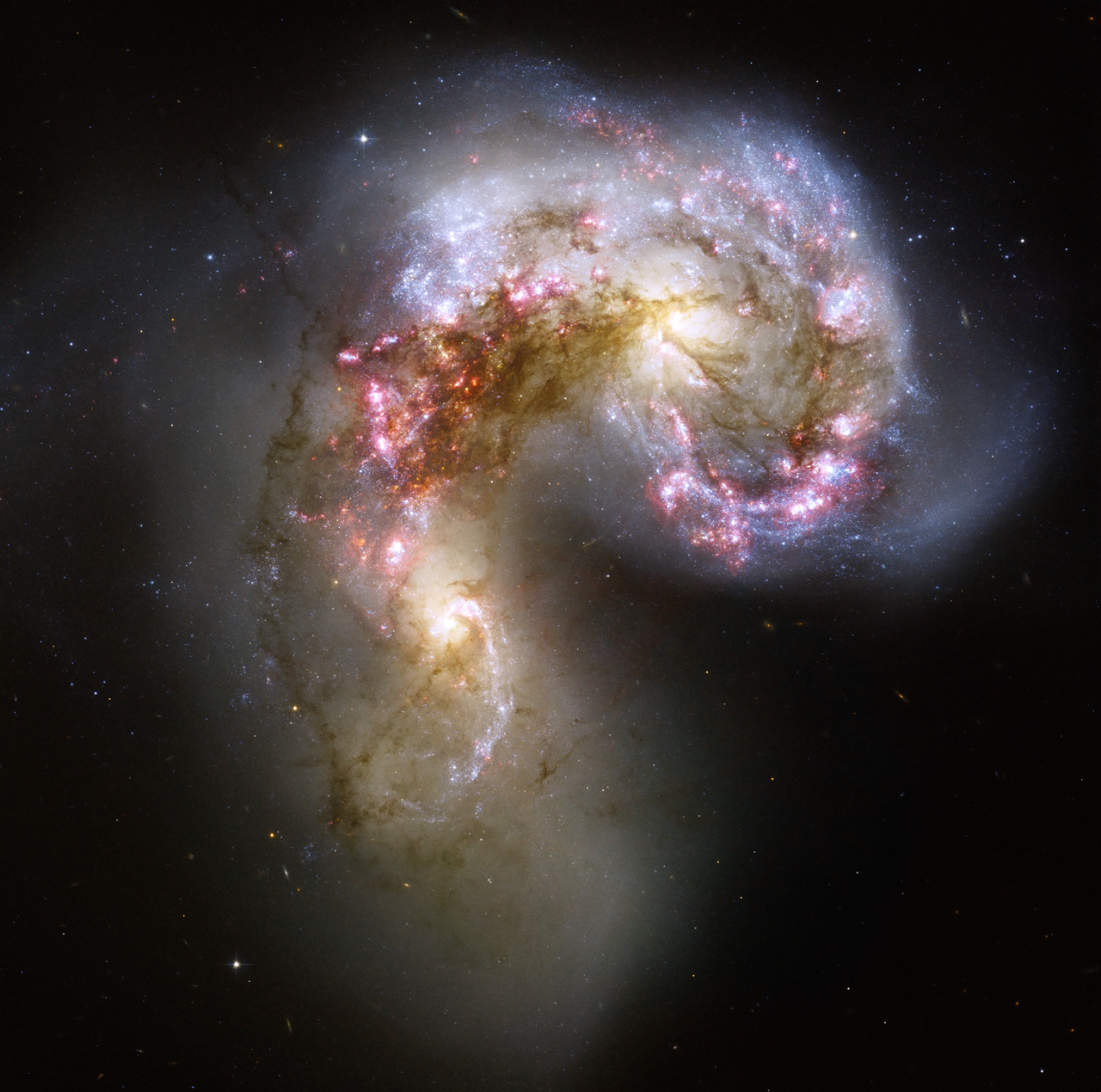
The two merging spiral galaxies that comprise the Antennae galaxies began their interaction only a few hundred million years ago. Over the course of the merger, billions of stars will be formed.
Scientific Significance
The Antennae are one of the closest major merger laboratories for studying merger-driven starbursts and cluster formation. They show how tidal interactions compress gas, trigger intense star formation, and reorganize galaxy structure before final coalescence. Results from this system are widely used to interpret distant merger populations observed at earlier cosmic times.
Observation Details
Hubble multi-band imaging resolves thousands of compact young clusters and complex dust geometry in the overlap region. Color-based age dating of clusters maps where star formation has recently peaked. Morphology and cluster demographics are compared with numerical simulations to constrain merger stage.
Location in the Universe
Constellation
Corvus
Distance from Earth
Approximately 45 million light-years
Fun Facts
- 1
The Antennae Galaxies are named for long tidal tails flung out by the merger.
- 2
The interaction is producing huge numbers of young star clusters.
- 3
This system previews what major spiral-spiral mergers can look like in detail.
Image credit: NASA, ESA, Hubble Space Telescope