About This Image
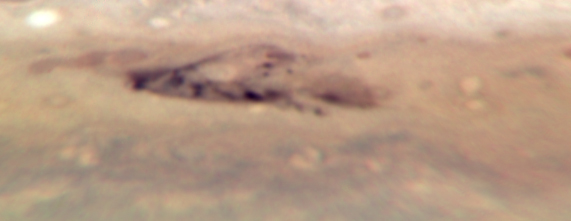
This image shows a dramatic scar on Jupiter's southern hemisphere, created when an unknown object — likely an asteroid several hundred meters across — plunged into the giant planet and exploded with tremendous force. The unexpected blemish was discovered by amateur astronomer Anthony Wesley in July 2009 and immediately became a target of intense professional observation. The dark debris field, scattered across Jupiter's cloud tops, spans an area roughly the size of the Pacific Ocean. This impact event provided astronomers with a rare opportunity to study planetary collisions in real-time, revealing how Jupiter's immense gravity makes it a cosmic vacuum cleaner that protects the inner solar system by sweeping up potentially dangerous space debris.
Scientific Significance
The 2009 Jupiter impact provided a natural experiment for studying the physics of hypervelocity impacts on gas giant planets. Unlike the Shoemaker-Levy 9 impacts, which were predicted months in advance, this event was discovered after the fact, demonstrating that Jupiter experiences significant impacts more frequently than previously thought. Hubble's observations tracked the evolution of the debris field over several weeks, revealing how Jupiter's powerful winds sheared and dispersed the impact material across latitude bands. Spectroscopic analysis detected the chemical signatures of the impacting body mixed with Jupiter's atmosphere, providing clues about its composition. The event sparked renewed interest in monitoring Jupiter for impacts and led to improved amateur-professional collaboration networks for tracking transient planetary phenomena.
Observation Details
Hubble observed the impact scar using the newly installed Wide Field Camera 3 (WFC3), just months after its installation during Servicing Mission 4. The observations were conducted in multiple visible and near-infrared filters to characterize the composition and altitude of the impact debris. The dark appearance of the scar results from material dredged up from deeper atmospheric layers and spread across Jupiter's ammonia ice cloud tops. Time-series observations tracked the scar's evolution as Jupiter's zonal winds stretched it into an elongated streak over subsequent weeks. Complementary observations from ground-based infrared telescopes detected excess heat radiation from the impact site.
Location in the Universe
Constellation
N/A (Solar System)
Distance from Earth
390 million to 576 million miles (varies)
Fun Facts
- 1
This was only the second time an impact on Jupiter had been witnessed — the first being the famous Shoemaker-Levy 9 comet impacts in 1994, exactly 15 years earlier to the month.
- 2
The impacting object released energy equivalent to thousands of nuclear weapons, yet Jupiter's massive atmosphere absorbed the explosion with barely a shudder.
- 3
Jupiter's gravity is so strong that it experiences impacts from asteroids and comets roughly 2,000 to 8,000 times more frequently than Earth — acting as a giant shield for the inner solar system.
Image credit: NASA, ESA, Hubble Space Telescope